Server
ECC RAM in Dedicated Servers: Why Memory Integrity Matters in Business Hosting
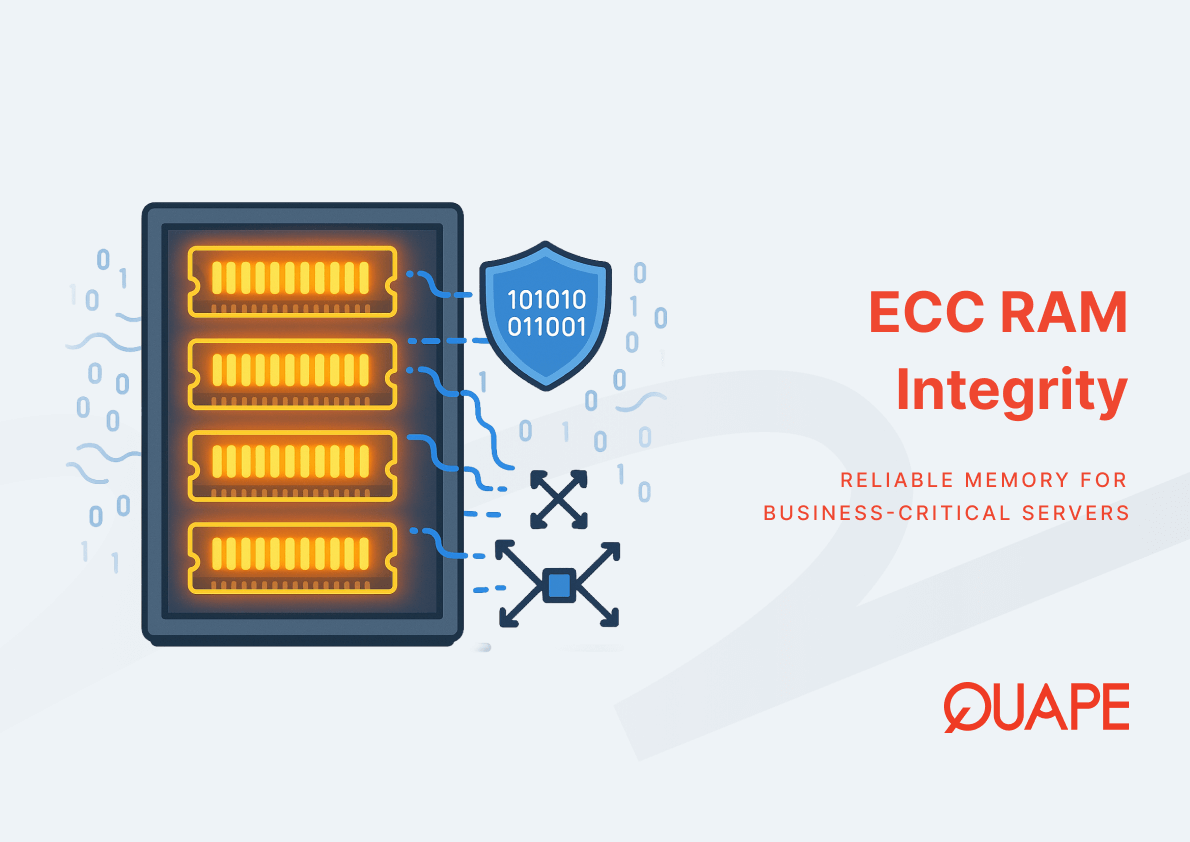
Memory errors in production environments occur far more frequently than most IT teams expect. Field studies analyzing millions of server hours reveal that over 8% of installed memory modules experience at least one detectable error per year, with error rates reaching 25,000 to 70,000 events per billion device-hours per megabit. For businesses running financial applications, databases, or mission-critical workloads on dedicated servers in Singapore, these errors translate directly into data corruption risk, transaction failures, and potential regulatory compliance gaps. ECC (Error-Correcting Code) memory addresses this exposure by detecting and correcting single-bit errors before they corrupt application data, providing a fundamental layer of reliability that non-ECC memory cannot offer.
An ECC dedicated server integrates error-correcting memory modules with server-grade hardware to protect data integrity throughout the memory subsystem. Unlike standard RAM, which stores only data bits, ECC memory adds parity information that enables the memory controller to identify when a bit flips unexpectedly and restore the correct value transparently. This capability matters because memory errors stem from multiple causes: cosmic ray strikes that flip individual bits (soft errors), manufacturing defects that produce persistent failures (hard errors), and voltage fluctuations or temperature variations that destabilize stored charge. Production measurements confirm that these events are not theoretical edge cases but routine occurrences that scale with installed memory capacity.
Key Takeaways
- Field studies show that DRAM error rates in production exceed older laboratory estimates by orders of magnitude, with more than 8% of memory modules affected annually in large server fleets.
- ECC memory implements SECDED (Single Error Correct, Double Error Detect) logic that corrects single-bit errors automatically and detects double-bit errors, preventing silent data corruption that non-ECC memory cannot catch.
- Memory errors exhibit strong spatial locality, clustering in specific modules and addresses, which means failure patterns are not uniformly distributed and require both correction capability and proactive monitoring.
- The business cost of silent memory corruption in financial applications or databases typically far exceeds the modest 10–20% hardware premium and sub-3% performance overhead that ECC introduces.
- Singapore’s Monetary Authority (MAS) Technology Risk Management Guidelines require financial institutions to maintain controls ensuring data integrity and system availability, aligning regulatory expectations with infrastructure choices that reduce corruption risk.
- DDR4 ECC remains widely deployed in enterprise servers, while emerging DDR5 introduces on-die ECC that shifts error correction responsibilities and requires architects to evaluate multi-layer integrity strategies.
- Database hosting and virtualization workloads present elevated memory corruption exposure due to large memory footprints and long-running processes, making ECC a critical component of uptime and data accuracy.
Key Components and Concepts of ECC Dedicated Server
How ECC Memory Works: Error Detection and Correction Explained
Error correction in memory relies on redundant information that the memory controller uses to validate and repair stored data. ECC modules include additional memory chips beyond those required for data storage alone; for every 64 data bits, the module adds 8 bits of error-correcting code. The memory controller calculates this ECC value when writing data and recalculates it when reading data back. If the recalculated value does not match the stored ECC, the controller identifies which bit has flipped and inverts it to restore the correct state. This process occurs transparently to the operating system and applications, imposing latency overhead measured in nanoseconds at the controller level.
The most common ECC implementation uses SECDED logic, which corrects any single-bit error within a 64-bit word and detects (but cannot correct) double-bit errors in the same word. Single-bit corrections happen silently and frequently; production systems log thousands of corrected events across large memory pools without user intervention. Double-bit errors trigger an uncorrectable error exception, typically halting the affected process or system to prevent corrupted data from propagating. Field research analyzing millions of corrected and uncorrected errors confirms that most memory failures manifest as hard errors (persistent device failures) rather than transient single-bit flips, which shifts mitigation strategy toward detection, logging, and module replacement in addition to on-the-fly correction.
Parity bits represent the foundation of ECC logic. Each parity bit covers a specific subset of data bits according to a Hamming code or similar algorithm. When an error occurs, the pattern of parity mismatches uniquely identifies the corrupted bit position, enabling correction. This mathematical encoding trades memory capacity (roughly 12.5% overhead for SECDED) and slight latency increases for fault tolerance that prevents silent corruption. Endpoint memory validation through ECC differs fundamentally from software-level checksums; ECC operates at the hardware level in real time, catching errors before they reach the CPU cache or application memory space, while checksums validate data after it has already been loaded and processed.
DDR4 ECC Technology and Its Role in Business Hosting
DDR4 memory standards defined by JEDEC (JESD79-4 family) include specifications for ECC-capable modules in both registered (RDIMM) and unbuffered (UDIMM) form factors. DDR4 ECC modules integrate seamlessly with server platforms that include memory controllers supporting error correction, which encompasses most Intel Xeon and AMD EPYC processors used in enterprise hosting. The transition from DDR3 to DDR4 brought higher data rates, improved power efficiency, and larger module capacities, all of which increase the absolute number of memory cells that could potentially fail and therefore amplify the value of error correction. When comparing Intel vs AMD dedicated server platforms, both architectures support DDR4 ECC, though memory channel counts and maximum capacities vary by processor family.
Enterprise-grade hardware configurations pair DDR4 ECC with additional reliability features: memory scrubbing routines that periodically read and rewrite memory to correct accumulated single-bit errors before they escalate to multi-bit failures, thermal management to reduce temperature-induced instability, and redundant power supplies that minimize voltage transients. These layers interact because ECC corrects bit-level errors while scrubbing prevents error accumulation, and stable power/thermal environments reduce the underlying error rate. Latency impact from ECC remains minimal in practice; measured application-level performance differences typically fall within 2–3% for non-latency-sensitive workloads, a trade that businesses accept when data corruption prevention outweighs microsecond response time variations.
Data corruption prevention through ECC extends beyond individual bit flips to systemic reliability. As server memory capacities scale into hundreds of gigabytes per node (common for database hosting and virtualization), the probability that at least one bit error occurs within the operational window increases proportionally. Soft-error rates measured in production environments range from 200 to 5,000 FIT (failures in time per billion hours) per megabit, which translates to frequent single-bit events across large memory pools. Without ECC, these events produce silent corruption that manifests as incorrect query results, failed transaction validation, or cascading application errors that are difficult to diagnose because the root cause lies in undetected memory faults rather than software bugs.
Memory Parity vs ECC: Which One Protects Data Better?
Memory parity represents an earlier, simpler error detection mechanism that adds a single parity bit per byte (8 data bits). The parity bit is set so that the total number of 1s in the byte, including the parity bit, is always even (or always odd, depending on the parity scheme). When the memory controller reads data, it recalculates the parity and compares it to the stored parity bit. A mismatch indicates an error has occurred, triggering a parity error exception. Parity can detect single-bit errors within a byte, but it cannot correct them, nor can it reliably detect errors affecting multiple bits in the same byte. This limitation makes parity insufficient for modern business hosting where silent corruption is unacceptable and system halts on every detected error disrupt availability.
ECC surpasses parity by providing both detection and correction. Where parity stops at signaling that an error exists, ECC identifies which bit is wrong and restores the correct value, allowing the system to continue operating without interruption or data loss. This difference becomes critical in long-running server workloads; a database server processing transactions over weeks or months will encounter correctable memory errors that ECC handles transparently, while parity-protected or non-ECC systems would either crash (if parity-checked) or silently corrupt data (if unchecked). Server reliability for production environments depends on this correction capability because uptime requirements prohibit frequent reboots or manual interventions triggered by transient errors.
Data integrity in enterprise hosting also involves understanding error frequency. Field studies demonstrate that memory errors are not rare anomalies but routine events whose frequency increases with installed capacity and operational time. A server with 256 GB of DDR4 ECC memory will experience correctable errors at measurable rates; ECC logs these events, enabling proactive monitoring and replacement of modules exhibiting elevated error counts before uncorrectable failures occur. Parity systems lack this visibility and resilience, making them unsuitable for workloads where data accuracy and business continuity are non-negotiable.
Fault Tolerance and Data Corruption Prevention in Enterprise Servers
Fault tolerance in server design encompasses multiple redundancy and error-handling mechanisms that work together to maintain operation despite component failures. ECC memory contributes one layer by correcting memory errors in real time, while other layers address storage failures (RAID configurations, as discussed in RAID dedicated server contexts), network path redundancy, and power supply duplication. These layers interact synergistically; ECC prevents memory corruption from propagating into the file system or database, while RAID prevents disk failures from causing data loss, and together they reduce the probability that any single hardware fault disrupts the application.
Data corruption prevention through ECC matters most for workloads that maintain state over long periods or accumulate data where errors compound over time. Database hosting exemplifies this risk profile: a single corrupted bit in a database index can cause incorrect rows to be returned in queries, leading to inaccurate reports, failed reconciliations, or violated foreign key constraints that cascade into application errors. Financial applications face similar exposure; an uncorrected memory error in a transaction processing buffer can silently alter amounts, account identifiers, or timestamps, producing incorrect ledger entries that violate audit trails and regulatory reporting requirements. Field measurements show that up to 15% of lost compute time in some commodity clusters stems from memory-related node outages, underscoring that memory reliability directly influences operational availability.
Uptime requirements for enterprise servers extend beyond simple availability metrics to encompass data correctness. A server that remains running but processes transactions with corrupted memory delivers worse business outcomes than one that fails cleanly and triggers failover to a healthy node. ECC addresses this by ensuring that correctable errors never reach the application layer and that uncorrectable errors are detected immediately rather than silently corrupting persistent state. This distinction aligns with the principle that controlled failure (detection and graceful shutdown) is preferable to uncontrolled data corruption that persists undetected until business processes uncover discrepancies.
Practical Application for Singapore-Based Business Workloads
ECC in Financial Applications and High-Risk Environments
Financial applications impose strict data integrity requirements because errors in transaction processing, ledger maintenance, or regulatory reporting carry direct compliance and business risk. Singapore’s Monetary Authority (MAS) publishes Technology Risk Management Guidelines that require financial institutions to implement controls ensuring system availability and data integrity. These guidelines do not mandate specific technologies but establish expectations that systems maintain accuracy and detect failures before they impact business operations. ECC memory supports these controls by reducing the probability of silent corruption and providing logged evidence of corrected errors, which contributes to the audit trails and operational monitoring that regulators expect.
Mission-critical workloads in financial services often involve real-time transaction processing, reconciliation engines, and risk calculation systems that operate on large datasets held in memory. A memory error affecting a price feed, position calculation, or settlement instruction can propagate incorrect data to downstream systems, triggering erroneous trades, failed compliance checks, or misreported exposures. ECC mitigates this risk by correcting single-bit errors before they alter application state and by detecting double-bit errors that indicate module failures requiring immediate attention. The business cost of a single undetected memory corruption event, measured in reputational damage, regulatory penalties, or financial loss from incorrect transactions, typically exceeds the incremental cost of ECC-equipped dedicated servers by orders of magnitude.
Compliance frameworks in highly regulated industries align naturally with infrastructure choices that reduce failure modes. When auditors review system architecture, the presence of ECC memory demonstrates a proactive approach to data integrity that complements software-level validation (checksums, cryptographic signatures, database constraints). This defense-in-depth strategy recognizes that hardware failures occur and that relying solely on software controls leaves exposure at the physical layer where cosmic rays, manufacturing defects, and aging components produce bit flips that software cannot prevent. High-risk environments therefore treat ECC as a baseline requirement rather than an optional enhancement.
ECC Servers for Database Hosting and Virtualization Stability
Database hosting presents elevated memory integrity requirements because databases cache indexes, query plans, and frequently accessed data in memory to minimize disk I/O latency. A corrupted bit in a cached database page can produce incorrect query results that propagate to application logic, reporting systems, or replicated databases, creating inconsistencies that are difficult to detect and costly to resolve. Large database footprints amplify this risk; a server running PostgreSQL, MySQL, or Oracle with 512 GB of allocated memory has billions of bits in play, and even low per-bit error rates accumulate into frequent events across the entire memory pool. ECC ensures that single-bit errors are corrected transparently, preventing cache corruption from reaching query results or transaction logs.
High I/O workloads benefit from the interaction between ECC memory and fast storage subsystems. When databases use NVMe vs SSD dedicated server configurations to achieve low-latency data access, the performance advantage of NVMe can be negated if memory errors force cache invalidation or trigger query retries. ECC preserves the integrity of cached data, allowing the database engine to trust that pages loaded from NVMe storage remain accurate throughout their residence in memory. This trust enables more aggressive caching strategies and longer cache retention, improving throughput without sacrificing correctness.
Virtualization stability depends on memory integrity because hypervisors manage memory allocation across multiple guest operating systems and applications. A memory error in the hypervisor’s memory management structures can corrupt page tables, virtual machine metadata, or inter-VM communication channels, potentially crashing multiple guests simultaneously or leaking data between isolated workloads. ECC reduces this exposure by correcting errors in hypervisor memory and guest memory allocations, maintaining the isolation and stability guarantees that virtualization platforms promise. Error correction also supports live migration and snapshotting features, which copy large memory regions between hosts or to persistent storage; uncorrected memory errors during these operations can corrupt the migrated state, producing virtual machines that fail or behave unpredictably after migration.
Server Reliability Requirements for SMEs, Developers, and IT Infrastructure in Singapore
Server reliability for small and medium enterprises extends beyond hardware uptime to encompass data accuracy and operational predictability. SMEs often lack the redundant infrastructure and dedicated operations teams that large enterprises deploy, making individual server failures more impactful. A memory corruption event that silently alters customer records, inventory counts, or financial summaries can disrupt business operations for days while IT teams diagnose the root cause and restore data integrity. ECC memory reduces this risk by correcting routine bit flips and alerting administrators to modules exhibiting abnormal error rates, enabling proactive replacement before uncorrectable failures occur.
Developers building applications for Singapore dedicated server hosting environments benefit from ECC because it removes an entire class of intermittent bugs that are difficult to reproduce and diagnose. Memory corruption produces symptoms that resemble software race conditions, logic errors, or data structure corruption, leading development teams to investigate application code when the root cause lies in hardware. ECC eliminates this ambiguity by ensuring that data loaded from memory matches data written to memory, allowing developers to trust that observed behavior reflects software logic rather than random bit flips. This clarity accelerates debugging and reduces the likelihood of shipping application updates that attempt to work around phantom issues caused by undetected memory errors.
Business continuity planning for IT infrastructure in Singapore’s competitive market includes evaluating infrastructure components that reduce unplanned downtime and data loss exposure. Hosting providers operating TIA-942 data centers offer physical redundancy (power, cooling, network paths), but this infrastructure-level resilience must extend to server-level components. ECC memory complements TIA-942 facilities by addressing a failure mode (memory errors) that data center infrastructure cannot prevent, creating a complete reliability stack from physical plant to memory subsystem. This layered approach aligns with the operational maturity that businesses require when selecting hosting partners for production workloads.
How Dedicated Servers Support ECC Memory for Enterprise Reliability
Dedicated servers provide the hardware foundation for ECC memory deployment by offering server-grade platforms with memory controllers, chipsets, and BIOS configurations that support error correction. Shared hosting and many VPS environments use consumer-grade hardware without ECC support, leaving tenants exposed to memory errors without visibility or mitigation. When businesses learn more about dedicated servers equipped with DDR4 ECC, they gain exclusive access to memory that includes error correction, scrubbing, and logging capabilities unavailable in multi-tenant environments. This exclusivity matters because ECC operates per-module; correcting errors on one tenant’s memory allocation does not protect others on shared hardware, and logging ECC events requires root-level access that shared hosting does not provide.
Customization capabilities of dedicated servers enable businesses to specify memory configurations that match workload requirements. A database server handling terabyte-scale datasets benefits from maximum ECC memory capacity (512 GB or more), while a development environment may prioritize cost efficiency with 128 GB ECC to maintain data integrity during testing. Memory allocation in dedicated hosting also supports performance optimization through NUMA (Non-Uniform Memory Access) awareness, where applications pin processes to specific CPU sockets and memory channels to minimize latency. ECC integrates into these configurations without compromising NUMA benefits, providing both performance and reliability.
DDR4 ECC modules used in enterprise dedicated servers include features beyond basic error correction: thermal sensors that report module temperatures to system management interfaces, SPD (Serial Presence Detect) chips that store module specifications and error thresholds, and support for memory mirroring or rank sparing on platforms that implement advanced RAS (Reliability, Availability, Serviceability) features. These capabilities interact with server management controllers (BMC/iDRAC/iLO) to provide comprehensive memory health monitoring, automated alerting when error rates exceed thresholds, and detailed logs for capacity planning and root cause analysis. Businesses leveraging these features gain visibility into memory subsystem behavior that informs hardware refresh cycles, vendor selection, and workload placement decisions.
Performance optimization with ECC memory involves understanding workload sensitivity to latency and bandwidth trade-offs. ECC introduces minimal overhead for most applications; CPU-bound workloads, disk I/O-intensive databases, and network-heavy services typically see sub-1% impact from ECC latency. Memory-intensive workloads with tight latency budgets (high-frequency trading, real-time analytics) may observe measurable but acceptable overhead in the 2–3% range. The cost premium for ECC memory (10–20% higher module prices) and compatible server platforms remains modest compared to the business value of the workloads they support, making ECC a default choice for production dedicated servers rather than an exception.
Ensure Data Integrity Across Your Infrastructure
Memory errors in production are routine, measurable events that ECC memory addresses by correcting single-bit failures and detecting multi-bit faults before they corrupt application data. For businesses running databases, financial applications, or mission-critical workloads on dedicated servers, the reliability and compliance benefits of ECC far exceed the modest cost and performance trade-offs. Singapore-based enterprises subject to regulatory scrutiny or operational uptime requirements should evaluate ECC as a foundational component of enterprise hosting, not an optional enhancement.
Contact Sales to discuss dedicated server configurations with DDR4 ECC memory tailored to your workload requirements.
Frequently Asked Questions
What is ECC memory and why does it matter for dedicated servers?
ECC (Error-Correcting Code) memory detects and corrects single-bit errors in real time, preventing memory corruption that can crash applications or silently alter data. Field studies show that over 8% of memory modules in production experience at least one error per year, making ECC essential for workloads where data accuracy and uptime are critical.
How much does ECC memory cost compared to non-ECC RAM?
ECC memory modules typically cost 10–20% more than equivalent non-ECC memory at the same capacity and speed. Server platforms supporting ECC also carry a premium, but the incremental cost is modest relative to the business risk of memory corruption in production environments. Most enterprise dedicated servers include ECC as standard equipment.
Does ECC memory reduce server performance?
ECC introduces single-digit nanosecond latency overhead at the memory controller level, translating to approximately 2–3% application-level performance impact in non-latency-sensitive workloads. For most business applications, databases, and virtualization platforms, this overhead is imperceptible and far outweighed by the reliability benefits ECC provides.
Can ECC memory prevent all types of memory errors?
ECC corrects single-bit errors and detects double-bit errors within a 64-bit word, but cannot correct multi-bit failures in the same word. Field research shows that most production memory errors are single-bit events that ECC handles transparently. For double-bit and larger failures, ECC detects the error and triggers an exception, preventing silent corruption even if correction is impossible.
What workloads benefit most from ECC dedicated servers?
Database hosting, financial transaction processing, virtualization platforms, and long-running computational workloads benefit most from ECC because they maintain large amounts of state in memory and process critical data where corruption carries high business cost. Regulatory compliance environments also favor ECC to meet data integrity requirements.
How does DDR5 memory change ECC implementation?
DDR5 introduces on-die ECC, where error correction occurs within the memory chip itself before data reaches the memory controller. This adds a layer of protection but shifts some error-handling responsibilities to chip vendors. System-level ECC (the traditional SECDED scheme) can still be implemented on top of on-die ECC for multi-layer protection, though specific implementations vary by platform.
Do Singapore hosting providers typically include ECC in dedicated servers?
Enterprise-grade dedicated server providers in Singapore generally include DDR4 ECC memory as standard equipment in their server configurations, recognizing that business workloads require data integrity protection. Budget or consumer-focused providers may offer non-ECC options, so businesses should verify memory specifications when evaluating hosting partners.
How can I monitor ECC memory errors on my dedicated server?
Most server management interfaces (iDRAC, iLO, IPMI) log correctable and uncorrectable ECC errors with timestamps, memory locations, and error counts. Operating systems also report ECC events through kernel logs (Linux) or event viewers (Windows). Monitoring tools can alert administrators when error rates exceed thresholds, indicating modules that should be replaced before failures escalate.