Hosting
Exabytes Alternative: Reliable Business Web & Email Hosting Starting at SGD 11
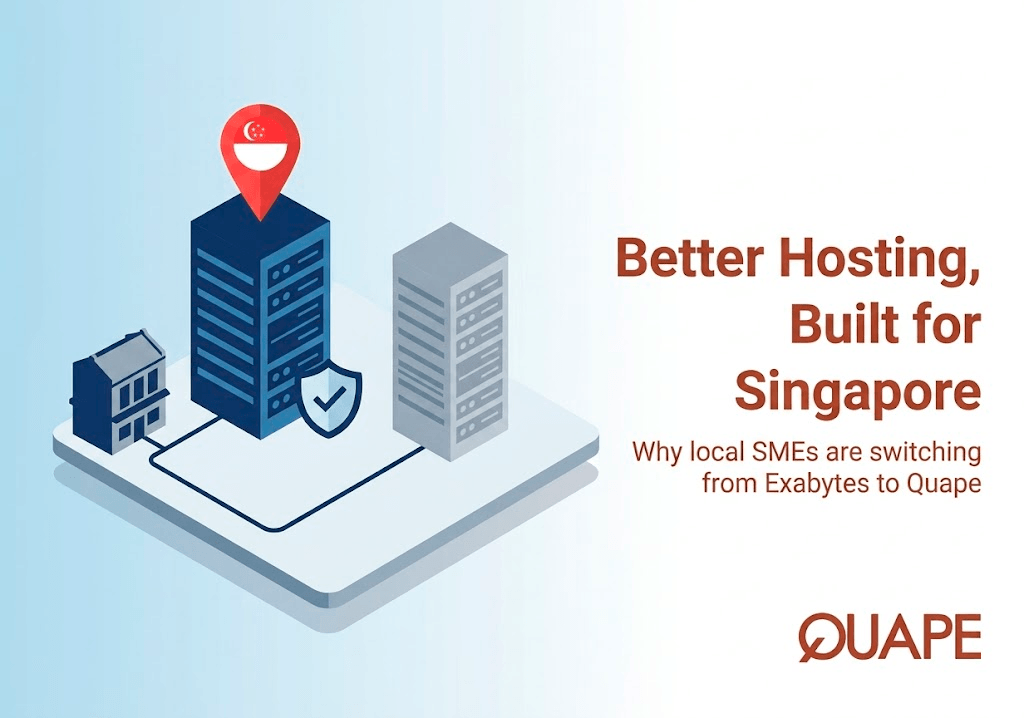
For Singapore SMEs running on shared hosting, the choice of provider affects more than just the price on your invoice. It shapes how reliably your website loads, how consistently your professional email reaches clients, and how much friction you encounter when something goes wrong or when you decide to move on. Exabytes is a widely used option across Southeast Asia, and many businesses sign up because the brand is familiar and entry costs appear low. However, SMEs that depend on predictable day-to-day performance, clearly bounded server resources, and a Singapore-registered host often find that what looked affordable at signup becomes less straightforward over time. This article compares Exabytes and Quape specifically for small teams of 1 to 15 users who need combined web and email hosting under SGD 30 per month, and examines where each provider fits, and where one creates less friction than the other.
What Exabytes does well, and what Quape brings to the comparison
Exabytes has served over 160,000 customers globally and built a recognisable presence across Singapore, Malaysia, and Indonesia. For businesses that need a regional provider with a wide product portfolio, including shared hosting, VPS, dedicated servers, domain registration, and email solutions, Exabytes offers a consolidated starting point. Its Plesk control panel is well-documented, its 100-day money-back guarantee on most plans reduces sign-up risk, and its entry-level pricing has historically appealed to budget-first buyers across Southeast Asia.
Quape enters this comparison as a Singapore-registered hosting company with a narrower but more focused proposition: business web and email hosting built specifically for local SMEs, supported by a Singapore data centre certified to TIA-942 standard. Where Exabytes competes on breadth, Quape competes on predictability, specifically around server resource management, infrastructure transparency, security layering, and migration cost. The two providers serve overlapping audiences, but the fit diverges clearly once a business starts asking questions about data residency, server density, and what switching costs look like in practice.
Key takeaways
- Quape’s Business One plan starts at SGD 11/month, compared to Exabytes’ promotional entry price of SGD 16.99/month.
- Quape’s servers are exclusively hosted in a Singapore data centre certified to TIA-942. Exabytes operates infrastructure across Singapore, Malaysia, the US, and Indonesia, making data residency less predictable depending on the plan.
- Quape caps each shared server at a maximum of 20 users. Exabytes does not publicly disclose a comparable limit.
- Quape includes a Web Application Firewall (WAF) and brute force prevention alongside standard SSL. Exabytes provides anti-spam and SSL at the comparable entry tier.
- Exabytes charges SGD 30 for hosting migrations in Singapore. Quape offers free migration for WordPress sites and email accounts.
- Exabytes is headquartered in Malaysia. Quape is a Singapore-registered company.
- Both platforms use established control panels: Exabytes on Plesk, Quape on DirectAdmin.
Why Singapore SMEs start looking for an Exabytes alternative
Common frustrations: slow support, unclear costs, and migration fees
Hosting dissatisfaction among SMEs rarely starts with a single catastrophic failure. It usually accumulates through smaller friction points: a support ticket that sits unanswered during business hours, a renewal price that differs from the promotional rate, or the discovery that migrating to a different provider carries a fee that was never mentioned at sign-up. For Exabytes users in Singapore specifically, third-party reviews indicate that while technical support is available 24/7, sales and billing support operates only during business hours. When an SME encounters an account or billing issue outside those hours, the gap between expectation and response can affect business continuity more than the hosting performance itself.
Migration fees create a separate category of friction. A SGD 30 charge for a hosting migration may seem minor in isolation, but it functions as a psychological anchor that discourages switching even when the hosting relationship is no longer working well. Research on IT disruption and small business recovery highlights that businesses often delay infrastructure changes longer than they should, and fee structures like this reinforce that delay.
Why “good enough hosting” becomes a business risk over time
Uptime statistics matter, but the downstream effects of hosting instability matter more. Email is the single most operationally critical channel for most SMEs. When email delivery slows, bounces, or fails intermittently, the damage is not confined to a missed message. It affects client trust, quote response times, and order confirmations. McKinsey research on digital communication consistently positions email reliability as foundational to business continuity, not supplementary to it. For small teams without dedicated IT staff, the hosting provider’s infrastructure quality directly determines the reliability of operations that feel manual but are quietly infrastructure-dependent.
What Exabytes does well (and why many SMEs choose it first)
Wide regional presence across Southeast Asia
Exabytes operates data centres in Singapore, Malaysia, the US, and Indonesia, which gives businesses with regional operations a degree of geographic flexibility. For a company that needs hosting presence across multiple markets simultaneously, the multi-country infrastructure Exabytes maintains provides an option that a Singapore-only provider cannot replicate. The Plesk control panel, included across plans, is one of the most widely documented panels in the industry, which reduces the learning curve for teams managing their hosting without technical support.
Familiar control panel and entry-level accessibility
Plesk’s graphical interface integrates website management, email configuration, and database access within a single dashboard. For non-technical users setting up a small business site for the first time, this familiarity reduces friction at the onboarding stage. The 100-day money-back guarantee (available on most plans) also lowers the commitment risk, which is a genuine advantage for SMEs evaluating hosting providers for the first time.
Where Exabytes creates friction for Singapore-based businesses
Data residency isn’t always Singapore-centric
When a hosting provider operates infrastructure across multiple countries, data routing and storage may occur outside the business’s primary jurisdiction depending on which plan and data centre the customer lands on. For Singapore SMEs handling customer data, particularly in sectors like finance, healthcare, or legal services, this introduces compliance ambiguity under Singapore’s Personal Data Protection Act (PDPA) framework. The IMDA and Singapore’s broader data governance approach place increasing emphasis on organisations understanding where their data is stored and processed. Even outside regulated industries, the predictability of knowing your data stays in Singapore carries operational and reputational value that is difficult to quantify until it becomes relevant.
Shared hosting without clear resource limits
In shared hosting environments, all tenants on a server compete for the same CPU, RAM, and storage I/O. Without disclosed resource limits, providers can oversubscribe servers to improve their own margins, resulting in performance variability that correlates with peak usage times rather than the customer’s own traffic. IEEE research on multi-tenant shared environments identifies this “noisy neighbour” effect as one of the most consistent causes of performance degradation in shared hosting, especially during business hours when multiple tenants are active simultaneously. Exabytes does not publicly disclose a user cap per server, which makes it difficult for prospective customers to evaluate the density of the environment they are buying into.
Migration costs add friction when switching providers
The SGD 30 migration fee Exabytes applies to Singapore hosting migrations is not large in absolute terms, but it interacts with the operational complexity of migration itself to create inertia. When a business weighs the fee alongside the time required to reconfigure email accounts, update DNS records, and test the new environment, the total effort often exceeds what was budgeted mentally. This friction keeps SMEs on hosting that no longer serves them well, and the cost accumulates over the extended period they remain.
What actually matters more than price for SMEs (but still affects cost)
The hidden cost of downtime and slow email systems
Hosting pricing is the visible cost. Downtime and email delivery failures are the invisible ones. Gartner’s analysis of IT downtime costs places the impact for small businesses in the range of hundreds to thousands of dollars per hour, depending on the business type and degree of digital dependency. For a team of five people where every client interaction runs through a business email address, even a one-hour email outage during a critical sales window has a cost that dwarfs the monthly hosting fee. The hosting provider’s infrastructure quality does not simply affect website availability. It determines the reliability of every system that depends on it.
Why infrastructure quality directly impacts daily operations
A TIA-942 certified data centre, as defined by the Uptime Institute’s tier classification system, is designed for concurrently maintainable infrastructure with availability reaching 99.982%, which translates to approximately 1.6 hours of downtime per year. This level of redundancy, covering power, cooling, and network paths, means that both planned maintenance and unplanned failures can be managed without taking systems offline. For an SME without internal IT redundancy, the data centre tier effectively becomes the business’s own uptime guarantee, because there is no backup system in the office to absorb a hosting failure.
Quape as an Exabytes alternative built specifically for Singapore SMEs
Singapore-registered company with Singapore-based infrastructure
Quape is registered in Singapore and operates its hosting infrastructure from a TIA-942 data centre in Singapore standard. For businesses that need to confirm where their data is stored, whether for compliance, customer assurance, or internal governance, this removes ambiguity entirely. There is no multi-country routing question to investigate, no plan-specific data centre assignment to verify. The answer is: Singapore, in a certified facility.
Predictable performance through server user capping
Quape caps each shared server at a maximum of 20 users. This is a directly stated operational policy, not an inferred commitment based on pricing tier. For businesses choosing business hosting and email hosting on a shared plan, the ceiling on co-tenants directly limits the “noisy neighbour” effect that degrades performance on oversubscribed servers. A team of five running their company website and 15 email accounts is not competing with an unbounded pool of other tenants during peak usage hours.
Built-in security layers beyond basic SSL
SSL encrypts data in transit but does not address application-level threats such as SQL injection, credential stuffing, or brute force login attempts. These attacks operate above the transport layer and require different controls. Quape includes a Web Application Firewall (WAF) and brute force prevention as part of its business hosting plans, alongside standard SSL. Verizon’s Data Breach Investigations Report consistently finds that 43% of cyberattacks target small businesses, a segment that is often underprotected relative to the volume of targeted activity. WAF protection and brute force controls reduce the attack surface at the layers that SSL does not reach.
Side-by-side: Exabytes vs Quape for real SME use cases
| Factor | Exabytes | Quape |
| Entry price | SGD 16.99/mo (promotional) | SGD 11/mo |
| Data centre location | SG, MY, US, ID (varies by plan) | Singapore only (TIA-942) |
| Server user cap | Not publicly disclosed | Max 20 users per server |
| Security | Anti-spam + SSL | WAF + brute force prevention + SSL |
| Free migration | No (SGD 30 fee for SG migrations) | Yes (WordPress + email accounts) |
| Control panel | Plesk | DirectAdmin |
| Company registration | Malaysia-headquartered | Singapore-registered |
| Unlimited email accounts | Yes (select plans) | Yes (all plans) |
Scenario 1: Small team (1 to 5 users) needing reliable email and a business website
A team of this size typically needs one website, a set of professional email addresses on their own domain, and a hosting environment that does not require active management. The Business One plan at SGD 11/month covers one website, 15 GB SSD storage, unmetered bandwidth, unlimited email accounts and databases, and a free SSL certificate. For the same entry-level requirement at Exabytes, the promotional price sits at SGD 16.99/month with a two-website and two-email-account cap on the equivalent starting tier. The gap in both cost and email account allowance is material for a team where every staff member needs their own address.
Scenario 2: Growing team (5 to 15 users) managing multiple domains
As teams grow, hosting requirements expand beyond a single site. The Business Two plan at SGD 24/month supports three websites, 30 GB SSD, unmetered bandwidth, and unlimited email accounts. For a business managing a main domain alongside a campaign subdomain or secondary regional site, this plan accommodates that structure without requiring an upgrade to a higher tier. For teams concerned about email hosting reliability specifically, the plan’s POP3 and IMAP support ensures compatibility with whatever email client the team uses.
Scenario 3: Switching hosts without technical headache
For a business currently on Exabytes and evaluating a move, the migration question is often the largest practical barrier. Quape’s free migration for WordPress sites and email accounts removes the SGD 30 charge and the negotiation around whether a migration qualifies as “standard.” The migration is handled by Quape’s team, which means the technical lift for the business itself is reduced to DNS changes and testing rather than a full manual transfer.
Pricing reality: entry cost vs long-term value
Entry-level comparison: SGD 11 vs SGD 16.99
Promotional pricing often obscures the renewal cost. At Exabytes, the SGD 16.99/month rate is a promotional entry rate, and the terms of service note that renewal prices may differ. Quape’s SGD 11/month monthly rate and SGD 120/year annual rate are listed as standard pricing, with the annual plan saving SGD 12 compared to paying monthly. Over a 12-month period, a business paying Exabytes’ promotional rate would spend at least SGD 203.88, versus SGD 120 annually with Quape on the equivalent entry plan. The annual difference of approximately SGD 83 is meaningful for an SME managing costs tightly, and it does not factor in the SGD 30 migration fee a business would incur if they later decide to switch away from Exabytes.
Migration and operational costs over 12 months
Total cost of ownership for hosting is not limited to the monthly fee. It includes the migration cost at the point of switching, the cost of any downtime that occurs due to infrastructure performance, and the administrative time spent managing hosting-related issues. Free migration, a stated server density limit, and a TIA-942 data centre each reduce a different component of that total cost. For a small team without dedicated IT resources, the administrative time dimension often dominates, which makes infrastructure predictability more valuable than a marginal difference in monthly rate alone.
When Exabytes still makes sense (and when it doesn’t)
Best fit: businesses targeting multi-country infrastructure
Exabytes is the more rational choice for a business that genuinely needs hosting presence across multiple Southeast Asian markets simultaneously, or one that is already embedded in the Exabytes ecosystem with active use of its broader product suite including digital marketing services, ecommerce tools, or Microsoft 365 integration. The multi-country data centre footprint and the breadth of integrated services are real advantages for businesses that need a single vendor to cover a regional digital operation. For those use cases, Quape’s Singapore-only infrastructure is a constraint rather than a feature.
Not ideal: SMEs wanting predictable Singapore-based hosting
For a Singapore-based SME whose customers, operations, and compliance obligations are all local, the multi-country infrastructure that makes Exabytes flexible for regional businesses introduces unpredictability that has no upside. Data residency variability, undisclosed server density, and a migration fee structure that creates switching friction are all disadvantages in this context. The scenario where Exabytes’ strengths translate to value is simply not the scenario most Singapore-only SMEs are in.
A more predictable alternative for SMEs that just want hosting to work
Simple plans that match real team sizes (1 to 15 users)
Quape’s three business hosting tiers map directly to team size rather than abstract feature levels. Business One covers 1 to 5 users, Business Two supports 5 to 15 users, and Business Three is designed for teams of 10 and above requiring greater storage and multi-domain capacity. Each plan includes unlimited email accounts, unmetered bandwidth, SSD storage, and free SSL. The plan structure means a business does not need to interpret feature lists to identify which tier fits their headcount.
Why “managed simplicity” beats over-complex hosting stacks
For a small team, the ideal hosting relationship is largely invisible. The site loads, the email delivers, and the only interaction with the hosting provider occurs at renewal or when something unusual happens. DirectAdmin’s interface supports this kind of low-overhead management: it handles domain, email, and database configuration without requiring technical expertise to navigate. When something does require support, Quape’s Singapore-based team operates within the same time zone and regulatory context as the business, which reduces the friction that comes from interacting with regional support structures during Singapore business hours.
Final decision: choosing based on stability, not just brand familiarity
Exabytes has built a legitimate regional presence over more than two decades, and for businesses with multi-country hosting needs or deep integration with its broader service ecosystem, it remains a viable option. For Singapore SMEs, the comparison shifts. A Singapore-registered host, TIA-942 data centre, explicit server density limits, layered security beyond SSL, and free migration collectively address the specific pain points that make hosting relationships difficult over time. For a team of 1 to 15 users that needs web and email hosting to work consistently, without the overhead of managing data residency questions or absorbing migration fees when performance falls short, the case for Quape’s business hosting is built on infrastructure substance rather than promotional pricing alone.
Ready to move to a more predictable Singapore hosting setup?
Get business hosting from SGD 11/month
Frequently asked questions
Is Quape’s business hosting really shared hosting?
Yes. Quape’s business hosting plans are shared hosting services. The key distinction is that Quape caps each shared server at a maximum of 20 users, which limits resource contention between tenants and reduces the performance variability that commonly affects oversubscribed shared environments.
How does Quape’s data centre compare to Exabytes for Singapore businesses?
Quape hosts exclusively in a Singapore data centre certified to TIA-942 standard, which means infrastructure is designed for 99.982% availability with concurrent maintainability. Exabytes operates data centres across Singapore, Malaysia, the US, and Indonesia, and data residency depends on the specific plan and data centre assigned, which varies. For businesses that need to confirm their data stays in Singapore, Quape’s single-location infrastructure removes that uncertainty.
Does Quape charge for migrating from Exabytes?
No. Quape offers free migration for WordPress sites and email accounts. For larger or more complex migrations involving custom systems or extensive mailboxes, a small fee may apply. The standard migration cases covering most SME switching scenarios are handled at no cost.
When is Exabytes actually the better choice?
Exabytes is the stronger option for businesses that need multi-country hosting infrastructure across Southeast Asia, or for those already using its broader ecosystem of services, including Microsoft 365, digital marketing tools, or ecommerce enablement. If regional infrastructure breadth and an integrated product suite matter more than Singapore-specific data residency and server density limits, Exabytes is the more suitable platform.
What security does Quape include on its business hosting plans?
Quape includes a Web Application Firewall (WAF), brute force prevention, and Let’s Encrypt SSL on all business hosting plans. The WAF protects against application-level attacks such as SQL injection and cross-site scripting, which operate above the transport layer that SSL secures. Routine security assessments are also conducted to monitor for ongoing threats.
Can I host professional email on Quape’s business hosting plans?
Yes. All Quape business hosting plans include unlimited email accounts with POP3 and IMAP support, which ensures compatibility with email clients such as Outlook, Apple Mail, and Thunderbird. The plans also include brute force prevention specifically applied to email login attempts, which reduces the risk of account compromise.
Is Quape’s pricing transparent at renewal?
Quape lists standard renewal pricing at the same rate as the sign-up price: SGD 11/month or SGD 120/year for Business One. The annual plan saves SGD 12 compared to the monthly rate and renews at the same SGD 120 annual price. There is no promotional rate that reverts to a higher renewal cost.
What control panel does Quape use, and how does it compare to Plesk?
Quape uses DirectAdmin, while Exabytes uses Plesk. Both are established hosting control panels with domain, email, database, and file management capabilities. Plesk has a larger general knowledge base online due to broader adoption, which can be useful for users troubleshooting independently. DirectAdmin is lighter in resource usage and covers all core hosting management tasks for SMEs without the additional complexity of Plesk’s more advanced modules.