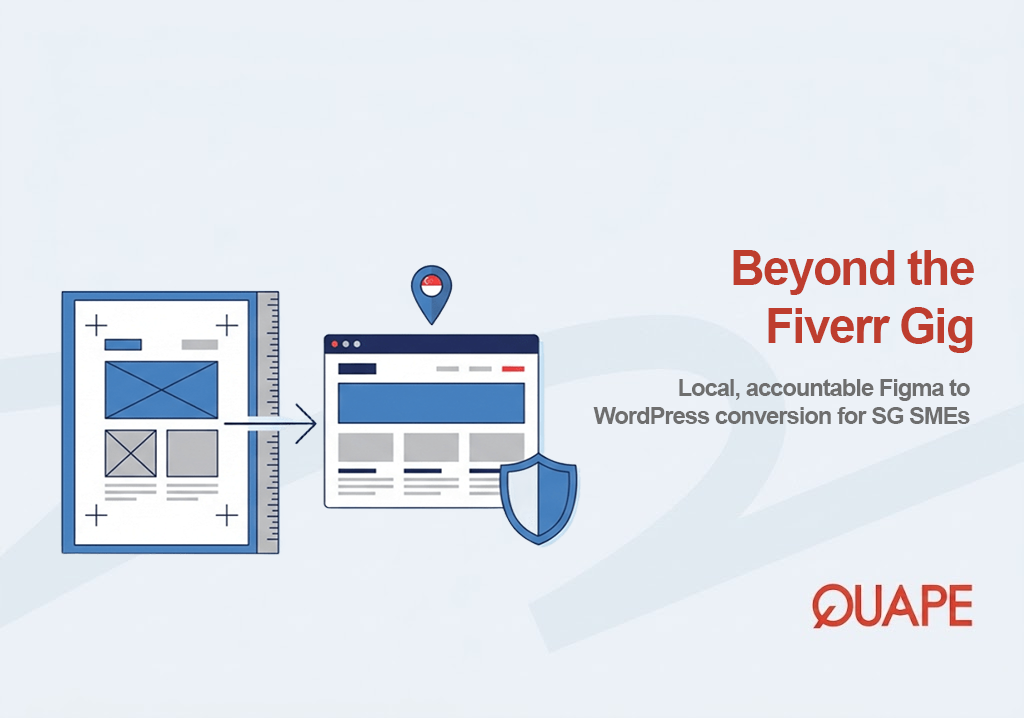
You have a polished Figma or PSD design ready, and the next decision is who turns it into a working WordPress site. For many Singapore SMEs the reflex is to open Fiverr, pick an affordable gig, and hand over the files. That route can work for simple builds, but it carries quiet risks around accountability, communication, and what happens to the site weeks after launch. This comparison is for owners, marketing managers, and in-house designers who want their design implemented accurately and kept running, not just delivered once and forgotten. The short version: Fiverr suits the lowest upfront cost on a straightforward page, while a local team becomes the better choice when the site matters to your business and needs to stay reliable after handover.
Table of Contents
ToggleA quick look at both options
Fiverr is a genuine marketplace strength. It connects you to thousands of specialized freelancers who convert Figma and PSD files to WordPress, often within two to six days, at gig prices that typically run from around 80 to 250 US dollars. For a single landing page or a brochure site with modest functionality, that access and speed are hard to beat, and the upfront pricing is clear before you order.
Quape approaches the same task as a service relationship rather than a one-time transaction. The conversion is handled by a local frontend team working in established frameworks like Divi and Elementor, producing pixel accurate, fully responsive, SEO ready builds that match the original design. Because Quape is a Singapore registered company, you deal with a real entity under Singapore jurisdiction rather than an anonymous seller profile, pricing is quoted in fixed SGD without layered add-ons, and the build is paired with managed hosting plus 24/7 local support so the site keeps working long after a gig would have closed.
Key takeaways
- Fiverr offers a large pool of specialized freelancers, fast turnaround, and transparent gig pricing that works well for simple, low-stakes conversions.
- The marketplace model distributes responsibility between platform policy and an individual seller, so accountability gets thinner exactly when a live site develops problems.
- Communication quality materially affects project outcomes, and design handover across wide time zones is where pixel accuracy tends to slip.
- The initial gig price is only part of the cost of ownership, since hosting, premium plugins, updates, and security patching continue after delivery.
- Most WordPress vulnerabilities originate from plugins rather than the core platform, making ongoing maintenance an operational responsibility, not an optional extra.
- Quape’s fixed SGD pricing, single accountable local team, and managed support after launch suit SMEs that value reliability and ownership over the lowest upfront number.
Why Singapore SMEs look beyond Fiverr for Figma to WordPress projects
WordPress sits at the center of this decision because it runs a large share of the web, with WordPress holding approximately 59.9% CMS market share according to W3Techs data summarized by Colorlib. That dominance means the design-to-development step is not the finish line. It is the start of a platform that needs configuration, plugins, and maintenance to stay healthy, which is why the choice of who builds it carries weight beyond the build itself.
The gap between a finished design and a production-ready WordPress website
A Figma or PSD file describes intent, while a WordPress theme has to honor that intent across breakpoints, devices, and real content. Translating spacing systems, responsive behaviour, typography, and component interactions into a stable theme is interpretive work, and it depends heavily on a shared understanding between the buyer and the builder. This gap widens as requirements grow, which matters because project complexity keeps rising. PMI reports that 81% of project professionals say projects have become more complex in recent years, and complexity is precisely where loose handover processes start to cost time and revisions.
Why accountability matters more than the lowest development cost
The cheapest build is not always the lowest total cost. When a site breaks, the practical question is who is responsible and who fixes it. A marketplace transaction spreads that responsibility between platform rules and an individual freelancer, whereas a vendor relationship centralizes it in one organization you can hold to account. That difference feels academic until a contact form stops capturing leads or a plugin update takes the site down, at which point clear ownership becomes the most valuable thing you bought.
What Fiverr does well for Figma to WordPress conversion
It would be unfair to treat Fiverr as a weak option, because for the right job it is a strong one.
Access to a large pool of specialized freelancers
Fiverr’s scale gives you immediate access to WordPress developers, frontend specialists, and web designers who convert design files daily. If you need a specific framework or a quick fix, you can usually find someone experienced and order within minutes. For one-off, well-defined tasks, that breadth is a real advantage.
Competitive pricing for simple conversion requirements
Fixed gig pricing makes budgeting easy on simple projects. A single landing page or a small brochure site converts cleanly at a known price, with no scoping calls required. When the requirement is genuinely simple and the site is not business critical, this efficiency is exactly what a budget-conscious team wants.
Fast turnaround for straightforward builds
Many gigs promise delivery in two to six days, and for uncomplicated layouts that pace is achievable. If speed is your main constraint and the build has few moving parts, Fiverr can get a working WordPress page deployed quickly.
Where Fiverr becomes riskier for growing Singapore businesses
The same structure that makes Fiverr efficient also introduces risk as the stakes rise.
Communication challenges across time zones and project complexity
Communication is one of the strongest predictors of whether a project succeeds. PMI research found that one in five unsuccessful projects can be attributed to ineffective communication, as documented in its analysis of communication in project outcomes. When a design handover runs through a chat window across a wide time difference, clarifications take a full day to resolve, and nuance in the design brief is easy to lose.
Why pixel accuracy often becomes a revision issue
Pixel accuracy is rarely a coding problem alone. It is an interpretation problem about spacing, breakpoints, and component behaviour, and it improves when the builder can ask questions and confirm intent quickly. Capped revisions and slow asynchronous replies make this harder, so small mismatches accumulate into revision cycles that erode the time and cost savings that made the gig attractive.
Hidden costs beyond the initial gig price
The gig price usually covers conversion and little else. Hosting, premium plugins, and ongoing maintenance are typically excluded, and those costs matter because most security exposure lives in the plugin layer. Plugin dependence is not a minor detail: forms, SEO, caching, and analytics all add plugins, and each one becomes a long-term maintenance responsibility rather than a one-time purchase.
What happens when the website needs support after delivery
Once files are handed over in a marketplace model, the relationship generally ends. There is no standing party to monitor the site, apply updates, or respond when something fails. For a site that needs to keep capturing enquiries and serving customers, that absence of ongoing support is the point where a cheap build can become an expensive problem.
Comparing Fiverr and a local WordPress conversion partner on the factors that actually matter
| Factor | Fiverr freelancer | Quape local team |
|---|---|---|
| Accountability | Shared between platform and individual seller | Single Singapore registered entity |
| Communication | Async chat, wide time zone gap | Local, real-time during the build |
| Pricing | Fixed gig price, common add-ons | Fixed SGD scope, no layered upgrades |
| After launch | Relationship ends at handover | Managed hosting and 24/7 support |
| Best fit | Simple, low-stakes pages | Business-critical, maintained sites |
Accountability and who is responsible when something breaks
With a registered company operating under Singapore jurisdiction, there is a named party answerable for the work and its consequences. That centralized responsibility becomes more important as your dependence on the website grows, because the cost of an unresolved issue scales with how much business runs through the site.
Communication quality during design-to-development handover
Figma and PSD handover is where design fidelity is won or lost, and it benefits from direct, prompt dialogue. A local team can confirm spacing, interactions, and edge cases without a day-long lag, which keeps the implementation close to the original design and reduces the revision loops that frustrate both sides.
Pricing transparency versus layered gig upgrades
Fixed SGD pricing with a defined scope tells you the real number before work begins. Instead of a low headline price that grows through add-ons for responsiveness, plugins, or extra revisions, the project cost reflects the full deliverable, which makes planning and approval far simpler.
Long-term website ownership versus one-time delivery
A WordPress site is a living asset, not a static file. Pairing the build with managed hosting and maintenance treats it that way, covering the updates and oversight that a one-time delivery leaves to you. This is where Quape’s Figma and PSD to WordPress conversion service differs most clearly from a marketplace gig, because the work is designed to keep the site healthy rather than simply ship it.
When a local team becomes the better alternative to Fiverr
Some scenarios point clearly toward a local partner.
Businesses requiring pixel-perfect Figma or PSD implementation
If your brand depends on the design being implemented exactly, the tighter feedback loop of a local team is a practical advantage. Close communication and established frameworks like Divi and Elementor support faithful, responsive builds that hold up against the original file.
Companies that need a single accountable vendor instead of multiple freelancers
If you would rather manage one relationship than coordinate several sellers, a single vendor simplifies governance. One team owns the design, the build, and the outcome, which removes the gaps that appear when responsibility is split across people who have never worked together.
Teams that need ongoing plugin, security, and hosting support
Maintenance is the strongest argument for a managed relationship. WPScan data shows that 93% of known WordPress vulnerabilities originate from plugins rather than the core platform, per its WordPress vulnerability statistics. A team that handles plugin updates, security patching, and hosting as standard absorbs that continual operational burden so it does not land on you after launch.
How Quape’s Figma and PSD to WordPress approach differs
Pixel-accurate development using established WordPress frameworks
Building in Divi and Elementor gives you maintainable themes you can update yourself while preserving the accuracy of the original design. The frameworks support responsive, SEO ready structure from the ground up, so the site is sound technically as well as visually.
Singapore-based accountability and PDPA considerations
Because data protection responsibility under Singapore’s PDPA sits with organizations, working with a registered company creates a clearer governance line than an anonymous profile. The question shifts from only who built the site to who is accountable for it, which matters for any business collecting enquiries, leads, or contact details.
Fixed SGD pricing and clear project scope
A fixed-price, fixed-scope quote in SGD removes the uncertainty of gig tiers. You know the deliverable and the cost in advance, which makes the project easier to budget and approve internally.
Managed support beyond the website launch date
The relationship continues past launch through managed hosting, plugin management, and security updates. This continuity is the decisive difference for a site that needs to keep working, not just exist on delivery day.
Fiverr or Quape? Choosing the right option based on your business goals
Fiverr may be suitable if your priority is lowest upfront cost
If you need a simple page built quickly and cheaply, and the site is not central to your operations, Fiverr is a reasonable choice. For basic builds where ongoing support is not a concern, the marketplace delivers exactly what it promises.
Quape is better suited when reliability, accountability, and ongoing support matter
When the website carries real business weight and must stay reliable, the balance shifts toward a single accountable local team with managed support. Reliability, clear ownership, and continuity after launch are where this model earns its place.
Get a fixed-price assessment for your design conversion project
For Singapore and Southeast Asian SMEs, the real comparison is not Fiverr versus Quape on price alone. It is a one-time transaction versus an owned, supported asset. Fiverr remains a sensible option for simple, low-stakes pages, but when accuracy, accountability, and post-launch reliability matter, a local team that stands behind the build and maintains it is the stronger choice. If your design deserves a faithful build and a site that keeps running, you can request a fixed-price quote for your Figma or PSD to WordPress conversion and review your requirements before committing.
Frequently asked questions
Is Fiverr ever the better choice over a local WordPress team?
Yes. For a single landing page or a simple brochure site that is not business critical, Fiverr’s speed and low gig price are hard to beat. If you do not need ongoing support and the build is straightforward, the marketplace is a practical option.
Why does accountability matter so much for a website build?
A live site eventually needs fixes, updates, or troubleshooting, and the value of clear ownership shows up at that moment. A single registered vendor centralizes responsibility, whereas a marketplace spreads it between platform policy and an individual seller.
Will a Fiverr conversion include hosting and plugins?
Usually not. Most gigs cover the conversion itself and exclude hosting, premium plugins, and ongoing maintenance. Those are recurring costs of ownership that continue long after the initial build is delivered.
Why is plugin maintenance such a recurring concern in WordPress?
Most WordPress security exposure comes from plugins rather than the core platform, and a typical site relies on several plugins for forms, SEO, caching, and analytics. Each one needs updates over time, which makes maintenance an ongoing operational task rather than a one-off.
How does communication affect the accuracy of a Figma to WordPress build?
Design handover involves interpreting spacing, breakpoints, and interactions, so prompt clarification keeps the build close to the original. When communication is slow or runs across a wide time gap, small mismatches accumulate into revision cycles.
Does PDPA require me to use a Singapore-based developer?
No. PDPA does not mandate a local developer, but it does place data protection responsibility on organizations. Working with a registered local company can make that accountability clearer than dealing with an anonymous seller profile.
What does fixed SGD pricing actually change for my budget?
It gives you the full project cost and scope before work starts, rather than a low headline price that grows through add-ons. That predictability makes the project easier to plan and approve internally.