If your business started on WordPress.com and has since run into a wall of plan tiers, plugin restrictions, and design limits, the real question is no longer which subscription to upgrade to, but whether you should keep renting a website platform at all. For Singapore SMEs that need brand differentiation, deeper functionality, and clearer data accountability, the decision often comes down to a constrained but convenient managed platform versus a website designed and built around the business itself. WordPress.com remains a strong choice for simple, fast-launch sites, and this comparison gives it full credit for that. The case for a custom build becomes compelling only at a specific point: when feature gating, ownership concerns, and Singapore-specific compliance considerations start costing more than the convenience is worth. This article maps where that tipping point sits and who should act on it.
Table of Contents
ToggleWhy More Singapore SMEs Are Looking Beyond WordPress.com
WordPress.com solved a genuine problem for an earlier stage of business. It bundled hosting, maintenance, and publishing into a single subscription so a non-technical owner could get a presentable site live in an afternoon. That value has not disappeared. What has changed is the maturity of the market around it. Singapore’s SME digital adoption rate reached 95.1% in 2024, which means most businesses are no longer trying to get online for the first time. The competitive pressure has shifted toward differentiation, system integration, and owning the customer relationship, and that shift is exactly where a subscription website platform begins to feel narrow. quape
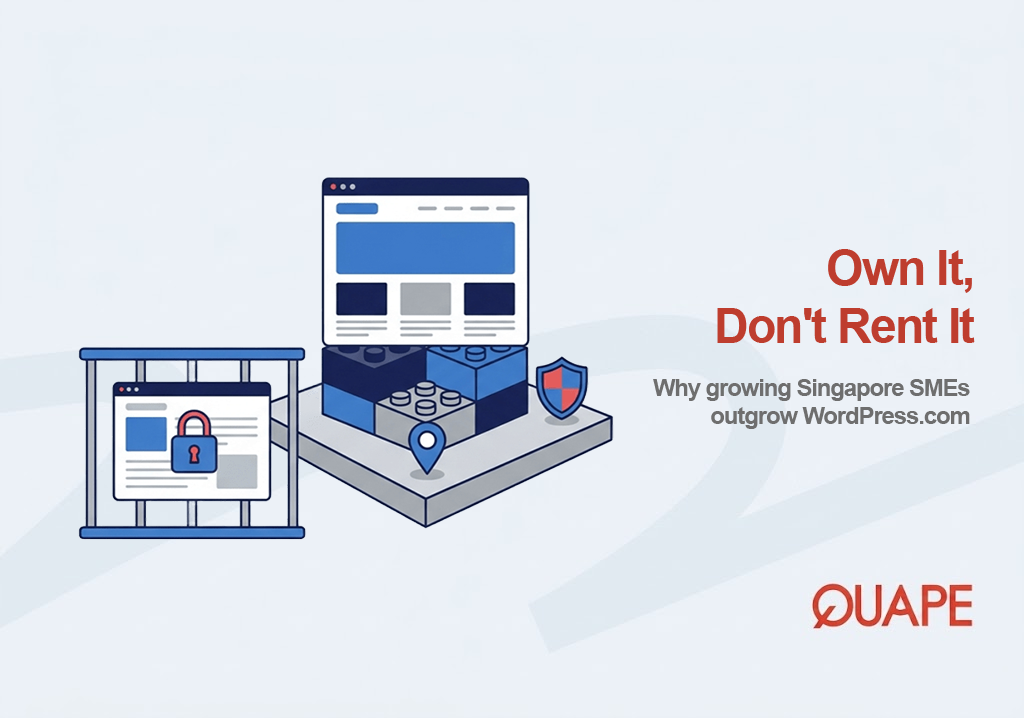
The deeper issue is structural. A platform like WordPress.com gives you a tenancy, not a title deed. Your content management system, your design ceiling, and your functional options are all defined by the plan you are on and the boundaries the platform sets. For a brochure site that rarely changes, that arrangement is fine. For a business that increasingly depends on its website as an operational asset, the gap between renting a slice of someone else’s platform and owning a tailored digital asset starts to matter.
The Point Where a Website Builder Stops Being Enough
Website builders reduce complexity by bundling everything into one environment, which is precisely why they work so well at the start. The friction appears as the business grows into requirements the builder was never designed to serve. Singapore SMEs are already moving in this direction: digital adoption intensity rose from an average of 2.0 digital areas in 2023 to 2.3 digital areas in 2024, a signal that businesses are layering on more specialised functionality rather than settling for a single static presence. quape
These requirements tend to arrive together: a CRM integration to manage leads, a booking system to capture appointments, a member portal to gate content, a product catalogue to structure offerings, and an SEO workflow built for competitive search. Each of these places pressure on architectural flexibility, and a platform that controls which plugins and features you can access will eventually answer that pressure with a paywall or a flat “not supported.”
Renting a Website Platform vs Owning a Business Asset
The trade-off here is convenience for control. An integrated platform simplifies operations by concentrating everything inside one ecosystem, but the more your business processes depend on platform-specific features, the harder it becomes to leave later. Industry analysts have long flagged this pattern: organisations frequently trade flexibility for convenience when they adopt tightly integrated platforms, and that decision quietly creates future migration and portability challenges. A website you own outright, built on a CMS you fully control, behaves like a business asset that supports continuity. A website you rent behaves like an expense that can change terms underneath you.
What WordPress.com Gets Right for Small Businesses
A fair comparison starts by acknowledging what the competitor does well, and WordPress.com does several things genuinely well for the right buyer.
It removes technical overhead almost entirely. Hosting, security patching, uptime, and infrastructure maintenance are handled by Automattic, which means a small team with no developer can keep a site running without ever touching a server. For businesses whose website is a supporting brochure rather than an operational engine, that is real value, and it is the main reason WordPress.com remains a sensible default for early-stage sites.
Fast Launch Times Without Technical Overhead
The managed model is built for speed. Because hosting and deployment are abstracted away, a business can move from sign-up to a published site in a single sitting. There is no provisioning, no configuration of a web server, and no separate hosting bill to manage. For a founder who needs a presence online this week, that compression of time-to-launch is a legitimate advantage that a custom build cannot match on raw speed alone.
An All-in-One Environment for Non-Technical Teams
WordPress.com also keeps day-to-day administration approachable. Content publishing, basic design edits, and site management live in one familiar dashboard, so a marketing coordinator or office manager can maintain the site without specialist help. For teams without technical staff, this all-in-one environment reduces dependency on outside support for routine updates.
When WordPress.com Is Still the Better Choice
It would be dishonest to suggest a custom website suits everyone. WordPress.com is still the better choice for a startup validating an idea, a simple brochure or portfolio site, a personal website, or any project where low maintenance and minimal cost matter more than flexibility. If your site is unlikely to need custom integrations, advanced SEO control, or distinctive design, the platform’s constraints will rarely bite, and paying for a bespoke build would be over-engineering the problem.
Where WordPress.com Starts Creating Friction as Your Business Grows
The friction is not a flaw in WordPress.com so much as a consequence of its model. A managed platform stays manageable by limiting what users can do, and those limits become visible exactly when a business needs to do more.
Why a Single Feature Requirement Can Trigger a Full Plan Upgrade
WordPress.com gates features by plan tier rather than letting you pay for the one thing you need. Plugin installation, the gateway to most serious functionality, only unlocks on the Business plan and above. The practical effect is that a single new requirement, such as one specific plugin, can force you to jump an entire pricing tier even if you will never use the rest of what that tier includes. This feature-gating logic keeps the platform simple, but it transfers the cost of that simplicity onto the growing business.
Plugin Restrictions and the Limits of Platform-Controlled Functionality
Below the higher tiers, you are limited to pre-approved plugins, which means the platform, not your business, decides what your website can do. A CRM integration, a marketing automation flow, or a custom workflow that maps to how your team actually operates may simply be off the table. When functionality is controlled by the platform rather than the owner, your roadmap is capped by someone else’s product decisions.
Design Constraints for Brands That Need to Stand Out
Theme and design control is similarly tiered. Lower plans restrict you to basic themes with limited customisation, and third-party themes are off-limits until you move up. For a business whose brand identity and user experience are part of how it competes, a templated look that resembles thousands of other sites works against differentiation. A distinctive brand needs design freedom that a platform ceiling cannot provide.
SEO Control Limitations for Businesses Competing in Search
Deeper SEO control is also reserved for higher tiers, which matters for any business depending on organic traffic. Competing in search increasingly requires technical and on-page control that constrained plans limit. When your search visibility depends on configuration options the platform restricts, your ability to compete for organic growth is bounded by your subscription rather than your strategy.
The Singapore-Specific Considerations Many Buyers Overlook
Beyond features and design, there is a layer of consideration that generic platform comparisons miss entirely, and it is particularly relevant for businesses operating under Singapore law.
Data Residency and Jurisdictional Accountability
Singapore’s Personal Data Protection Act (PDPA) establishes obligations governing the collection, use, disclosure, and care of personal data by organizations, and crucially, that accountability sits with your organisation. Cross-border transfers of personal data remain permissible under the PDPA, but organizations retain accountability for ensuring comparable protection standards wherever the data lives. On a global managed platform, your customer data sits on infrastructure spread across overseas data centres, which does not remove your obligations but does complicate governance and oversight. Local hosting does not automatically create compliance, and it should not be sold as if it does, but Singapore-based infrastructure with genuine data residency can simplify auditing, legal review, and operational control. Hosting on Tier 3 TIA 942 infrastructure inside Singapore keeps your data under a jurisdiction you can reason about clearly. quapequape
Why Local Support Matters During Website Incidents
When something goes wrong, accountability does not transfer to your technology vendor. Singapore’s PDPA places responsibility on organizations, not technology vendors, for safeguarding personal data, and enforcement is real, with multiple organisations fined for inadequate security arrangements. During an incident, the difference between a global help-centre queue and a local team operating in your timezone is the difference between waiting and resolving. Managed DevOps support included as standard, rather than billed as a paid add-on, means there is a team that owns the outcome when continuity is on the line. quape
The Hidden Cost of Platform Dependency
Platform dependency carries a cost that rarely shows up on the invoice. 68% of business leaders believe they would grow faster if not tied to a single vendor ecosystem, and the same research found that 73% report hidden costs from all-in-one platform dependency, with lock-in pushing average spending up by roughly 35%. The more deeply your operations embed into a platform’s specific features, the more expensive and disruptive it becomes to ever move, which is the essence of vendor lock-in. quapequape
| Consideration | WordPress.com | Custom Build (Quape) |
|---|---|---|
| Infrastructure ownership | Rented tenancy on Automattic’s platform | Fully owned website asset |
| Plugins and themes | Gated by plan tier; pre-approved only on lower plans | No artificial caps on plugins or themes |
| Data residency | Global data centres | Singapore Tier 3 TIA 942 with local residency |
| Support model | Tiered help centre | Managed DevOps included as standard, local team |
| Pricing | Recurring subscription, tier upgrades | Transparent fixed pricing in SGD |
| Design freedom | Capped by platform | Built around brand requirements |
What Changes When Your Website Is Designed Around Your Business Instead of a Platform
The alternative to renting a constrained slice of a platform is a website designed and built from scratch around your exact requirements. This is where a dedicated Singapore web design agency that builds custom company websites approaches the problem from the opposite direction, assessing what the business actually needs and recommending the right architecture rather than fitting the business into a fixed product.
Building Only the Functionality You Actually Need
A custom build inverts the feature-gating logic. Instead of upgrading a plan to unlock a capability, you specify the capability and it gets built: a membership system, a booking system, a product catalogue, or a custom integration that mirrors your real workflow. This matters because 97% of Singapore SMEs adopted at least one sector-specific digital solution in 2024, up from 85% in 2023, and sector-specific needs rarely fit neatly inside a generic platform’s pre-approved options. You pay for what your business requires, not for a tier that happens to contain it. quape
Choosing WordPress or Laravel Based on Business Requirements
Ownership also means the technology serves the requirement rather than the reverse. A custom approach can deliver on the WordPress CMS when familiarity and a rich content workflow are the priority, or on a framework such as Laravel when a project calls for bespoke business application logic. The decision follows the business case, not a platform’s limitations, which keeps the build aligned to what the site actually has to do.
Avoiding Bloated Builds and Long-Term Technical Debt
There is a real risk in the opposite direction worth naming honestly: stacking workarounds and excess plugins onto any site can create bloat, fragility, and long-term technical debt. A disciplined custom project counters this by building only what is needed, hardening security from the outset, and handing over comprehensive documentation, so the site stays performant and maintainable rather than accumulating hidden complexity.
WordPress.com vs Quape: The Differences That Actually Affect Business Outcomes
Stripping away the marketing, a handful of differences actually change business outcomes.
Infrastructure Ownership and Control
On WordPress.com you operate inside managed hosting you do not own. With a custom build on Singapore Tier 3 TIA 942 infrastructure, the website is an asset under your control, which changes how you handle data, continuity, and long-term strategy.
Plugins, Themes, and Functional Flexibility
WordPress.com restricts plugins and third-party themes by tier. A custom website carries no artificial caps on functionality or extensibility, so the site can evolve with the business instead of against its plan.
SEO Implementation and Growth Readiness
Where WordPress.com limits SEO control on lower plans, a custom build ships with full SEO optimisation through Yoast and the technical access to compete for organic growth properly. This should be framed as control and readiness rather than a guarantee of rankings, which no honest provider can promise.
Support Model and Accountability
The support contrast is structural. A tiered help centre answers when it reaches you; managed DevOps support included as standard means a local team owns the result, which is the model that matters most during an incident.
Pricing Structure and Long-Term Cost Predictability
A subscription escalates as you climb tiers to unlock features. A custom build uses transparent fixed pricing in SGD from a clear starting point, which makes total cost of ownership easier to predict, especially against the roughly 35% spending creep that lock-in tends to introduce.
Which Option Fits Your Business Stage?
The right answer depends entirely on where your business sits. Singapore’s digital economy contributed SGD 128 billion and 18.6% of national GDP, and businesses across every stage of that economy use both models well. quape
Choose WordPress.com If Simplicity Matters More Than Flexibility
If you need a starter website live quickly, have no technical staff, and your site is essentially a brochure, WordPress.com is the pragmatic choice. Do not pay for a custom build to solve a problem you do not have.
Choose a Custom Website If Your Business Needs Ownership, Control, and Differentiation
If your website is becoming an operational asset that needs custom functionality, distinctive design, and clear data ownership, a custom build fits better. With four in five Singapore businesses actively engaged in digital transformation, more SMEs are reaching this stage every year. quape
The Tipping Point That Signals It’s Time to Rebuild
The signal is concrete. When you are upgrading plans purely to unlock single features, when the platform blocks an integration your operations depend on, or when 67% of business leaders report that platform lock-in reduces their ability to adapt starts describing your own experience, you have reached the point where rebuilding costs less than staying. quape
Moving Beyond WordPress.com Without Sacrificing Manageability
The common fear about leaving a managed platform is losing ease of use. A well-run custom project, like those delivered through Quape’s custom website design and migration service, is structured specifically to avoid that, pairing full control with a managed handover.
Maintaining Ease of Use While Gaining Full Control
The CMS handover is the bridge. You receive an easy-to-use content management system so day-to-day editing stays as simple as it was on the platform, while the underlying ownership, governance, and flexibility all improve. You gain control without inheriting complexity.
What a Fully Managed Custom Website Project Looks Like
A complete project covers planning around your requirements, development on the right architecture, security hardening, free managed migration with a security audit, and documentation, all backed by ongoing managed support. The result is a site you own and can maintain, not a one-off handover that becomes someone else’s problem.
Get a Custom Website Design Quote (Free Consultation)
For Singapore and Southeast Asian SMEs that have outgrown a templated subscription site and now need brand differentiation, full functional control, and data they can account for under PDPA, a custom-built website is the more strategic foundation. WordPress.com remains the smarter pick for simple, low-maintenance sites, and that honesty is the point: the right choice depends on your stage, not on which option is universally “better.” If you recognise the tipping point in your own business, you can schedule a website strategy consultation to work through whether rebuilding or staying on WordPress.com makes more sense for you.
Frequently Asked Questions
Is WordPress.com bad for business websites?
No. WordPress.com is a solid choice for simple, low-maintenance business sites, particularly brochure sites and early-stage ventures. It becomes limiting only when a business needs custom functionality, distinctive design, deeper SEO control, or clearer data ownership than its plan tiers allow.
When should I move off WordPress.com to a custom website?
The clearest signal is when you find yourself upgrading plans purely to unlock a single feature, or when the platform blocks an integration your operations depend on. If your website has become an operational asset rather than a brochure, a custom build usually justifies itself.
Does a Singapore-hosted website make me PDPA compliant?
Not automatically. Under the PDPA, your organisation remains accountable for protecting personal data regardless of where it is stored, and compliance depends on your practices, not your hosting location alone. Local Singapore hosting can simplify governance, auditing, and oversight, but it is a governance advantage rather than a compliance guarantee.
Will a custom website rank better in search than WordPress.com?
A custom build gives you fuller technical and on-page SEO control, including Yoast integration, which removes the limits that lower WordPress.com plans impose. That is readiness to compete, not a guarantee of higher rankings, since rankings depend on content, competition, and ongoing optimisation.
Is a custom website harder to maintain than a managed platform?
It does not have to be. A well-delivered custom project includes a CMS handover so everyday editing stays as simple as a platform, plus documentation and managed support. The aim is to keep ease of use while adding ownership and control.
What about vendor lock-in with a custom build?
A custom website you own is the opposite of lock-in. Because you control the infrastructure, code, and CMS, you are not dependent on a single platform’s pricing tiers or feature decisions, which is what reduces the hidden costs and rigidity that all-in-one platforms tend to create.
Is WordPress.com ever genuinely the better choice over a custom build?
Yes. For a startup validating an idea, a personal site, or a simple brochure site where low cost and minimal maintenance matter most, WordPress.com is the better fit. Commissioning a bespoke build for that scenario would be over-engineering a problem that does not exist.