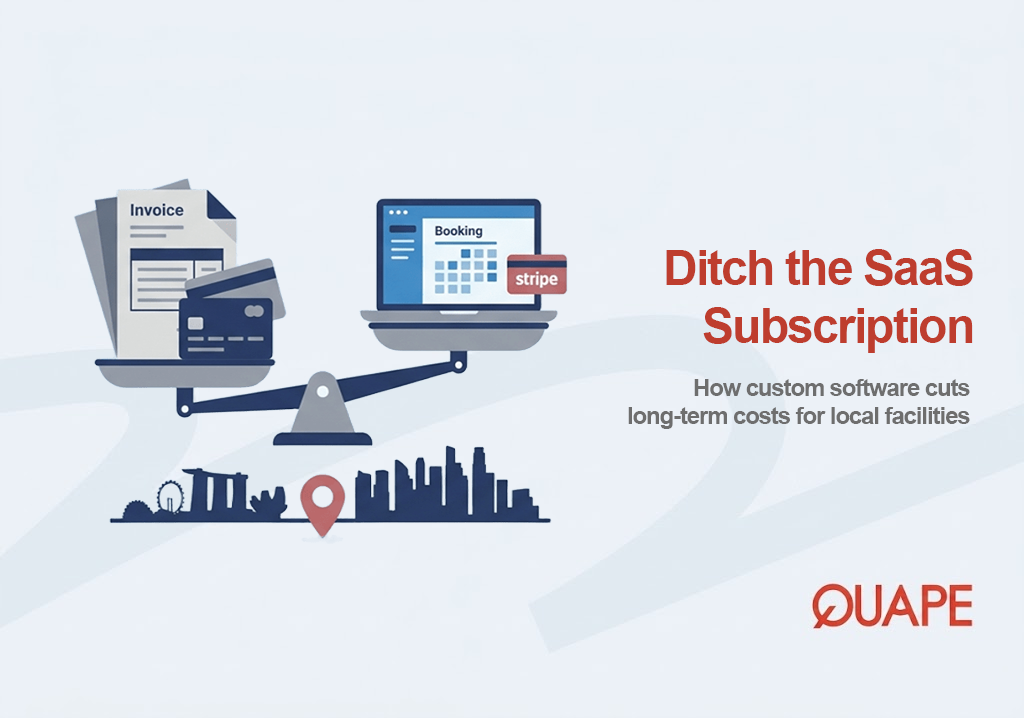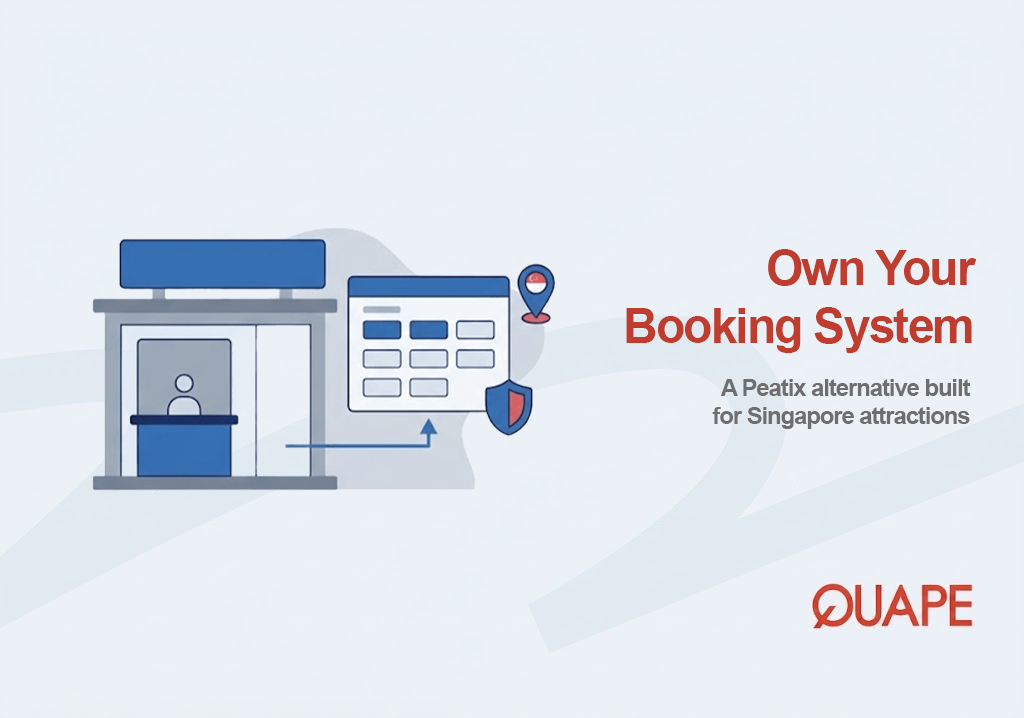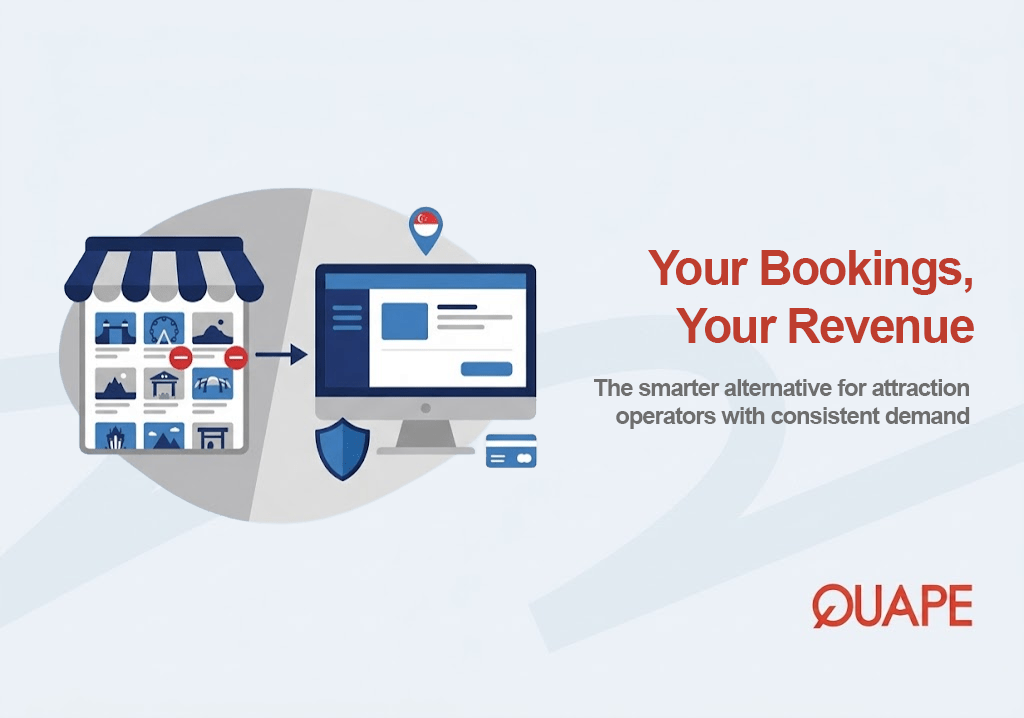
If you run an escape room, museum, tour operation, or leisure attraction in Singapore, Klook has likely been part of how you fill your booking calendar. It works, especially in the early stages when visibility matters more than margin. But as your attraction matures and visitor demand becomes more predictable, the economics of marketplace dependency begin working against you. Every ticket sold through a third-party platform costs you a percentage of revenue, and that cost scales upward as your business grows. This article is for operators who have already built demand and are now asking whether owning their booking infrastructure makes more strategic sense than continuing to pay for distribution they no longer need at the same rate.
Table of Contents
ToggleWhy More Singapore Attraction Operators Are Looking Beyond Marketplace Ticketing
Singapore’s tourism sector is one of the most digitally sophisticated in Southeast Asia. The Singapore Tourism Board actively encourages data-driven decision making among attraction operators, and the country’s broader Tourism 2040 strategy places emphasis on owned visitor relationships, not just footfall volume. Against that backdrop, a growing number of established attraction businesses are examining what marketplace platforms actually cost them, not just in commissions, but in customer data, brand control, and long-term relationship building.
Klook is a dominant force in this space. Its partnership with the Singapore Tourism Board, renewed in 2025 under a three-year agreement, signals the platform’s continued relevance as a distribution channel for inbound tourism. For operators trying to reach international travellers who are actively browsing for things to do, that distribution power is real and difficult to replicate independently. The question is not whether Klook is useful. The question is whether it remains the right primary channel once your attraction has established its own audience.
What Klook Gets Right for Growing Attraction Businesses
Access to an Established Travel Marketplace
Klook connects millions of travellers across more than 2,700 destinations with local experiences, attraction tickets, transport, and activities. For a new escape room or recently launched guided tour, that reach compresses the time it takes to acquire early visitors significantly. Rather than building organic search presence, paid traffic, and brand awareness from scratch, listing on Klook positions your attraction in front of travellers who are already in discovery mode and ready to book.
Oxford Economics estimated that Klook contributed approximately S$655 million to Singapore’s GDP and supported around 6,000 jobs through tourism activity, which illustrates how deeply the platform is embedded in Singapore’s visitor economy. For operators entering the market, that ecosystem provides immediate commercial relevance.
Faster Exposure Without Building Your Own Booking Platform
Klook handles the technology infrastructure, payment processing, QR ticket redemption, customer communication, and review management on behalf of listed operators. A new attraction can go live with a fully functional booking experience without a single line of custom development. For businesses that are still validating their concept or working through early operational challenges, this removes meaningful technical risk from the equation.
Why Klook Makes Sense for New or Low-Visibility Operators
Discovery is the scarcest resource for an attraction without an existing audience. Klook’s recommendation algorithms, search visibility, and affiliate network actively surface your listing to relevant travellers. For operators who rely heavily on tourist footfall rather than repeat local visitors, that distribution channel continues to deliver value even at the commission rates it charges. If the majority of your visitors are still first-time international travellers who found you on a marketplace, staying listed makes commercial sense.
When Marketplace Success Starts Becoming an Expensive Business Model
Commission Costs Continue Growing as Your Revenue Grows
The structure of marketplace commission creates a compounding cost problem for successful operators. Industry reports indicate that attraction marketplace commissions commonly fall within the 15% to 25% range, depending on commercial agreements negotiated individually between operators and the platform. There is no publicly disclosed fixed rate. What that means in practice is that a business generating SGD 50,000 in monthly ticket sales through Klook may be paying SGD 7,500 to SGD 12,500 every month for the same distribution channel it used when it was generating a fraction of that volume. The platform cost scales with your success rather than remaining fixed, which is the defining limitation of the commission model.
During Singapore’s SingapoRediscovers voucher programme, tourism businesses reported standard marketplace commissions in the 20% to 25% range, with temporary programme rates reduced significantly for the duration of government support. That reporting, covered by The Straits Times, confirmed what many operators already knew: the default commission environment for established attractions is materially expensive.
Your Customer Relationship Belongs to the Marketplace Instead of Your Business
When a visitor books through Klook, the booking relationship exists between that visitor and Klook. The operator receives a confirmed reservation and typically a name, but the direct customer relationship, including email contact, purchase history, and behavioural data, resides with the platform. This is not a technical detail. It has direct consequences for how you can market to past visitors, build loyalty programmes, or understand which customer segments return most frequently. First-party data is the foundation of retention marketing, and marketplace distribution structurally prevents operators from building it.
Competing Beside Similar Attractions Instead of Building Your Own Brand
On a marketplace listing page, your attraction appears alongside competing options, often with similar pricing, similar photography formats, and similar review counts. The platform’s design optimises for traveller choice, not operator brand differentiation. This creates a commercial environment where the strongest lever you have is pricing, which erodes margin, or review volume, which takes time to build. Neither lever builds brand equity in the way that owning your own booking experience does.
Why This Matters More for Established Attractions in Singapore
Repeat Visitors Are More Valuable Than One-Time Marketplace Customers
For escape rooms, family attractions, museums, and seasonal experiences, repeat visitors represent a disproportionate share of long-term revenue. A family that visits an escape room once and has a strong experience is a candidate for a second visit, a birthday party booking, or a referral. If that family booked through Klook, there is no direct channel through which the operator can follow up, offer a returning visitor discount, or build the relationship that converts a one-time purchase into a loyalty pattern. Owning the booking relationship changes that entirely.
Growing Operators Need Control Over Pricing, Promotions, and Customer Experience
An operator managing their own booking platform controls the full commercial experience: pricing tiers, promotional codes, group rate structures, early-bird discounts, and upsell opportunities at the point of booking. These levers are either absent or constrained when operating through a third-party marketplace. As an attraction matures, the ability to respond dynamically to demand patterns, seasonality, and customer segments becomes a meaningful competitive advantage.
What Changes When You Own Your Own Attraction Booking Platform
Every Booking Happens Under Your Own Brand
A white-label booking system hosted on your own domain means that every step of the customer journey, from discovering available slots to completing payment to receiving a confirmation email, reflects your brand. The visitor never encounters a third-party interface. This consistency builds trust, supports brand recall, and creates the conditions under which direct repeat booking becomes the default behaviour for returning visitors.
Quape’s attraction booking system is built specifically for this transition, giving Singapore-based operators a fully customisable platform with real-time slot management, automated confirmations, and Stripe payment integration, all delivered under the operator’s own domain and brand identity.
Payments Go Directly to Your Business Through Stripe
Rather than receiving a net settlement after marketplace commission deductions, operators using an owned booking platform collect full payment at the point of booking through Stripe. Stripe’s PCI-DSS compliance handles the security requirements for credit card and digital wallet processing. The operator receives revenue directly, with no intermediary holding a percentage before disbursement. For cash flow management, particularly for businesses with high seasonal demand, that timing difference carries real operational significance.
Real-Time Slot Management Without Marketplace Limitations
Managing availability across timed entry slots, group bookings, maintenance windows, and blackout periods requires flexible scheduling infrastructure. Quape’s system includes a slot management engine that prevents double bookings in real time, allows operators to set capacity limits per session, and supports recurring availability rules without manual intervention. This level of scheduling granularity is not typically available through marketplace listing interfaces, which prioritise simplicity for the traveller over operational control for the operator.
Own Every Customer Record and Build Long-Term Relationships
Every booking processed through an owned platform creates a customer record that belongs to the business. Over time, that database supports segmentation, personalised re-engagement, loyalty offers, and direct marketing campaigns without dependence on a third-party platform’s data policies. Singapore’s growing emphasis on data-driven tourism decision making, reflected in the Singapore Tourism Analytics Network (STAN), which has onboarded more than 400 tourism companies, underscores how central data ownership is becoming to sustainable tourism business models.
Klook vs Quape: Which Model Fits Your Business Stage?
| Dimension | Klook | Quape Attraction Booking System |
|---|---|---|
| Customer Acquisition | Strong: marketplace discovery for new and international visitors | Requires existing demand or independent marketing |
| Booking Fees | Commission per transaction (commonly 15 to 25%, negotiated) | One-time development investment, zero per-transaction commission |
| Customer Data Ownership | Data held by marketplace platform | Full first-party data owned by operator |
| Branding | Klook-branded experience, operator listed alongside competitors | Fully white-label, hosted on operator’s own domain |
| Scheduling Control | Basic availability management within platform constraints | Real-time slot management with capacity controls and custom rules |
| Payment Flow | Net settlement after commission deduction | Direct Stripe collection at point of booking |
| Scalability | Scales through platform infrastructure | Scales through Quape’s Singapore Tier 3 TIA-942 infrastructure |
The Better Choice Depends on How Your Customers Find You
Stay on Klook if Marketplace Discovery Is Still Your Primary Source of Visitors
If a significant share of your bookings still originates from travellers browsing Klook rather than searching for your attraction directly, removing yourself from the platform would reduce revenue rather than protect it. The commission cost is the price of distribution, and for operators without an established direct audience, that distribution is genuinely valuable. Klook also supports multi-channel strategies: many operators maintain a marketplace presence while simultaneously building a direct booking channel, using the two in parallel rather than as alternatives.
Choose Quape When You Already Have Consistent Demand and Want to Own Your Revenue
The inflection point arrives when you can identify a reliable volume of visitors who would find and book your attraction regardless of whether it appeared on a marketplace. At that stage, the commission you pay represents a cost for distribution you no longer fully depend on. Operators with strong repeat visitor patterns, established local brand recognition, or consistent direct search traffic are the businesses for whom an owned booking engine delivers the clearest financial and strategic return.
Conclusion
Klook and Quape’s Attraction Booking System solve fundamentally different problems. Klook optimises for discovery and reach, which is the right priority when a business is building its initial audience. Quape’s solution optimises for ownership, margin, and long-term customer relationships, which is the right priority when a business has already built its demand and wants to stop paying a percentage of its revenue to maintain access to an audience it has effectively earned. For established attraction operators in Singapore, and increasingly across Malaysia, Indonesia, Thailand, and the Philippines, the strategic case for owning your booking infrastructure grows stronger with every ticket sold through a platform that keeps the customer relationship for itself. If you are ready to explore what that shift looks like for your operation, you can request a demo to see how an owned booking platform could reduce recurring marketplace costs while giving you full control over your customer experience.
Frequently Asked Questions
Can I continue using Klook while operating my own booking website?
Yes, and many operators do exactly this. A hybrid approach allows you to keep your Klook listing active for new visitor discovery and international travellers while directing repeat customers and direct search visitors toward your own booking platform. Singapore’s SingapoRediscovers programme demonstrated this multi-channel model at scale, with operators listing simultaneously across several platforms without exclusivity requirements.
Will customers prefer booking directly on my website?
Research from the South Australian Tourism Commission found that 56% of Singapore visitors booked experiences directly with the experience provider, compared with 32% using online travel agents. Customer preference for direct booking exists, but it tends to activate more strongly when the direct channel offers clear advantages: better pricing, exclusive availability, or a more personalised experience.
How difficult is it to launch a custom booking system?
Quape handles the full implementation process, including system configuration, customisation to match your branding and operational workflow, and post-launch support. Operators do not need to manage technical development independently. Once the system is configured, the ongoing management is handled through an administrative dashboard without requiring developer involvement for day-to-day operations.
Can the system handle high booking volumes and timed entry requirements?
The system is built for scalability and supports large numbers of concurrent users without performance degradation. Timed entry with per-slot capacity limits, blackout periods, and recurring availability rules are core features of the slot management engine. This makes it suitable for attractions with high seasonal demand, where booking platforms typically experience peak traffic during public holidays and school breaks.
Is Klook ever the better long-term choice over a custom booking platform?
For attractions that depend primarily on international tourist discovery, or for operators who are still in early growth stages without an established direct audience, Klook provides distribution value that a custom booking platform cannot immediately replicate. Building a direct booking channel requires independent marketing effort to drive traffic. If your business does not yet have the brand recognition or marketing capacity to sustain that traffic, maintaining Klook as your primary channel is the more commercially sound decision.
What happens to my existing Klook bookings if I launch a direct booking platform?
Launching your own booking platform does not affect existing Klook commitments or reservations. Operators can run both systems simultaneously during a transition period, fulfilling Klook bookings as normal while gradually shifting future marketing and repeat customer communications toward the direct channel.
Does owning my booking platform affect how I can use customer data?
Yes, significantly. An owned platform gives you access to complete first-party booking data: contact details, visit history, ticket types purchased, and booking frequency. This data supports direct email marketing, personalised promotions, and loyalty programmes. Marketplace platforms typically restrict how operators can contact or re-market to customers who booked through the platform.