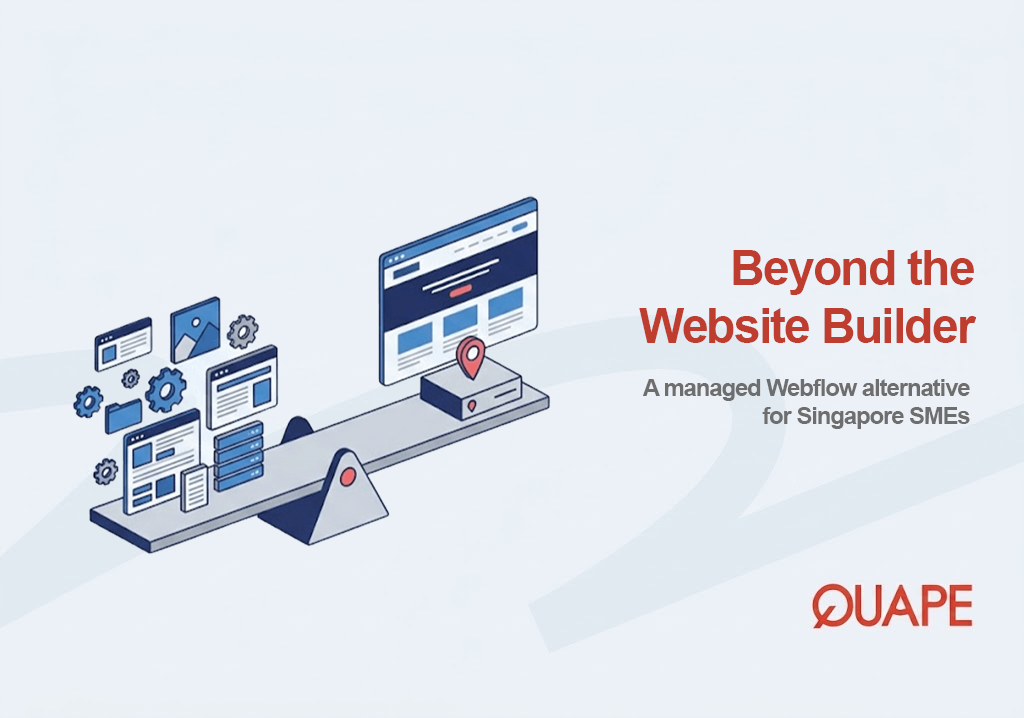
Choosing how to build a corporate website is no longer a purely technical decision for Singapore SMEs, it is a business decision that affects brand perception, lead generation, and internal workload. Many growing companies start with Webflow because it promises a polished site without writing code, then discover that someone inside the business still has to learn the platform, manage it, and absorb a pricing model that climbs as the site scales. This article compares Webflow, a capable visual website builder, with Quape, a Singapore web design agency that delivers a fully managed corporate website as an outcome rather than a tool. The distinction matters most for owners, marketing managers, and operations leads who want a credible, professional website without staffing an internal web team. For that specific buyer, the better choice is often a managed partner, and the sections below explain why and when that holds true.
Webflow is genuinely strong at what it was designed for. It lets marketing teams build and publish pages visually, controls layout with precision, and after its 2026 restructure it has leaned further into AI-native features that speed up content workflows. For an in-house team that wants direct control of every page, that combination is hard to beat.
Quape approaches the same goal from the opposite direction. Instead of renting a builder and staffing it, a business hands the entire project to a Singapore-based team that handles strategy, design, build, and launch, then hosts the site on its own Tier 3 TIA-942 datacenter with PDPA-aligned data residency and includes 24/7 DevOps managed support as standard. The comparison, in practice, is less builder versus builder and more learn a tool and run it yourself versus hand the website to one local partner who designs it, hosts it, and maintains it for you.
Table of Contents
ToggleKey takeaways
- Webflow is a website builder that reduces front-end coding, while Quape is a managed service that delivers a finished, maintained website.
- A builder still requires internal ownership: someone must learn it, maintain it, and govern content and integrations.
- Webflow costs stack across Site plans, per-seat Workspace fees, and usage-priced add-ons, with the realistic path to scale running through a Team plan at roughly USD 2,500 a month on an annual contract.
- Quape includes hosting and 24/7 DevOps managed support as standard, with transparent SGD pricing and no per-seat or bandwidth-add-on surprises.
- Quape hosts on a Singapore Tier 3 TIA-942 datacenter with PDPA-aligned data residency, simplifying governance for businesses handling customer data.
- For requirements beyond a builder, Quape can build custom React and Laravel applications with CRM and ERP integrations.
- Webflow remains the better fit for teams that genuinely want full in-house control and are comfortable running their own website stack.
Why many Singapore SMEs start with Webflow but eventually look for an alternative
Digital presence has moved from optional to essential for Singapore businesses. The country’s digital economy reached S$128.1 billion in 2024 and accounted for 18.6% of GDP, up from 14.9% in 2019, which signals that a company’s website now carries real commercial weight. Adoption is near universal, and most SMEs have already integrated at least one digital technology into how they operate. When a marketing lead or owner first evaluates options, Webflow appeals because it converts design ambition into a live site quickly, without a developer on payroll. The friction tends to surface later, once the website needs ongoing care, deeper integrations, or a level of polish that a busy internal team cannot sustain.
What Webflow does well for modern marketing teams
Visual development without traditional coding
The Webflow Designer lets a team build layouts visually while it generates clean front-end markup underneath. This no-code approach removes a real barrier, because a marketer can shape a page directly instead of briefing a developer and waiting on a build cycle. The visual CMS extends that control to structured content, so teams can manage collections and templates without touching code.
Fast landing page creation and content publishing
Webflow supports rapid landing page creation, which suits content marketing programs that ship frequently. A campaign page can move from idea to publish in hours, and the CMS keeps recurring content types consistent. For teams whose primary need is publishing velocity, this responsiveness is a genuine strength.
AI-native features and marketing workflow enhancements
Webflow’s 2026 direction adds AI website tools that assist with content generation and layout, aligning the platform with broader marketing automation trends. The appetite for this is real, since SME AI adoption in Singapore rose sharply within a single year. AI accelerates production, but it does not transfer accountability, and the same developer research that tracks rapid AI tool adoption also notes that a meaningful share of practitioners do not fully trust AI output and lose time correcting it. Faster building still requires a person who owns the result.
Where Webflow creates operational challenges for growing businesses
A website platform still requires internal ownership
A builder reduces development effort, but it does not remove operational ownership. Someone inside the organization still manages updates, permissions, publishing standards, integrations, and vendor relationships, and that work accumulates into the kind of maintenance burden that developers consistently rank as their single largest frustration in the 2024 Stack Overflow developer survey. For a lean marketing or operations team, absorbing that governance load competes directly with the work they were hired to do.
Understanding the real cost of scaling beyond basic plans
Webflow’s pricing layers Site plans, per-seat Workspace fees, and usage-priced add-ons on top of one another. Each layer is reasonable in isolation, but together they make total cost harder to predict as the site and team grow. The realistic path to scale runs through a Team plan at roughly USD 2,500 a month on an annual contract, which reframes the decision: the visible subscription is only part of the picture, and internal time spent operating the platform is the cost that rarely appears on the invoice.
When corporate website requirements outgrow a website builder
As SMEs mature digitally, requirements often expand from publishing content toward integrating the website with CRM systems, lead management, customer workflows, and internal operations. A builder excels at presentation but reaches its limits when a business needs custom logic or deep enterprise integrations. At that point the question shifts from how do we publish faster to who can build and maintain the systems our business now depends on.
Why Singapore companies often prefer a managed website partner instead of another platform
The difference between buying software and buying outcomes
A website builder and a managed website service solve different problems. A platform reduces the need to write front-end code, but the organization still owns design decisions, governance, content operations, and maintenance. A managed partner absorbs those responsibilities and delivers a working corporate website as the outcome. Most SMEs, in truth, do not want to become web development companies, they want a website that represents their brand and keeps working.
Reducing technical overhead for marketing and operations teams
When hosting, security, and support sit with a partner, the internal team’s overhead drops considerably. Quape includes 24/7 DevOps managed support as standard, so updates, monitoring, and security management are handled rather than added to a marketer’s task list. That arrangement frees the people inside the business to focus on growth instead of website administration.
React and Laravel development for businesses that need more than a website builder
Custom business logic and workflow integration
When a corporate site needs to do more than present information, custom development becomes the practical route. Quape assesses requirements and recommends the right foundation, whether a streamlined WordPress build or a custom application using Laravel and React. That flexibility supports CRM and ERP integration and bespoke workflows that a template-driven builder cannot express natively.
Scalability for multi-department and multi-region operations
A custom architecture scales with a business as it adds departments or expands across Southeast Asia. Where a builder ties growth to plan tiers and add-ons, a purpose-built system grows around the company’s actual operations, which matters for organizations planning regional expansion.
Flexibility beyond templates and predefined components
Custom front-end and back-end development gives a business control over user experience and interface decisions that templates constrain. For a company whose brand or functionality genuinely differs from the norm, that freedom turns the website from a constraint into an asset.
Webflow vs Quape: the comparison factors that actually matter to Singapore SMEs
The table below summarizes how the two approaches differ across the factors that most affect an SME’s workload, budget, and governance.
| Factor | Webflow | Quape |
|---|---|---|
| Strategy, design, build, launch | Your internal team | Handled by Quape’s Singapore team |
| Ongoing maintenance and support | Owned in-house | 24/7 DevOps managed support included |
| Cost structure | Layered: Site plans, per-seat fees, add-ons | Transparent SGD pricing, no per-seat math |
| Hosting and data residency | Webflow-managed, overseas | Singapore Tier 3 TIA-942, PDPA-aligned |
| Custom logic and integrations | Limited beyond CMS and templates | Custom React and Laravel, CRM and ERP |
| Load on internal team | Higher | Lower |
Local hosting, data residency, and compliance considerations
For Singapore organizations handling customer information, hosting location affects governance, audit processes, and vendor management. Data residency does not automatically equal compliance, and businesses transferring personal data overseas remain responsible for ensuring comparable protection under Singapore privacy rules, but local hosting can simplify operational oversight. Quape hosts on a Tier 3 TIA-942 datacenter, a classification the Uptime Institute defines as concurrently maintainable, meaning infrastructure can undergo maintenance without forcing downtime for operations. Paired with PDPA-aligned data residency, that gives a Singapore SME a clearer compliance footing than overseas hosting.
When Webflow is the better choice
Webflow is the stronger option for companies that genuinely want full in-house control of website creation. A team with an internal marketer or developer who enjoys shaping every page, and who has the capacity to manage updates, integrations, and governance, will get real value from the Designer and CMS. If owning and operating the website stack is a deliberate choice rather than an accidental burden, Webflow rewards that ownership with flexibility and speed.
When Quape is the better alternative
Quape fits businesses that want a professional website without building an internal web team. Companies seeking local support, predictable costs, and long-term maintenance benefit from a single partner that designs, hosts, and maintains the site, which is the core of Quape’s managed corporate web design service. For an SME that needs one accountable partner across design, hosting, and ongoing support, that consolidation removes the coordination overhead of stitching a builder, a host, and a freelancer together.
Choosing the right Webflow alternative for long-term business growth
Before committing, it helps to ask a few grounding questions: Does the team have genuine capacity to own and maintain a website platform? How predictable does the budget need to be over two or three years? Do compliance and data residency carry weight with customers or auditors? Will the site need custom logic or integrations as the business grows? Answering these honestly usually points either toward a builder for the team that wants control, or toward a managed partner for the business that wants the outcome. For Singapore SMEs and Southeast Asian businesses that evaluated Webflow and concluded they would rather hand the whole project to a local team, the practical next step is a conversation about requirements. You can start by booking a free consultation with Quape’s Singapore web design team to map the right approach for your business.
Frequently asked questions
Is Quape a direct replacement for Webflow?
Not exactly, because they are different categories. Webflow is a website builder you operate yourself, while Quape is a managed service that delivers and maintains the website for you. The right one depends on whether you want a tool to run or an outcome to receive.
When is Webflow actually the better choice over Quape?
Webflow is the better choice when your team wants full in-house control and has the capacity to manage the site day to day. If you have an internal marketer or developer who wants to build and govern every page directly, Webflow’s visual control is a real advantage.
Why does hosting location matter for a Singapore business?
Hosting location affects governance, audit processes, and vendor management for organizations handling customer data. Local Singapore hosting with PDPA-aligned data residency can simplify operational oversight, though it does not by itself guarantee compliance.
How is Quape’s pricing different from Webflow’s?
Webflow layers Site plans, per-seat Workspace fees, and usage-priced add-ons, which makes total cost harder to predict at scale. Quape uses transparent SGD pricing with hosting and 24/7 support included, so there is no separate hosting bill or per-seat math to track.
Can Quape build custom features that a website builder cannot?
Yes. Quape can develop custom applications using Laravel and React, including CRM and ERP integrations and bespoke workflows. This suits businesses whose requirements have grown beyond templates and standard CMS collections.
Does choosing a managed partner mean losing control of my website?
No. Quape provides an easy-to-use CMS so you can edit content after handover, while the heavier maintenance, security, and hosting stay with the team. You keep editorial control without carrying the technical ownership.
What does a corporate website with Quape typically cost to start?
Quape’s corporate web design packages start from SGD 3,800, with a detailed quote provided after an initial consultation. The exact figure depends on complexity, features, and the level of customization your business needs.