Server
Private Network and VLAN Segmentation in Dedicated Servers
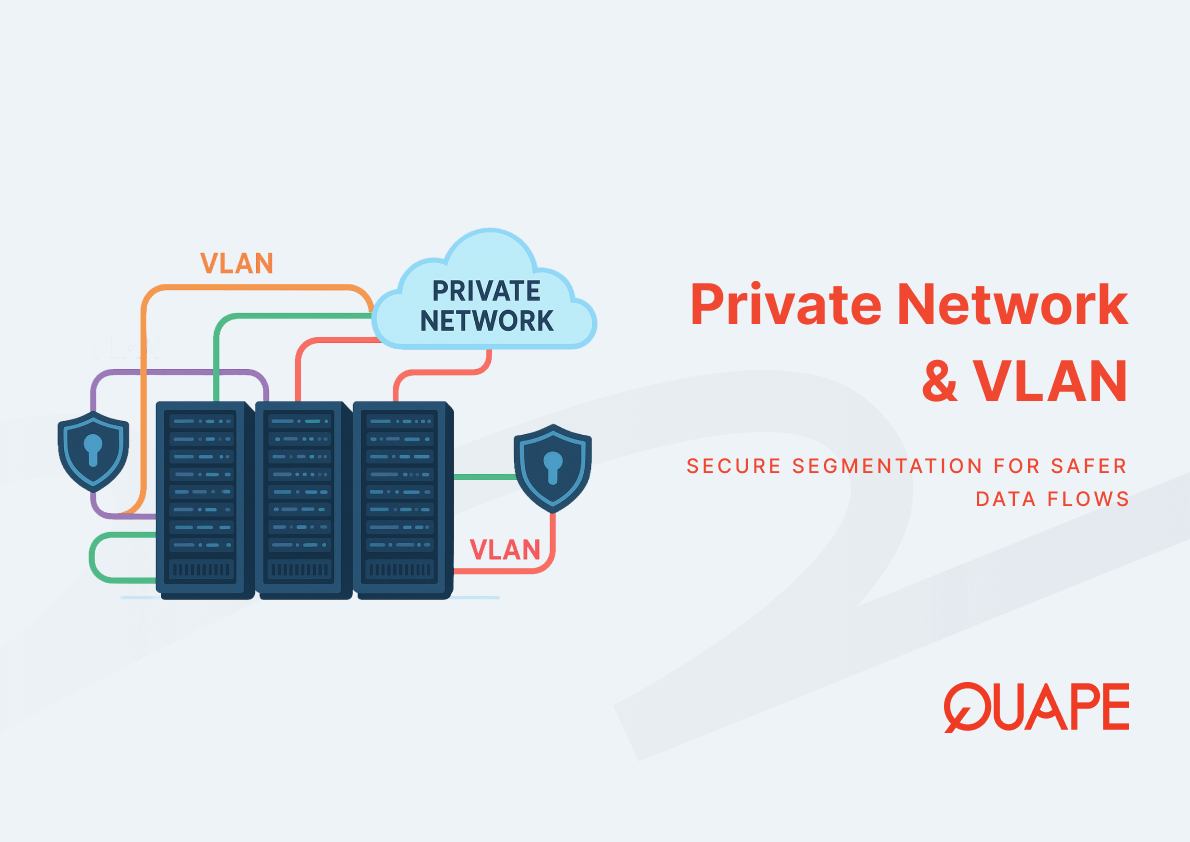
Private network infrastructure and VLAN segmentation give dedicated server deployments the control, isolation, and compliance capabilities that multi-tenant environments cannot reliably provide. For organizations operating in Singapore’s constrained, highly regulated data center market, these technologies directly address data sovereignty requirements under PDPA, operational resilience standards enforced by MAS TRM, and the technical demands of hybrid cloud architectures. With 88% of cloud buyers now deploying hybrid infrastructure, the ability to route traffic securely between on-premises dedicated servers, colocation facilities, and public cloud VPCs has become essential. Private networks built on VLAN tagging, MPLS routing, and encrypted IPsec tunnels enable enterprises to maintain compliance, reduce attack surface, and scale workloads without exposing sensitive traffic to the public internet. This article explains how these components work together and why they matter for IT managers and CTOs managing infrastructure in Singapore.
A dedicated server private network is a logically or physically isolated network environment that connects dedicated servers, storage systems, and external resources without using the public internet. Unlike shared hosting or multi-tenant cloud environments where network boundaries depend on virtualization software, dedicated server private networks often combine hardware-level isolation, VLAN tagging defined by IEEE 802.1Q standards, and provider-managed routing technologies like MPLS to create segmented traffic paths. These networks support workload isolation, regulatory compliance, and secure interconnection between data centers, colocation facilities, and cloud platforms. Organizations deploy private networks to control routing policies, enforce encryption at the network layer, and reduce the risk of lateral movement in the event of a security incident.
Key Takeaways
- VLAN segmentation uses IEEE 802.1Q tagging to create logical Layer-2 boundaries on shared physical switches, enabling workload isolation and traffic classification without dedicated hardware per segment.
- MPLS and BGP-based VPNs (RFC 4364) provide carrier-managed routing isolation across geographically distributed sites, offering predictable SLAs but requiring longer provisioning times compared to internet-based overlays.
- Hybrid cloud architectures increasingly combine private interconnects, VPC peering, and IPsec VPN tunnels to secure traffic between on-premises dedicated servers and public cloud environments while meeting compliance requirements.
- Zero Trust frameworks (NIST SP 800-207) are shifting security focus from perimeter-based segmentation to resource-level authentication and continuous authorization, though VLANs and private links remain operationally valuable for compliance and traffic engineering.
- Singapore’s low data center vacancy (approximately 1% per CBRE) and regulatory frameworks like PDPA and MAS TRM increase reliance on efficient private interconnects, carrier-neutral colocation, and VLAN-based segmentation to satisfy data sovereignty and resilience obligations.
Key Components and Concepts of Dedicated Server Private Networking
Private networking for dedicated servers relies on several complementary technologies that together provide isolation, routing control, and secure interconnection. Understanding how these components interact helps organizations design architectures that balance operational flexibility, compliance requirements, and cost constraints.
VLAN Segmentation and Data Isolation
VLAN segmentation creates logical network boundaries by inserting a 4-byte tag into Ethernet frames, as defined by the IEEE 802.1Q standard. This tagging allows a single physical switch to carry traffic for multiple isolated broadcast domains, each identified by a VLAN ID ranging from 1 to 4094. When dedicated servers connect to VLAN-aware switches, administrators can assign specific network interfaces or subinterfaces to different VLANs, ensuring that traffic from one VLAN does not leak into another under normal operation. This mechanism supports workload isolation, simplifies access control list (ACL) enforcement, and reduces the scope of potential lateral movement if an attacker compromises a single host.
VLANs do not inherently provide encryption or protection against misconfigured switch ports, bridge domain mismatches, or malicious insiders with administrative access to switching infrastructure. Organizations often layer VLANs with firewall policies, intrusion detection systems, and host-based access controls to strengthen isolation. In multi-tenant data centers or environments where compliance requirements intersect with data protection strategies, VLAN boundaries also simplify auditing by grouping workloads according to sensitivity level or regulatory scope. The ability to scale VLAN deployments using techniques like QinQ (IEEE 802.1ad) allows providers to extend VLAN tagging across carrier backbones, supporting large enterprises that operate thousands of logical segments.
MPLS, vRack, and Virtual Private Cloud (VPC)
MPLS operates at a layer between traditional IP routing and physical transport, using labels rather than IP addresses to forward packets through a provider’s network. RFC 4364 describes how BGP and MPLS combine to deliver Layer-3 VPNs that isolate customer routing tables, preventing one tenant’s traffic from appearing in another tenant’s forwarding path. This architecture enables service providers to offer managed WAN connectivity with guaranteed bandwidth, low jitter, and SLA-backed latency targets, which remain important for applications like real-time financial trading, voice over IP, and database replication between geographically distributed data centers.
MPLS VPNs trade provisioning speed and cost efficiency for routing predictability and carrier-managed isolation. Enterprises often deploy MPLS for critical links while using internet-based SD-WAN overlays or encrypted tunnels for cloud-centric flexibility. The security properties of MPLS VPNs depend on correct implementation and operational discipline, as noted in RFC 4381’s architectural analysis, which found that BGP/MPLS VPNs can provide isolation comparable to many legacy Layer-2 services when properly configured. Proprietary interconnect platforms like OVH’s vRack or similar private backbone services extend this concept by allowing customers to connect dedicated servers, storage, and public cloud instances (VPCs) through provider-managed private links, bypassing the public internet entirely and reducing exposure to DDoS attacks or man-in-the-middle risks.
Hybrid Cloud Connectivity and Inter-Data Center Routing
Hybrid cloud architectures require secure, reliable connectivity between on-premises dedicated servers and public cloud VPCs. Organizations achieve this through a combination of private interconnects (such as AWS Direct Connect, Azure ExpressRoute, or Google Cloud Interconnect), carrier cross-connects, and encrypted IPsec VPN tunnels. IPsec remains a standards-based method for protecting IP traffic in transit, providing both confidentiality through encryption and endpoint authentication through pre-shared keys or certificate-based identity verification. NIST SP 800-77r1 provides operational guidance for IPsec VPN deployment, emphasizing the importance of selecting strong cipher suites, managing key lifecycles, and monitoring tunnel health.
When enterprises deploy dedicated servers in colocation facilities, they frequently use BGP to exchange routing information between their on-premises networks and cloud VPCs, enabling dynamic failover and load balancing across multiple paths. This approach supports compliance routing scenarios where certain workloads must remain within specific jurisdictions or follow designated network paths to satisfy data sovereignty requirements. In Singapore’s capacity-constrained market, where CBRE reports approximately 7.2 MW of available data center capacity and near-record low vacancy, the ability to efficiently connect colocated dedicated servers to cloud regions through private links reduces latency and helps meet performance and network latency expectations for latency-sensitive applications. IDC’s Q3 2024 Cloud Pulse survey found that 88% of cloud buyers are deploying or operating hybrid cloud, driving demand for interconnection platforms, private networking, and secure routing between data centers and cloud providers.
Private Network Security Models: Zero Trust and Compliance Routing
Zero Trust represents a shift in security architecture from perimeter-based defenses to resource-centric policies that enforce continuous authentication and authorization. NIST SP 800-207 defines Zero Trust as an approach that assumes no implicit trust based on network location, requiring verification of identity, device posture, and contextual factors before granting access to any resource. In this model, VLANs and private links still serve operational purposes by simplifying traffic engineering, reducing attack surface, and supporting compliance obligations, but they no longer function as the primary security boundary.
Organizations implementing Zero Trust alongside VLAN segmentation typically deploy identity-aware proxies, micro-segmentation tools, and policy enforcement points that validate access requests at the application or workload level. This layered approach addresses scenarios where network segmentation alone cannot prevent credential theft, misconfiguration, or insider threats. For enterprises subject to Singapore’s PDPA or MAS Technology Risk Management Guidelines, compliance routing and private networking become operationally important. MAS TRM requires financial institutions to conduct due diligence on outsourced and cloud services, manage technology risk, and ensure secure connectivity and resilience. Private VLANs, encrypted tunnels, and routing controls help organizations demonstrate that they have implemented technical safeguards to protect personal data and maintain business continuity. Combining firewall policies, IDS, and IPS with VLAN isolation and Zero Trust principles creates defense-in-depth architectures that satisfy both regulatory expectations and threat mitigation goals.
Practical Applications in Singapore Infrastructure
Singapore’s data center market faces unique constraints that influence private networking decisions. CBRE’s 2024 analysis shows the market operating at near-record low vacancy with limited spare capacity, driven by AI infrastructure demand and continued cloud expansion. At the same time, Reuters reports significant investment activity, including Keppel’s plans to more than double data center funds under management, reflecting strong commercial interest despite space limitations. These dynamics make carrier-neutral colocation, multi-homing, and efficient use of private interconnects strategically important for enterprises that need flexibility and resilience.
Organizations deploying dedicated servers in Singapore often prioritize facilities that offer direct access to multiple network carriers, cloud on-ramps, and private interconnect platforms. This carrier-neutral approach reduces dependency on any single provider and supports compliance routing scenarios where traffic must follow specific paths to meet data sovereignty or regulatory requirements. For financial institutions subject to MAS TRM, the ability to segment production workloads using VLANs, route sensitive traffic through dedicated MPLS links or encrypted VPNs, and maintain detailed logging and monitoring becomes essential for demonstrating technology risk controls during audits. PDPA obligations similarly push organizations toward architectures that minimize data exposure by keeping personal information on isolated network segments, encrypting traffic in transit, and controlling access at both the network and application layers.
The combination of high demand, limited capacity, and regulatory scrutiny also drives interest in hybrid architectures that distribute workloads across on-premises dedicated servers, colocation facilities, and public cloud regions. Private VLANs and interconnects enable enterprises to place latency-sensitive databases or compute workloads close to users in Singapore while using cloud resources in other regions for burst capacity, disaster recovery, or global distribution. This flexibility supports business continuity planning and helps organizations respond to changing market conditions without rebuilding entire network topologies.
How Dedicated Servers Enable Private Network and VLAN Segmentation
Dedicated servers provide the hardware-level control necessary to implement sophisticated private networking and VLAN segmentation strategies. Unlike virtualized cloud instances where the hypervisor and cloud provider control the underlying network configuration, dedicated servers grant direct access to physical network interface cards (NICs), BIOS settings, and operating system networking stacks. This control allows administrators to configure VLAN tagging at the NIC level, assign subinterfaces to different VLANs, and deploy routing or firewall software directly on the server without relying on external network appliances.
When dedicated servers connect to VLAN-aware switches in a colocation facility or managed hosting environment, each physical port can carry tagged traffic for multiple VLANs simultaneously. Administrators can dedicate one VLAN to public-facing web services, another to backend database replication, and a third to management interfaces, all using the same physical network connection. This approach reduces cabling complexity, simplifies capacity planning, and supports incremental scaling as workloads grow. The presence of 10 Gbps or faster NICs on modern dedicated server platforms ensures that VLAN segmentation does not introduce bottlenecks, even when multiple high-throughput applications share the same physical interface.
Hardware isolation also improves security posture by eliminating the shared-kernel risks present in some virtualized environments. Dedicated servers running VLAN-segmented workloads can enforce strict access controls at the operating system level, deploy host-based intrusion detection, and maintain separate cryptographic keys or certificates for different network segments without depending on hypervisor trust boundaries. This level of control appeals to organizations with stringent compliance requirements or those operating in regulated industries where auditability and data lineage matter. The ability to customize network drivers, enable jumbo frames for storage replication traffic, or implement source-based routing policies gives infrastructure teams the flexibility to optimize performance and meet specific service-level objectives that generic cloud instances cannot easily accommodate.
Conclusion
Private network infrastructure and VLAN segmentation transform dedicated servers into compliance-ready, performance-optimized platforms capable of supporting hybrid cloud architectures, regulatory obligations, and zero-trust security models. For organizations operating in Singapore’s capacity-constrained, highly regulated market, these technologies provide the routing control, data isolation, and interconnection flexibility needed to meet PDPA and MAS TRM requirements while maintaining operational resilience. As hybrid cloud adoption continues to grow and security frameworks shift toward resource-centric access policies, the combination of hardware-level control, standards-based VLAN tagging, and encrypted interconnects positions dedicated server deployments as strategic infrastructure for enterprises that cannot compromise on performance, compliance, or customization.
For customized private network architecture or VLAN segmentation planning, contact our team at https://www.quape.com/contact-us/.
Frequently Asked Questions
What is the difference between VLANs and physical network segmentation?
VLANs use IEEE 802.1Q tagging to create logical Layer-2 boundaries on shared physical switching infrastructure, allowing multiple isolated broadcast domains to coexist on the same hardware. Physical segmentation uses dedicated switches, cables, and network paths for each segment, providing stronger isolation but at significantly higher cost and complexity. Most enterprises combine both approaches, using physical separation for high-security boundaries and VLANs for operational workload isolation.
How does MPLS improve dedicated server connectivity compared to internet-based VPNs?
MPLS provides carrier-managed routing isolation and predictable SLAs by using label-based forwarding instead of best-effort internet routing. This approach delivers lower jitter, guaranteed bandwidth, and reduced packet loss for latency-sensitive applications like database replication or real-time financial systems. Internet-based VPNs offer faster provisioning, lower cost, and better cloud integration, making them suitable for less critical links or hybrid architectures that combine both technologies.
Can VLAN segmentation satisfy PDPA and MAS TRM compliance requirements on its own?
VLAN segmentation helps organizations demonstrate technical controls for data isolation and traffic classification, but compliance frameworks like PDPA and MAS TRM require layered defenses. Organizations must combine VLANs with encryption, access controls, logging, monitoring, and operational procedures to meet due diligence and technology risk management obligations. VLANs form one component of a broader compliance architecture, not a complete solution.
What role does IPsec play in hybrid cloud architectures using dedicated servers?
IPsec provides standards-based encryption and endpoint authentication for traffic moving between on-premises dedicated servers and cloud VPCs, protecting data in transit and preventing man-in-the-middle attacks. NIST SP 800-77r1 recommends IPsec VPNs for securing inter-data center connections and hybrid cloud links where dedicated carrier circuits are not used or where additional encryption layers are required for compliance.
Why does Singapore’s data center capacity constraint affect private network design?
Limited data center capacity and low vacancy (approximately 1% per CBRE) increase competition for rack space, cross-connects, and network services. Organizations respond by prioritizing carrier-neutral facilities, efficient multi-homing, and private interconnects that maximize flexibility without requiring physical expansion. This constraint makes VLAN segmentation and virtualized network overlays strategically valuable because they enable dense, multi-tenant deployments without dedicated physical infrastructure per workload.
How does Zero Trust architecture interact with traditional VLAN-based segmentation?
Zero Trust shifts the security focus from network boundaries to resource-level policies that verify identity, device posture, and context before granting access. VLANs remain useful for traffic engineering, compliance routing, and operational simplicity, but they no longer serve as the primary security perimeter. Organizations implementing Zero Trust typically deploy identity-aware proxies and micro-segmentation alongside VLANs to enforce granular access controls that work independently of network location.
What is the difference between vRack and standard VLAN configurations?
vRack and similar proprietary interconnect platforms extend VLAN concepts by providing provider-managed private backbones that connect dedicated servers, storage, and public cloud instances across multiple data centers without using the public internet. Standard VLAN configurations operate within a single Layer-2 domain or require manual coordination to extend VLANs across sites using techniques like QinQ or MPLS. vRack simplifies hybrid cloud deployment by abstracting the underlying connectivity and routing complexity.
Can dedicated servers support multiple VLANs on a single physical network interface?
Yes, dedicated servers with VLAN-aware NICs and operating systems can trunk multiple VLANs over a single physical port using IEEE 802.1Q tagging. Administrators configure subinterfaces (such as eth0.100, eth0.200) that correspond to different VLAN IDs, allowing the server to participate in multiple isolated networks simultaneously. This capability reduces cabling requirements, simplifies capacity planning, and supports incremental scaling as workload complexity increases.