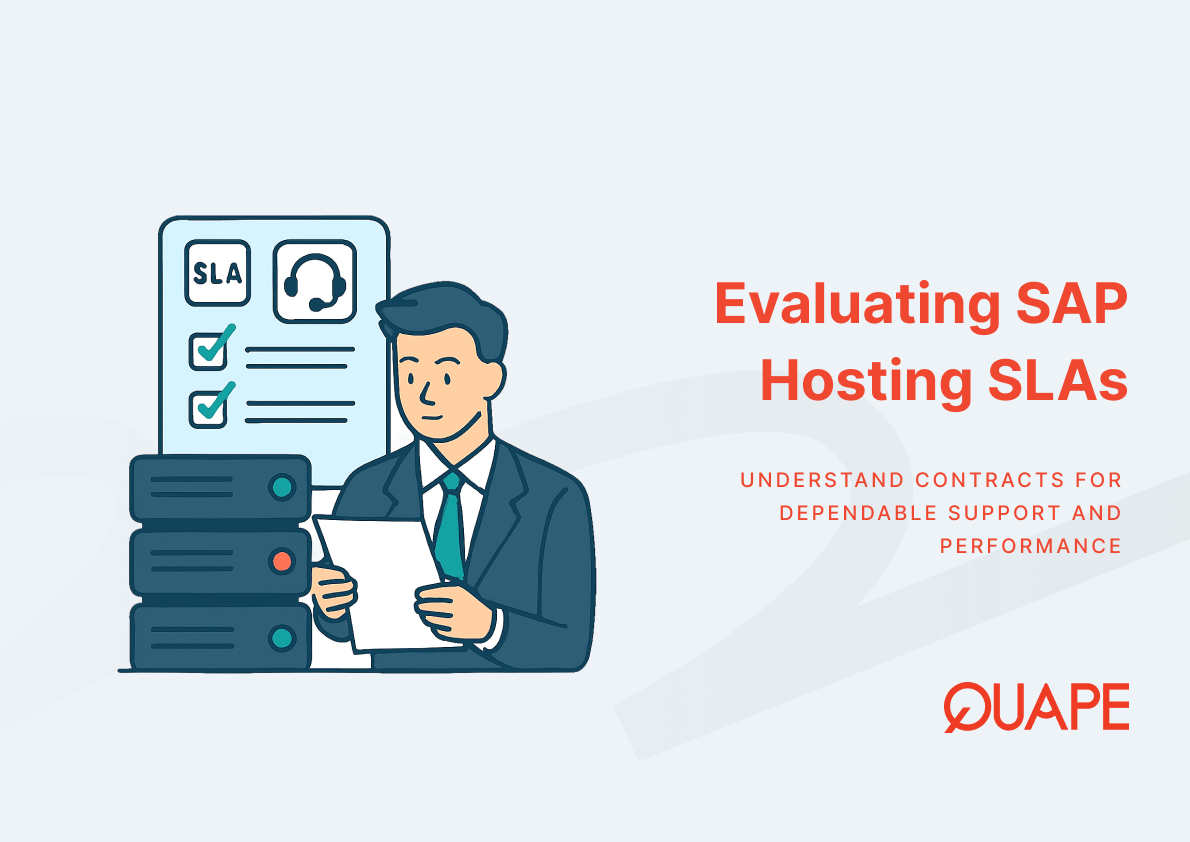
When your business runs SAP as its core ERP system, the hosting contract behind it is not a formality. It is a binding commitment that defines how quickly your provider responds when something goes wrong, how much downtime you can legally be held to, and what recourse you have when service falls short. For IT managers and CTOs in Singapore, evaluating these agreements with precision is not optional, it is a risk management responsibility. A poorly structured SLA can expose your organisation to hours of unplanned downtime, unclear escalation paths, and financial loss that far exceeds any cost savings from a cheaper hosting plan. This guide walks through the critical components of SAP hosting SLAs so you can assess contracts with confidence and negotiate from a position of clarity.
A Service Level Agreement is a formal contract between a hosting provider and a customer that defines performance expectations across availability, support responsiveness, and incident resolution. In the context of SAP hosting, the SLA governs one of the most operationally sensitive layers of your business infrastructure. SAP systems like SAP Business One HANA process real-time transactions, consolidate financial data, and coordinate supply chain workflows. Any disruption to availability or performance directly affects business continuity.
Evaluating an SAP hosting SLA means more than checking an uptime percentage. It means understanding how your provider defines downtime, what severity tiers govern support responses, and where accountability ends on their side and begins on yours. As part of a broader SAP hosting infrastructure strategy, SLA evaluation is the layer that converts provider promises into enforceable outcomes.
Key Takeaways
- Uptime percentages express reliability in “nines,” and the difference between 99.9% and 99.99% represents hours of allowable downtime per year.
- Response SLAs and resolution SLAs serve different purposes and must both be defined to avoid accountability gaps.
- Escalation paths determine whether a critical incident reaches the right engineer quickly or stalls at a helpdesk queue.
- Support scope boundaries define what your provider is responsible for versus what your internal team must handle.
- SLA penalties and credits are only valuable if the trigger conditions are clearly defined and enforceable.
- Disaster recovery commitments require explicit RTO and RPO values, not general statements about backup availability.
- Common SLA gaps include exclusions for planned maintenance, shared responsibility ambiguity, and undefined third-party dependencies.
- Singapore IT decision-makers should review SLAs against both operational risk tolerance and applicable data protection obligations.
Why SLAs Matter for SAP Workloads in Singapore
SAP systems are not general-purpose applications. They carry financial records, inventory data, procurement workflows, and HR systems that the rest of the business depends on in real time. When SAP goes down, so does the ability to issue invoices, process purchase orders, or run payroll. This is what makes availability commitments in SAP hosting agreements materially different from those in standard web hosting contracts.
According to IT downtime cost research, over 90% of mid-size and large enterprises report that a single hour of IT downtime costs more than $300,000 in lost productivity and revenue. For large enterprises, 41% say that figure exceeds $1 million per hour. These numbers reframe SLA evaluation from a procurement exercise into a financial risk decision. Singapore enterprises operating in regulated industries, including financial services, healthcare, and logistics, carry additional obligations around system availability that connect directly to how hosting SLAs are written.
The benefits of managed SAP hosting in Singapore extend beyond cost efficiency. They include access to contractually committed availability targets and support structures that internal IT teams cannot always replicate. For procurement leads and CTOs, the SLA is the legal instrument that converts those benefits into accountable service standards.
Key Components of SAP Hosting SLAs
Availability Guarantees and Uptime Definitions
Uptime is expressed as a percentage of total time, and the practical implications of each percentage tier are significant. A 99.9% uptime commitment allows approximately 8.76 hours of downtime per year, while 99.99% reduces that to roughly 52 minutes. For a mission-critical SAP environment, the difference between these two tiers can represent the difference between an inconvenient maintenance window and a business-disrupting failure.
What matters beyond the percentage is how downtime is defined. Some providers exclude planned maintenance windows from their availability calculations, which means scheduled updates and infrastructure work do not count against their SLA commitment. Others calculate availability at the network layer rather than the application layer, which can mask SAP-specific performance issues that do not constitute a full outage. When reviewing SAP high availability configurations, availability guarantees must be evaluated alongside the technical architecture that supports them, including redundant storage, failover clustering, and load distribution.
Response SLAs vs Resolution SLAs
Response time and resolution time are distinct commitments that serve different functions. Response time defines the maximum period within which your provider must acknowledge a reported incident. Resolution time defines how long they are permitted to take before the issue is fixed. Conflating these two metrics is one of the most common sources of contract dissatisfaction in managed hosting relationships.
An SLA that commits to a one-hour response for critical incidents but places no enforceable ceiling on resolution time offers limited protection. Businesses can wait days for resolution while technically remaining within contract terms. Effective SAP infrastructure support agreements define both dimensions explicitly, align them with incident severity classifications, and attach escalation triggers to resolution delays.
Severity levels typically range from critical (system down, no workaround) to low (cosmetic issues, no operational impact). Each tier should carry its own response and resolution commitment, with stricter targets at higher severities.
Escalation Paths and Support Accountability
An escalation path defines what happens when a standard support response fails to resolve an issue within the expected timeframe. Without a documented escalation structure, critical incidents can remain stuck at the first support tier while business operations continue to suffer.
Effective escalation governance includes tiered support levels, named escalation contacts at each level, and time-based triggers that automatically elevate an incident if it remains unresolved. Named account management adds a layer of relational accountability that generic ticket systems cannot replicate. When a dedicated account manager is part of the service model, they function as an internal advocate who understands your SAP environment and can accelerate resolution by bridging communication between your team and technical staff.
Evaluating Support Scope in SAP Hosting Contracts
Support scope defines the boundary between what your hosting provider is responsible for and what remains with your internal team. In SAP hosting contracts, this boundary typically runs through three layers: infrastructure, operating system and database, and SAP Basis.
Infrastructure responsibility usually falls clearly on the provider. This includes hardware availability, network connectivity, power continuity, and physical security at the data centre level. OS and database responsibilities depend on the contract model. In a fully managed engagement, the provider handles patching, updates, and performance tuning at the OS and database layer. In a partially managed model, these responsibilities may be shared or delegated back to the customer.
SAP Basis support is where scope ambiguity creates the most risk. Basis administration covers system startup, user management, transport management, and performance monitoring at the SAP layer. Some providers include Basis support explicitly; others treat it as an add-on or exclude it entirely. Before signing any SAP infrastructure support contract, document exactly which Basis functions the provider covers and which require your internal team or a separate SAP partner.
SLA Alignment with Security, Compliance, and Risk
Security incidents have their own SLA requirements that sit alongside availability and support commitments. A security-focused SAP hosting environment should define the maximum time within which a detected security event must be investigated, contained, and reported. Vague language such as “we take security seriously” is not a contractual commitment.
Data protection obligations in Singapore are governed by the Personal Data Protection Act (PDPA), which imposes specific requirements around data handling, breach notification, and cross-border transfers. If your SAP environment processes personal data, the hosting contract must align with these obligations. SAP hosting compliance frameworks should reflect applicable regulatory standards and define the provider’s responsibilities in audit support, compliance reporting, and evidence collection.
Shared responsibility models must clarify which party is accountable for security controls at each layer. Encryption at rest and in transit, intrusion detection, access control, and vulnerability management should each have a named responsible party in the contract. Gaps in this mapping create risk exposure that neither party intends but both parties end up bearing.
Disaster Recovery and SLA Enforcement
Recovery Time Objective (RTO) and Recovery Point Objective (RPO) are the two metrics that define your disaster recovery commitment. RTO specifies the maximum time to restore service after a failure. RPO defines the maximum acceptable data loss, expressed as a time interval, meaning how far back your data may roll in a worst-case recovery scenario.
A managed SAP disaster recovery commitment without explicit RTO and RPO values is not a commitment at all. Providers that offer “daily backups” without specifying recovery timelines create ambiguity that becomes a liability during an actual incident. Ensure that RTO and RPO values are expressed in hours, not vague assurances, and that they are tied to the same severity classification framework that governs your incident response SLAs.
SLA penalties and service credits are the enforcement mechanism that gives availability commitments teeth. Credit structures typically offer a percentage of monthly fees back when uptime falls below the guaranteed threshold. However, many credit structures are designed so that thresholds are difficult to breach and credits are small relative to actual business impact. Review the penalty structure carefully: understand the measurement period, the credit calculation formula, and any conditions that must be met to claim a credit.
Common SLA Gaps to Watch for in SAP Hosting Agreements
Planned maintenance exclusions are one of the most frequently overlooked SLA gaps. If a provider can schedule maintenance during business hours without penalty, their effective uptime commitment may be substantially lower than the headline figure suggests.
Shared responsibility ambiguity creates disputes after incidents occur. When the contract does not clearly define which party owns each layer of the stack, both parties can reasonably argue that the other was responsible. This ambiguity is especially problematic in environments where SAP performance depends on a combination of hosting infrastructure, network configuration, and application tuning.
Hidden operational dependencies can affect availability without triggering the provider’s SLA obligations. If your SAP system depends on a third-party monitoring tool, an external DNS service, or a network carrier not directly managed by your hosting provider, failures in those components may be excluded from availability calculations. Review the dependency map and confirm that all components critical to SAP operations are covered under the SLA or independently protected.
Force majeure clauses are standard in hosting contracts but should be narrow in scope. An overly broad force majeure provision can allow providers to excuse availability failures that result from reasonably foreseeable events, including infrastructure failures that proper redundancy planning should have prevented.
Practical SLA Evaluation Checklist for Singapore IT Decision-Makers
Before signing or renewing an SAP hosting contract, work through the following evaluation points.
Confirm that uptime is defined at the SAP application layer, not only at the network or infrastructure layer. Verify that planned maintenance is either excluded from downtime calculations in a transparent way or counted toward the uptime commitment. Ensure that response and resolution SLAs are documented separately for each incident severity tier.
Review the escalation matrix and confirm that named contacts exist at each escalation level. Validate that SAP Basis responsibilities are explicitly assigned rather than implied. Check that RTO and RPO values are documented in hours and linked to a tested recovery process.
Assess the security incident response SLA alongside the availability SLA. Confirm that compliance reporting obligations are included in the contract scope. Review credit trigger conditions and ensure that the measurement methodology is auditable. For SAP on-premises versus hosted infrastructure comparisons, SLA coverage is one of the primary differentiators that justifies the managed model.
How Managed SAP Hosting Strengthens SLA Reliability
Managed SAP Hosting shifts operational accountability from your internal team to a provider whose commercial model depends on meeting the commitments they have signed. This structural alignment between provider incentives and customer outcomes is what differentiates managed hosting from infrastructure-only arrangements.
Proactive monitoring is the operational foundation that makes availability commitments enforceable. When a provider monitors SAP system health continuously, including memory utilisation, I/O performance, and process availability, they can identify and address degradation before it becomes an outage. This moves SLA compliance from a reactive measure to a preventive practice.
Dedicated support ownership, including a named account manager and certified SAP professionals, reduces the time between incident detection and resolution by eliminating the handoff delays common in generic support queues. QUAPE’s Managed SAP Hosting includes 24/7 monitoring, daily backups, VPN-secured access, and a dedicated account manager, offering the structural accountability that SLA evaluation frameworks are designed to assess.
Conclusion and Next Steps for SAP SLA Due Diligence
An SAP hosting SLA is not a document to sign and file. It is the operational contract that governs your most business-critical system, and evaluating it with precision protects your organisation from financial exposure, compliance risk, and operational disruption. The most effective SLAs are those that define availability at the application layer, separate response from resolution commitments, assign clear ownership across the infrastructure and support stack, and include enforceable recovery objectives. Singapore IT decision-makers who approach SLA evaluation systematically are better positioned to hold providers accountable and sustain long-term SAP operational stability.
If you are currently reviewing a hosting contract or preparing to evaluate SAP hosting providers, our team can help you assess coverage gaps and align your requirements with the right service model. Contact our sales team to discuss your SAP hosting requirements.
Frequently Asked Questions
What is the difference between a response SLA and a resolution SLA in SAP hosting?
A response SLA defines how quickly your provider must acknowledge a reported incident, while a resolution SLA sets the maximum time to fix it. Both must be defined separately in your contract, as a strong response SLA without a resolution ceiling offers limited practical protection during critical SAP outages.
What uptime percentage should I require for a production SAP environment?
For mission-critical SAP workloads, a minimum of 99.9% uptime is a common baseline, but 99.99% is preferable because it limits allowable annual downtime to under one hour. More important than the percentage itself is how uptime is measured and whether planned maintenance is included in the calculation.
How do I know if SAP Basis support is included in my hosting contract?
Look for explicit language in the support scope section that lists Basis-level tasks such as system startup procedures, transport management, user administration, and performance tuning. If the contract only references infrastructure or OS support without mentioning SAP Basis, you should assume it is excluded and clarify this before signing.
What are RTO and RPO and why do they matter in SAP hosting SLAs?
Recovery Time Objective defines the maximum acceptable time to restore your SAP system after a failure, while Recovery Point Objective defines how much data loss is acceptable in hours. Both must be expressed as specific values tied to your business requirements, not general statements about backup availability.
How should security incidents be covered in an SAP hosting SLA?
Your SLA should define a maximum time for the provider to detect, investigate, contain, and notify you of a security event. It should also specify which security controls the provider is responsible for, including encryption, intrusion detection, and access management, so that accountability is clear before an incident occurs.
What are service credits and when should they apply?
Service credits are partial refunds, typically calculated as a percentage of monthly fees, issued when a provider fails to meet their availability commitment. Credits should apply automatically when uptime falls below the guaranteed threshold during any measurement period, and the trigger conditions and credit calculation method should be clearly documented in the contract.
Can a provider exclude planned maintenance from their uptime SLA?
Yes, and many do. This is a common clause that can significantly reduce the effective availability commitment. Evaluate whether planned maintenance windows are capped in duration, scheduled outside business hours, and communicated with adequate notice, and consider whether these windows should count toward your uptime measurement.
What does shared responsibility mean in an SAP hosting contract?
Shared responsibility means that the hosting provider and the customer each own defined portions of the infrastructure and application stack. In SAP hosting, this typically means the provider manages physical infrastructure and OS, while the customer manages application configuration and user management. Any layer not explicitly assigned in the contract creates an accountability gap that can delay incident resolution.