E-Commerce
Connecting E-Commerce Stores with Instagram, TikTok & Social Channels
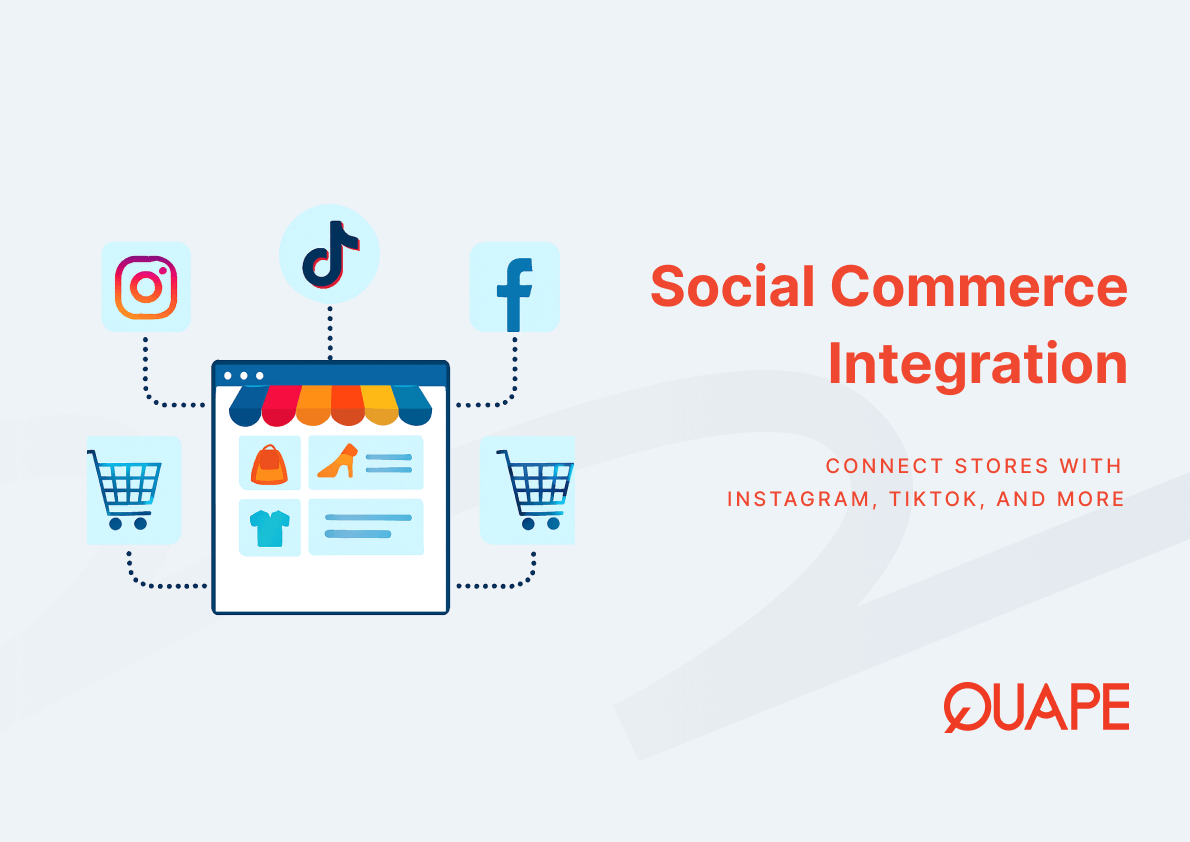
Social commerce integrates product discovery, engagement, and purchasing directly into platforms like Instagram and TikTok, transforming how consumers interact with brands. For Singapore businesses, this shift represents both an opportunity and a technical challenge: connecting backend commerce systems to social endpoints requires API orchestration, attribution tracking, and infrastructure that supports real-time catalog synchronization. As social commerce now represents 18.5% of global ecommerce sales, the ability to operationalize this channel determines competitive positioning. This article examines how e-commerce social integration works, what components enable it, and how purpose-built architecture supports scalable deployment.
E-commerce social integration is the technical and operational framework that connects an online store’s product catalog, inventory, and checkout systems to social media platforms like Instagram, TikTok, and Facebook. This integration enables native product tagging, shoppable posts, and in-app purchasing, embedding commerce experiences directly into the social attention graph where consumers already spend time.
Key Takeaways
- Social commerce channels account for nearly one-fifth of global ecommerce sales, making integration a core growth lever rather than an optional experiment.
- API integrations synchronize product catalogs, inventory states, and order data between backend commerce systems and social platform endpoints in real time.
- Attribution tracking captures multi-touch conversion paths across social feeds, product views, and purchases, requiring server-side and client-side signal blending.
- Influencer-driven funnel flows leverage parasocial relationships and credibility to elevate purchase intent, particularly among mobile-first demographics.
- Checkout continuity from social traffic reduces conversion friction by maintaining cart state and session data when users transition from social apps to commerce environments.
- Singapore’s mobile-first buyer behavior and cross-border payment complexity require infrastructure that supports low-latency API responses and regional compliance.
- Custom API integrations and performance-optimized architecture determine whether social commerce scales sustainably or introduces operational bottlenecks.
Key Components of E-Commerce Social Integration
Social Platform APIs and Commerce Endpoints
Social platform APIs connect commerce backends to Instagram, TikTok, and Facebook storefronts by exposing endpoints that handle product catalog synchronization, order ingestion, and inventory updates. The Instagram Graph API enables product tagging in posts and stories, while TikTok for Business API supports catalog uploads and in-feed shopping features. These APIs translate between the data structures used by commerce platforms like Shopify and WooCommerce and the product feed formats required by social networks. When a product catalog changes (new SKU, price update, stock depletion), API integrations propagate those changes to social endpoints, ensuring that shoppable content reflects current availability. This synchronization depends on webhook listeners, API rate limit management, and retry logic that prevents data drift between systems.
Order and inventory sync operates bidirectionally. When a customer completes a purchase through Instagram Shop, the platform sends order data back to the commerce backend via API callback, triggering fulfillment workflows and inventory deductions. This closed-loop integration maintains consistency across sales channels, preventing overselling and ensuring that inventory displayed on social platforms matches backend stock levels. For businesses managing multiple sales channels, API orchestration layers coordinate these data flows, routing order events to the appropriate fulfillment systems and updating inventory across all connected endpoints simultaneously.
Attribution Tracking Across Social Touchpoints
Attribution tracking quantifies how social interactions contribute to conversions by mapping touchpoints along the customer journey, from initial feed exposure through product view and eventual purchase. Social commerce journeys often span multiple sessions: a user discovers a product through an influencer post, revisits the brand profile later, then completes checkout in-app or on the brand’s website. Capturing this multi-touch path requires combining UTM parameters, conversion tracking pixels, and server-side tracking that logs events regardless of browser restrictions. Server-side tracking sends conversion data directly from the commerce backend to advertising platforms, bypassing client-side limitations introduced by cookie restrictions and ad blockers.
Multi-touch attribution models assign fractional credit to each touchpoint based on its influence on the final conversion. For example, a first-touch model credits the initial Instagram post, while a linear model distributes credit equally across all interactions. E-commerce analytics and A/B testing infrastructure provides the data layer that stores these event sequences, enabling analysis of which social channels and influencer campaigns generate the highest conversion lift. Attribution accuracy matters because it determines budget allocation: if tracking underreports social conversions, businesses underinvest in a channel that actually drives revenue.
Influencer-Driven Funnel Flow Architecture
Influencer marketing leverages parasocial interactions (the perceived personal connections consumers form with creators) to drive purchase intent. Research shows that influencer credibility and message quality significantly influence consumer purchase intentions, particularly among demographics that prioritize authenticity over traditional advertising. Funnel flow architecture for influencer campaigns routes traffic from creator posts to dedicated landing pages that maintain visual continuity and reinforce the creator’s messaging. These landing pages incorporate social proof elements (reviews, user-generated content) and product recommendations aligned with the influencer’s content theme.
Creator-led commerce extends beyond traffic routing to include custom storefronts, affiliate tracking, and commission structures embedded in the commerce platform. When an influencer shares a product link, the URL contains tracking parameters that attribute conversions to that creator, enabling performance-based compensation. This tracking feeds back into product page design decisions, informing which social proof elements and messaging frameworks convert social traffic most effectively. For high-volume influencer programs, API integrations automate affiliate link generation, commission calculation, and payout processing, reducing manual overhead while scaling creator partnerships.
Checkout and Payment Continuity from Social Traffic
Social checkout enables in-app purchasing without redirecting users to external websites, reducing conversion friction by keeping the transaction within the platform where attention is already focused. Instagram and TikTok support native checkout flows that store payment credentials and shipping information, allowing one-tap purchases. For brands that route social traffic to their own checkout pages, cart handoff maintains session state and product selections as users transition from social app to browser. This handoff uses deep linking and session tokens that preserve cart contents, preventing the abandonment that occurs when users must re-add items after clicking through.
Payment gateway integrations must support both in-app social checkout (where the platform processes payments) and external checkout (where the brand’s commerce system handles transactions). Payment gateways in Singapore need to process cross-border transactions, handle multiple currencies, and comply with regional fraud detection requirements. Conversion friction increases when payment methods familiar to social platform users are unavailable at checkout, making gateway selection a direct factor in checkout UX and cart abandonment rates. Infrastructure that pre-populates shipping addresses from social platform data further reduces friction, shortening the path from product interest to completed order.
Practical Application for the Singapore Market
Singapore’s mobile-first buyer behavior aligns well with social commerce adoption. On Instagram, 44% of active users engage with shopping features weekly, and this engagement rate is higher among Southeast Asian consumers who use social platforms as primary discovery channels. The Singapore ecommerce ecosystem includes both domestic brands and cross-border sellers targeting regional buyers, creating complexity around payment routing, currency conversion, and shipping logistics. Mobile commerce trends in Singapore show that conversion rates peak when checkout flows are optimized for smartphone screen sizes and touch interactions, reinforcing the importance of mobile-native design in social commerce integrations.
Data privacy compliance intersects with attribution tracking in Singapore’s regulatory environment. While the Personal Data Protection Act (PDPA) governs data collection and usage, businesses must balance regulatory requirements with the tracking infrastructure needed for accurate attribution. Server-side tracking reduces reliance on client-side cookies, helping maintain attribution accuracy while respecting user privacy preferences. Understanding Singapore buyer psychology also informs social commerce strategy: local consumers prioritize trust signals, peer reviews, and localized payment options, elements that must be integrated into both social storefronts and landing pages receiving social traffic.
How E-Commerce Web Design Supports E-Commerce Social Integration
Custom API integrations built into e-commerce web design determine how smoothly commerce backends connect to social platform endpoints. Pre-built themes and generic e-commerce templates often lack the API extensibility needed for real-time catalog sync, webhook processing, and bidirectional order flow. Custom development enables precise control over data mappings, error handling, and rate limit management, ensuring that social commerce features operate reliably at scale. Performance optimization matters because API response times directly affect how quickly product updates propagate to social platforms and how seamlessly checkout handoffs execute when users transition from social apps.
Scalable ecommerce architecture supports high-volume social traffic without degradation. When influencer campaigns drive sudden traffic spikes, infrastructure must handle concurrent API requests, session management, and database queries without latency increases that abandon conversions. This scalability requires database indexing strategies, caching layers, and load-balanced server configurations that distribute traffic across multiple compute instances. For businesses integrating multiple social platforms simultaneously, modular architecture allows independent scaling of each integration, preventing bottlenecks in one channel from affecting others.
Conclusion
Social commerce integration transforms Instagram, TikTok, and Facebook from awareness channels into full-funnel conversion environments. The technical foundation (API orchestration, attribution tracking, checkout continuity) determines whether social commerce scales sustainably or introduces operational friction. For Singapore businesses competing in mobile-first markets, infrastructure that supports real-time catalog synchronization, multi-touch attribution, and frictionless payment handoffs directly impacts revenue capture from social channels. Building this infrastructure requires development expertise that extends beyond template customization to include custom API work, performance optimization, and compliance-aware architecture.
Ready to integrate social commerce into your e-commerce infrastructure? Contact our sales team to discuss API integrations, attribution tracking, and scalable architecture that supports multi-platform commerce operations.
Frequently Asked Questions
What is the difference between social commerce and social media marketing?
Social commerce enables direct purchasing within social platforms through native checkout and shoppable posts, while social media marketing drives traffic to external websites. Social commerce reduces conversion friction by keeping the transaction in-app, shortening the path from discovery to purchase.
Which social platforms support native e-commerce integrations?
Instagram, TikTok, and Facebook offer native commerce features including product tagging, in-app checkout, and catalog management. Each platform provides APIs that sync product data, process orders, and track conversions, though implementation requirements and feature sets differ across platforms.
How does attribution tracking work when users switch between social apps and websites?
Attribution combines UTM parameters, conversion pixels, and server-side tracking to map touchpoints across sessions and devices. Server-side tracking logs events directly from your commerce backend, capturing conversions even when browser restrictions block client-side pixels, enabling more accurate multi-touch attribution.
What technical requirements are needed to integrate Instagram Shop with an existing e-commerce store?
Integration requires a product catalog feed in the format specified by Instagram, API credentials for the Instagram Graph API, webhook endpoints to receive order data, and inventory sync logic that updates stock levels bidirectionally. Most implementations also include conversion tracking pixels and catalog refresh automation.
How do payment gateways handle transactions that start on social platforms?
For in-app checkout, social platforms process payments directly and transfer funds to your account minus their fees. For external checkout, payment gateways on your website handle transactions, requiring cart handoff mechanisms that preserve product selections and session data when users transition from the social app.
Why is server-side tracking becoming more important for social commerce?
Browser privacy restrictions and ad blocker usage reduce the reliability of client-side tracking pixels. Server-side tracking sends conversion data directly from your backend to advertising platforms, bypassing browser limitations and providing more complete attribution data for social commerce campaigns.
Can social commerce integrations work with headless or custom-built e-commerce systems?
Yes, social platform APIs are platform-agnostic and work with any commerce backend that can generate product feeds and process API callbacks. Headless architectures often provide better flexibility for custom integrations, enabling precise control over data mappings and real-time synchronization logic.
What performance metrics should businesses track for social commerce channels?
Key metrics include social-attributed revenue, conversion rate by traffic source, cart abandonment rate for social visitors, average order value from social channels, and influencer campaign ROI. Multi-touch attribution models provide deeper insight into how social touchpoints influence overall conversion paths.