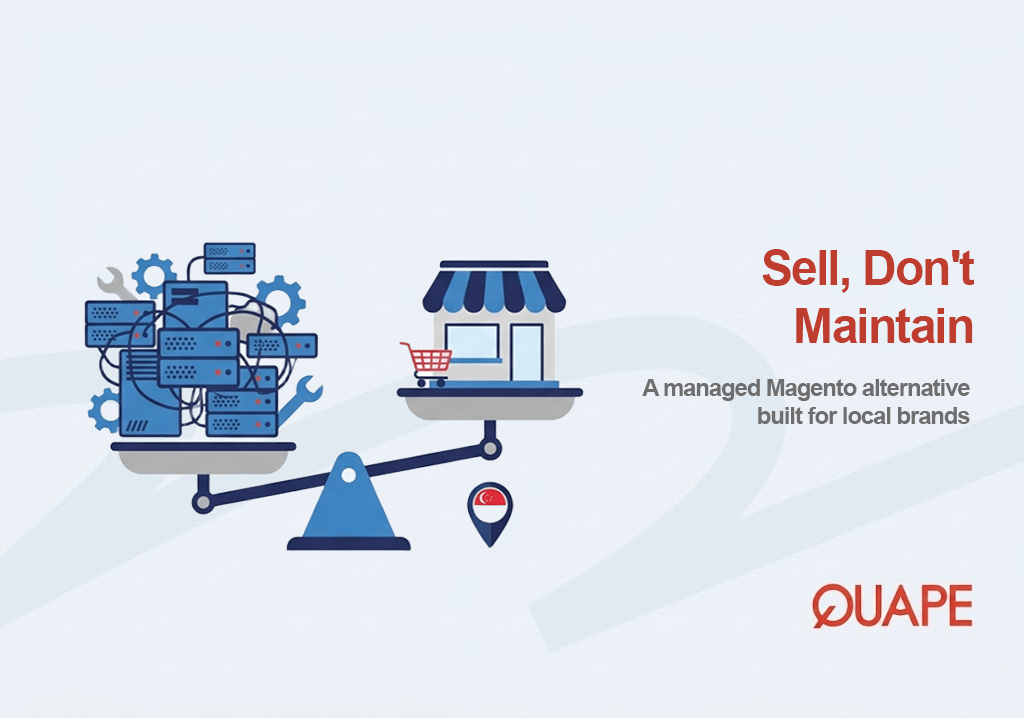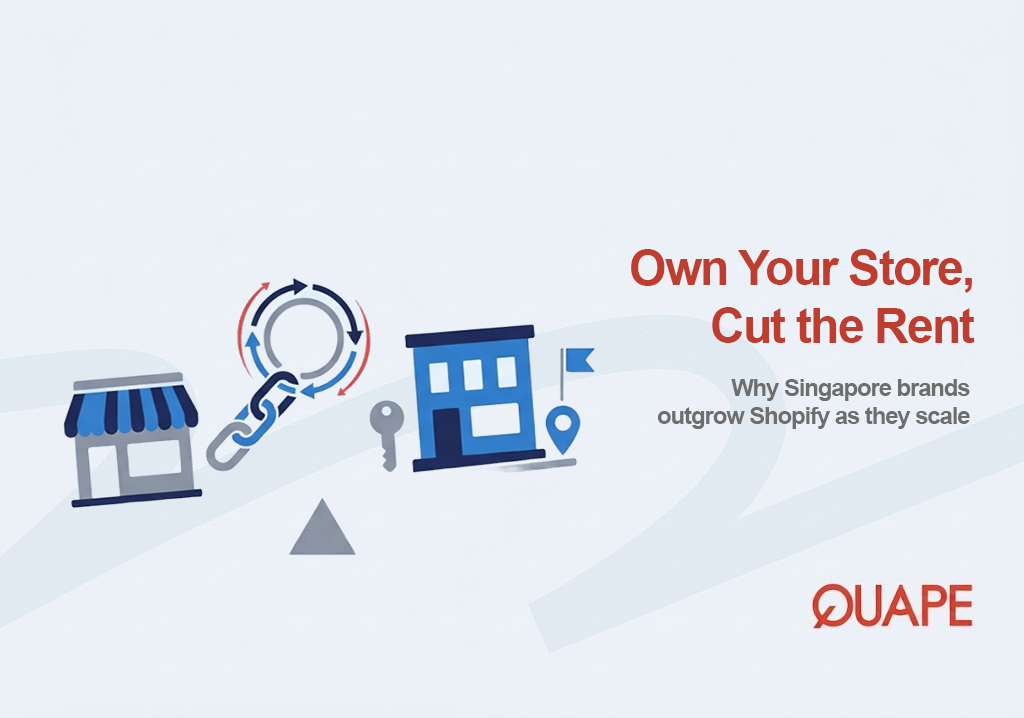
If you run an online store in Singapore and your monthly platform bill keeps climbing while your control over the storefront stays flat, this comparison is written for you. Shopify earned its reputation by making it fast and simple to launch a store, and for early-stage sellers that convenience is genuinely valuable. The problem arrives later, when recurring USD subscriptions, per-sale transaction surcharges, and a growing stack of paid apps start to scale with your revenue instead of your needs. For Singapore SMEs and Southeast Asian mid-market brands that have moved past the launch phase, a custom e-commerce website built once for a fixed SGD fee can shift the economics from renting a storefront to owning a business asset. The right choice depends on where your business sits today, and this article maps out exactly where each option wins.
Table of Contents
ToggleWhy Singapore Businesses Start Looking for a Shopify Alternative
Shopify solved a real problem for online sellers: it removed the technical barrier to opening a store. That value is highest at the start, when speed to market matters more than anything else. As a business grows, the calculation changes. The Southeast Asian e-commerce market reached US$157.6 billion in GMV in 2025, representing 22.8 percent year-over-year growth, and that expansion has pushed merchants to compete less on raw growth and more on margins, fulfilment, customer experience, and operational infrastructure. When the market matures, every dollar leaving your business as a recurring platform fee becomes a dollar you cannot reinvest into the parts of the operation that actually differentiate you. Qualimero
Singapore sits at the leading edge of this shift. As one of the region’s most digitally mature economies with high e-commerce penetration, its sellers feel platform economics earlier and more sharply than most. The businesses that begin searching for alternatives are rarely unhappy with how their store looks. They are reacting to a structural realisation: their storefront is a rented space, and the rent never stops.
The Point Where Convenience Stops Outweighing Cost
Every SaaS commerce platform converts website infrastructure into an operating expense. You pay continuously through the subscription, then again through transaction fees, then again through the third-party apps that fill the gaps the base platform leaves open. The difficulty is that these costs are tied to volume. Platform-based e-commerce in Southeast Asia reached US$128.4 billion in GMV in 2024, which shows the sheer scale at which percentage-based fees compound. A store doing well is also a store paying more, in absolute terms, every single month. At a low volume the convenience clearly justifies the cost. At a higher volume, the same fee structure quietly erodes the margin that growth was supposed to deliver. Commerce-UI
Why Ownership Matters More as an E-Commerce Business Scales
In the early days, few founders think about who owns the underlying commerce engine, because the priority is simply getting products in front of buyers. Maturity reframes the question. A custom-built website is intellectual property the business controls, with source code, data, and functionality that belong to the company rather than to a vendor. A hosted store, by contrast, depends on the platform continuing to exist, continuing to price reasonably, and continuing to permit the customisations the business relies on. The more a store scales, the more disruptive vendor lock-in becomes, because more revenue and more operational process are now resting on infrastructure the business does not own.
Key Takeaways
- Shopify is the stronger choice for early-stage sellers who need to launch fast without managing technical infrastructure.
- Shopify’s costs are recurring and volume-linked: subscriptions run from USD 39 a month on Basic to USD 2,300 a month or more on Plus, plus payment processing of roughly 2.4 to 2.9 percent plus 30 cents per transaction.
- Using any payment gateway other than Shopify Payments adds a further 0.2 to 2.0 percent surcharge per transaction.
- A custom e-commerce website from Quape is a one-time fixed SGD investment between SGD 4,800 and SGD 15,000, with no per-transaction levy taken by Quape and no forced payment processor.
- Custom development gives full freedom to integrate Stripe, PayPal, 2C2P, or any gateway with an API, alongside ERP, CRM, and inventory systems built around your workflow.
- Hosting on Singapore Tier 3 TIA-942 infrastructure supports local data residency, PDPA compliance accountability, and 24/7 managed DevOps support.
- The decision is fundamentally about ownership versus rental: convenience and speed on one side, control and long-term cost predictability on the other.
What Shopify Does Well for New and Fast-Moving Online Stores
It would be dishonest to position Shopify as a weak product. It is a mature, well-engineered platform, and for a large segment of sellers it remains the correct decision. Understanding where it genuinely excels is what makes the rest of this comparison credible.
Fast Deployment Without Technical Management
Shopify’s central strength is that it removes infrastructure from the seller’s plate entirely. Hosting, security patching, uptime, and platform updates are all handled by the platform, which means a non-technical founder can open a functioning store in days. For a business testing a product or validating demand, that managed model is exactly right, because it lets the team spend energy on products and marketing rather than servers.
A Mature Ecosystem of Themes and Extensions
Shopify supports a deep marketplace of themes and apps, which lets a store add functionality without writing code. Need a review widget, a subscription billing tool, or a shipping calculator? There is usually an app for it. This ecosystem is a real asset early on, because it turns complex features into a few clicks and a small monthly fee.
Why Many Startups Choose Shopify First
For most startups, time-to-market is the dominant constraint. Shopify wins on that axis decisively. When the goal is to launch a minimum viable store, reach customers quickly, and iterate, the platform’s speed and simplicity outweigh concerns about long-term ownership that have not yet become real. The friction described in the next section only emerges once the store succeeds.
Where Shopify Creates Long-Term Friction for Singapore Businesses
The same design choices that make Shopify excellent for launching become sources of friction as a Singapore business scales. None of these are flaws in the product. They are simply consequences of the rental model meeting a growing operation.
Monthly Subscription Costs That Continue Indefinitely
The subscription is the most visible cost and the easiest to underestimate. Plans run from USD 39 a month on Basic up to USD 2,300 a month or more on Plus. That fee continues for as long as the store exists, and it buys access rather than ownership. Over a three to five year horizon, the cumulative figure can dwarf the cost of building a website outright, yet at the end of that period the business still owns nothing.
Payment Processing and Transaction Surcharges That Grow With Revenue
Beyond the subscription sit the transaction costs, and this is where success becomes expensive. Shopify’s payment processing runs at roughly 2.4 to 2.9 percent plus 30 cents per online transaction. If a merchant chooses any payment gateway other than Shopify Payments, an additional surcharge of 0.2 to 2.0 percent applies per transaction. The structural issue is straightforward: the more a store sells, the larger the absolute dollar value flowing to the platform. Growth and platform cost rise together.
The Hidden Cost of Building Around Multiple Paid Apps
A base Shopify store rarely does everything a maturing business needs, so merchants add apps. Each app typically carries its own monthly fee, and a mid-market store can accumulate a meaningful stack. These costs are easy to overlook individually and significant in aggregate, and they represent functionality the business is renting rather than owning.
USD-Based Pricing and Currency Exposure for Singapore Companies
A factor rarely discussed in platform comparisons is currency. Shopify’s pricing is quoted in US dollars, while a Singapore business earns and reports in SGD. Movements in the SGD to USD exchange rate change the effective cost of the platform over time, independent of any pricing decision Shopify makes. This adds a layer of unpredictability to operating costs that a fixed SGD project fee simply does not carry.
Ownership vs Rental: The Fundamental Difference Between Shopify and Custom E-Commerce Development
Strip away the feature comparisons and one distinction remains underneath everything: a Shopify store is rented, and a custom-built store is owned. This is the lens that makes every cost and control decision easier to reason about.
What It Means to Rent a Storefront
Renting a storefront means the business pays continuously for access to infrastructure it does not control. The platform sets the pricing, the feature roadmap, the permitted customisations, and the terms of service. If any of those change, the business adapts or leaves, and leaving means rebuilding. Vendor dependence is the defining characteristic of the model, and it deepens as the store grows.
What It Means to Own an E-Commerce Asset
Owning an e-commerce asset means the website, its source code, and its custom functionality are the property of the business. The store becomes a genuine business asset that can be modified without permission, integrated freely, and carried forward regardless of any single vendor’s decisions. Ownership converts an ongoing liability into a controlled investment, which is precisely what a maturing operation needs.
Why Custom E-Commerce Web Design Becomes Attractive After the Growth Stage
Once a business has validated demand and built real transaction volume, the priorities that made Shopify attractive give way to new ones: margin preservation, integration flexibility, and ownership. This is the stage where commissioning a tailored store starts to make clear financial and operational sense.
Fixed Project Investment Instead of Perpetual Platform Fees
A custom build replaces an indefinite stream of platform fees with a single, predictable investment. Quape’s custom e-commerce projects run on a fixed SGD fee between SGD 4,800 and SGD 15,000 depending on complexity, with no per-transaction levy taken by Quape afterward. Comparing cumulative platform spend over several years against a one-time development cost often reframes the entire decision, because the rented model never stops charging while the owned model is paid once.
Freedom to Choose Any Payment Gateway
A custom store integrates payments directly, which means the business selects whichever gateway serves its customers and margins best. Quape’s approach to building a fully owned online store supports Stripe, PayPal, 2C2P, and effectively any provider that exposes an API, with no platform surcharge layered on top for the choice. The result is payment flexibility that a hosted model, with its incentive to keep merchants on its own processor, structurally cannot match.
Building Around Business Processes Instead of Platform Limitations
Hosted platforms standardise, which is efficient until a business needs something the platform was not built for. Custom development inverts this. Inventory and order management, custom API and complex system integrations, SEO-optimised product pages, and membership and loyalty systems with CRM integration are all built around the way the business actually operates, rather than forcing the business to operate around the platform’s constraints.
Comparing Shopify and Custom E-Commerce Web Design on the Factors That Matter Most
| Factor | Shopify (Hosted SaaS) | Custom E-Commerce (Quape) |
|---|---|---|
| Ownership | Rented access, vendor-controlled | Fully owned business asset |
| Cost structure | Recurring USD subscription plus fees | One-time fixed SGD project fee |
| Transaction fees | 2.4 to 2.9% plus 30c, plus gateway surcharge | No per-transaction levy by Quape |
| Payment gateway | Strong incentive toward Shopify Payments | Any API-based gateway, freely chosen |
| Currency | Priced in USD, exposed to SGD/USD movement | Priced and paid in SGD |
| Customisation | Within theme and app limits | Built around business workflows |
| Data residency | Globally hosted | Singapore Tier 3 TIA-942 |
| Support | Platform support tiers | 24/7 managed DevOps support |
Ownership and Long-Term Business Value
Over a long enough horizon, an owned store accrues value while a rented one accrues cost. Reducing platform dependency means the business is not exposed to a single vendor’s pricing or roadmap, and the store itself becomes part of the enterprise’s worth rather than a perpetual line item.
Cost Structure and Revenue Impact
The clearest way to see the difference is to stop comparing monthly prices and start comparing cumulative spend. Shopify’s subscription and percentage-based fees climb with revenue, so a more successful store pays more. A fixed development investment does not move with sales, which means every additional dollar of revenue after launch retains more margin.
Customisation and Integration Flexibility
A growing business usually accumulates systems: an ERP, a CRM, specialised fulfilment tools. Custom development lets these connect through purpose-built API integrations rather than whatever connectors the platform marketplace happens to offer. The store bends to the business processes instead of the reverse.
Data Residency, PDPA Accountability, and Local Infrastructure
This factor is widely misunderstood. Singapore’s Personal Data Protection Act does not focus only on where data sits. According to the Personal Data Protection Commission, the law places accountability obligations on organisations handling personal data, including appointing a Data Protection Officer and implementing policies and processes to protect that data. Compliance responsibility does not transfer to a cloud vendor simply because infrastructure is outsourced. Hosting on Quape’s Singapore Tier 3 TIA-942 infrastructure keeps data within local jurisdiction and supports the accountability model directly, which a globally hosted store cannot replicate in the same way.
Operational Support and Ongoing Control
A custom store hosted and maintained by Quape comes with 24/7 managed DevOps support, which means the ownership benefit does not come at the price of taking on infrastructure headaches. The business gains control without being forced to build an internal operations team to keep the store running.
Which Option Is Better for Different Types of Businesses?
There is no universal answer, and pretending otherwise would be misleading. The honest framing is that each option fits a different stage and profile.
When Shopify Remains the Better Choice
For an early-stage startup, a solo founder testing a product, or any business whose priority is launching quickly with minimal technical involvement, Shopify is very likely the better choice. When the store has low volume and limited custom requirements, the recurring fees are modest and the convenience is worth paying for. There is no reason to commission a custom build before the model is proven.
When a Custom E-Commerce Website Delivers Greater ROI
For high-growth brands with real transaction volume, multiple systems to integrate, and a long-term view of ownership, custom development delivers stronger returns. The scale of regional commerce makes this concrete: Shopee owner Sea reported 33.7 percent year-over-year revenue growth in a recent quarter, a reminder of how large transaction volumes in this market can become. At that scale, percentage-based platform costs are substantial, and owning the platform that processes them changes the economics decisively. nerdwallet
The Tipping Point Where Renting Stops Making Financial Sense
The tipping point arrives when cumulative platform and transaction costs over a few years exceed the cost of building and owning a store outright. As regional e-commerce growth pushes merchants to optimise profitability and cut recurring operational costs, more Singapore businesses are reaching that threshold sooner. The exact point varies by transaction volume and feature needs, but the direction is consistent: the more a store sells, the faster renting stops making sense.
Moving Beyond Shopify Without Sacrificing Growth
A common fear is that leaving a hosted platform means sacrificing the smooth experience customers already enjoy. Handled properly, the opposite is true.
Preserving Customer Experience While Gaining More Control
A well-executed custom build preserves the checkout quality and UX that drive retention, because those elements are designed deliberately rather than inherited from a template. The customer notices a faster, more tailored store; the business gains the control that a hosted platform withholds. Continuity and ownership are not in tension when the migration is planned around the existing customer journey.
Creating an E-Commerce Platform Built Around Your Business
The end state is a store shaped by the business rather than by a marketplace template. Inventory management, loyalty programs, CRM connections, and custom workflows all reflect how the company actually operates. The platform becomes an extension of the business strategy instead of a constraint on it.
Contact Quape for a Custom E-Commerce Web Design Consultation
Explore Whether Full Ownership and Lower Long-Term Platform Costs Fit Your Growth Strategy
For Singapore SMEs and Southeast Asian mid-market brands that have outgrown the convenience of a rented storefront, the decision comes down to a single trade-off: keep paying rent and a percentage of every sale to a foreign platform, or invest once in a store the business fully owns, hosted locally and built around its own processes. Shopify remains the right starting point for many sellers, but the point at which ownership beats rental arrives reliably as a store scales. If your platform costs are climbing faster than your control, you can speak with the team about a custom-built, fully owned online store to see whether full ownership and lower long-term costs fit your growth stage.
Frequently Asked Questions
Is custom e-commerce web design always cheaper than Shopify?
No. For a low-volume or early-stage store, Shopify’s recurring fees are modest and a custom build would be unnecessary spending. Custom development becomes the more economical choice once cumulative subscription, transaction, and app costs over several years exceed a one-time development investment, which typically happens as transaction volume grows.
When is Shopify actually the better choice over a custom store?
Shopify is the better choice when speed to market is the priority, technical resources are limited, and the store has not yet proven its model. A founder validating a new product benefits far more from launching in days than from owning source code. Custom development is worth considering only after the store has real, growing volume.
Do I lose my customers or data if I move off Shopify?
No. A properly planned migration carries customer records, product data, and order history into the new store, and a well-designed custom build preserves the checkout experience customers expect. The goal is continuity of experience alongside a gain in ownership and control.
Does hosting my store in Singapore make me PDPA compliant automatically?
No. PDPA places accountability obligations on your organisation regardless of where data is hosted, and compliance responsibility cannot be outsourced to a vendor. Local Singapore hosting supports the accountability model and keeps data within local jurisdiction, but the business still needs appropriate policies and a Data Protection Officer.
Can a custom store use the same payment gateways I use now?
Yes, and with more freedom. A custom store can integrate any gateway that provides an API, including Stripe, PayPal, and 2C2P, without the platform surcharge that applies when a hosted store uses a non-native processor. You select the provider that best fits your customers and margins.
Why is currency a factor in this comparison at all?
Shopify prices its plans in US dollars while a Singapore business earns in SGD, so exchange rate movements change the effective cost of the platform over time. A fixed SGD project fee removes that variable entirely, which makes long-term budgeting more predictable.
What ongoing support comes with a custom-built store?
A custom store hosted with Quape includes 24/7 managed DevOps support, so the business gains ownership without taking on the burden of running infrastructure itself. This keeps the store reliable and secure while leaving the team free to focus on selling.