Server
Managed vs Unmanaged Dedicated Servers: Security and Maintenance Responsibilities
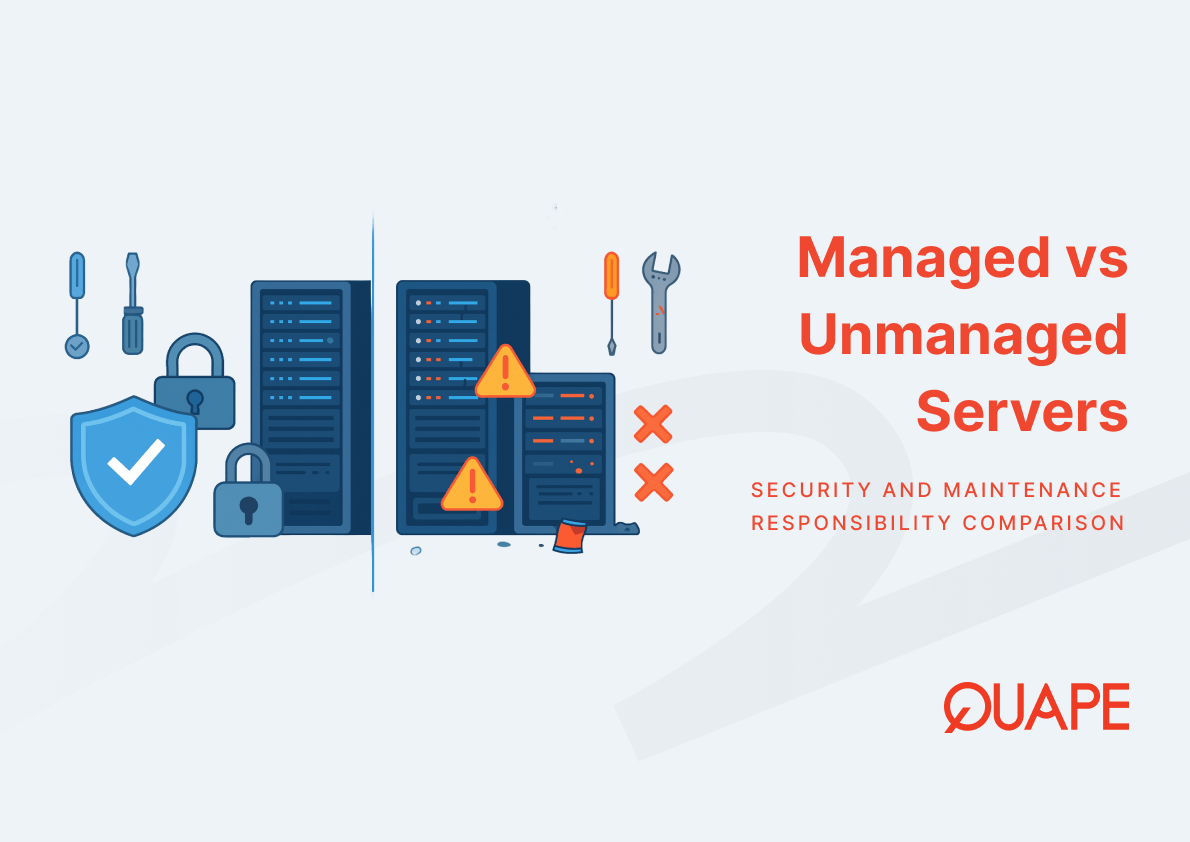
Organisations choosing dedicated server infrastructure face a critical decision about operational control and security responsibility allocation. The distinction between managed and unmanaged models determines who handles patching, monitoring, firewall configuration, backup management, and incident response when threats emerge. This choice affects breach risk, compliance posture, operational costs, and the speed at which security vulnerabilities are addressed. With the global managed services market projected to exceed USD 335 billion in 2024 and data breach costs averaging USD 4.88 million per incident, understanding how security and maintenance responsibilities distribute across managed versus unmanaged configurations directly impacts business risk and operational efficiency.
A managed dedicated server transfers day-to-day security operations, patch management, monitoring, and backup responsibilities to the hosting provider, supported by defined service-level agreements and often backed by Security Operations Center (SOC) capabilities. An unmanaged dedicated server grants complete root access and control to the customer, requiring in-house system administrators to implement firewall policies, apply operating system updates, configure intrusion detection systems, establish backup schedules, and respond to security alerts without provider intervention.
Key Takeaways
- Managed dedicated servers transfer patching, monitoring, firewall management, and backup responsibilities to the provider under SLA terms, reducing operational burden but requiring vendor governance oversight.
- Unmanaged servers grant full root access and customization freedom, demanding in-house SysAdmin expertise to manage vulnerabilities, apply patches, and operate security monitoring independently.
- National cyber agencies consistently identify unpatched vulnerabilities as leading attack vectors, making timely patch management a critical differentiator between managed and unmanaged security outcomes.
- SOC capabilities integrated into managed offerings provide continuous threat monitoring and incident response, a feature absent in standard unmanaged configurations where detection depends entirely on internal resources.
- Regulatory pressure from frameworks like SEC cybersecurity disclosure rules increases the operational value of managed SLAs that define detection timelines, patch cadence, and breach notification responsibilities.
- Average data breach costs approaching USD 5 million elevate the financial importance of choosing a security responsibility model aligned with organizational risk tolerance and internal capability maturity.
- Compliance hosting requirements under PDPA, ISO 27001, or MAS TRM guidelines often benefit from managed provider controls that maintain audit trails, backup retention, and documented security procedures.
Introduction to Managed Dedicated Server Entities
The managed versus unmanaged decision fundamentally revolves around where security and maintenance responsibilities reside. In an unmanaged dedicated server environment, the customer receives root access to the operating system and assumes complete responsibility for system administration tasks including kernel updates, security patching, firewall rule configuration, log analysis, backup scheduling, and incident investigation. This model maximizes customization flexibility and supports unique software stacks or specialized compliance requirements that demand granular control over every configuration parameter. Organizations with experienced SysAdmin teams and established security operations often select unmanaged infrastructure to maintain direct oversight of dedicated server performance, control, and business reliability without intermediary dependencies.
Conversely, a managed dedicated server shifts operational security tasks to the hosting provider. The provider maintains the operating system, applies security patches on a defined schedule, configures and updates managed firewall policies, monitors system health and security events through centralized platforms, manages backup and disaster recovery processes, and coordinates incident response when anomalies are detected. The customer retains control over application-layer configurations and business logic but delegates infrastructure-layer security and maintenance to specialists operating under service-level agreements that specify response times, uptime guarantees, and escalation procedures. This delegation reduces the need for in-house 24/7 security monitoring and allows organizations to redirect internal resources toward application development and business objectives rather than infrastructure operations.
The global expansion of managed services reflects a broader shift in how organizations allocate security responsibilities. Grand View Research estimates the managed services market at approximately USD 335 billion in 2024, with projected compound annual growth exceeding 14 percent through 2030. This growth signals increasing preference for outsourcing complex operational tasks to specialized providers who maintain SOC capabilities, threat intelligence feeds, and dedicated security engineering teams. The financial stakes underlying this shift are clear when examining breach impact data: IBM’s 2024 Cost of a Data Breach Report documents an average global breach cost of USD 4.88 million, a figure that continues rising year-over-year as attack sophistication increases and regulatory penalties for inadequate security controls expand.
Security responsibility distribution affects not only operational efficiency but also legal and financial exposure. New SEC cybersecurity disclosure rules require companies to report material cyber incidents within strict timelines and maintain documentation of cybersecurity risk management processes, including third-party vendor oversight. Organizations using managed dedicated servers must ensure their SLAs define clear incident notification procedures, breach detection timelines, and provider responsibilities for forensic support during investigations. Unmanaged server customers bear sole responsibility for detecting, documenting, and disclosing incidents, placing greater emphasis on internal monitoring capabilities and incident response planning.
Key Components and Security Concepts of Managed Dedicated Servers
Root Access and Control Delegation
Root access provides unrestricted administrative privileges over the operating system, enabling installation of arbitrary software packages, modification of kernel parameters, creation of custom firewall rules, and deep troubleshooting of performance issues or security anomalies. In unmanaged dedicated server environments, customers receive direct root credentials and assume full control over system configuration, which supports specialized use cases requiring non-standard kernel modules, custom security tools, or compliance architectures that mandate specific hardening procedures. This level of access proves essential for organizations running proprietary software stacks, developing infrastructure-as-code pipelines, or maintaining compliance frameworks that prohibit third-party administrative access to production systems.
Managed dedicated server models restrict or mediate root access to preserve the integrity of provider-maintained security controls and ensure patch management processes remain consistent across the infrastructure fleet. Many managed providers offer controlled root access through secured channels where customers can execute approved commands or install application-layer software while core system administration tasks such as kernel updates, firewall baseline management, and security agent configuration remain under provider control. This hybrid approach balances operational flexibility with the consistency required for automated patch deployment and centralized security monitoring, a model explored in detail when understanding dedicated server setup and root access considerations.
The trade-off between root access autonomy and managed operational assurance becomes particularly relevant when evaluating compliance hosting requirements. Regulatory frameworks including PDPA, ISO 27001, and MAS Technology Risk Management Guidelines often require documented evidence of patch management procedures, change control processes, and security monitoring capabilities. Organizations maintaining unmanaged servers with full root access must independently document and audit these processes, while managed customers can leverage provider audit reports, SOC 2 attestations, and SLA-backed documentation to demonstrate compliance controls to auditors and regulators.
Access control decisions also influence incident response effectiveness. When security events occur, root-level access enables immediate forensic investigation, log collection, and remediation actions. Unmanaged customers control this timeline entirely but depend on internal expertise and availability. Managed providers typically integrate incident response procedures into their SLAs, deploying SOC analysts and security engineers to investigate alerts, but may require customer authorization before executing certain remediation actions. Defining these authorization boundaries and escalation paths within SLAs prevents response delays during active security incidents.
Managed Firewall and Threat Monitoring
Managed firewall services implement network-layer security controls that filter inbound and outbound traffic according to security policies designed to block exploitation attempts, unauthorized access, and data exfiltration. Unlike basic stateful firewalls configured once during initial deployment of firewall, IDS, and IPS on dedicated servers, managed firewall offerings include continuous policy updates as new threat intelligence emerges, regular review of rule effectiveness based on traffic analysis, and integration with intrusion detection and prevention systems that identify and block attack patterns matching known exploits or anomalous behavior signatures.
Intrusion detection systems (IDS) monitor network traffic and system logs for indicators of compromise, including port scanning activity, brute-force authentication attempts, malware command-and-control communications, and data access patterns inconsistent with normal operations. Intrusion prevention systems (IPS) extend detection capabilities by actively blocking identified threats in real time, preventing malicious packets from reaching application services. Managed providers typically operate centralized IDS/IPS platforms monitoring multiple customer environments simultaneously, enabling cross-customer threat intelligence correlation and faster identification of emerging attack campaigns.
Security Operations Center integration represents a key differentiator in managed security offerings. A SOC provides 24/7 monitoring by security analysts who triage alerts generated by firewall logs, IDS/IPS sensors, endpoint detection tools, and system integrity monitors. According to MSSP Alert’s 2023 Top 250 MSSPs Report, approximately 67 percent of leading managed security service providers operate in-house SOCs, with others utilizing hybrid or outsourced models. This prevalence underscores SOC capability as a standard component of mature managed security offerings, providing continuous vigilance that most organizations cannot economically replicate with in-house resources alone.
SOC-backed monitoring reduces the time between initial compromise and detection, a critical factor in limiting breach impact. IBM’s breach cost research consistently demonstrates that faster detection and containment significantly reduce total breach costs, with organizations detecting breaches in under 200 days experiencing substantially lower financial impact than those requiring longer detection periods. Managed dedicated servers with SOC integration formalize detection timelines through SLA commitments, whereas unmanaged environments depend entirely on internal monitoring discipline and tool effectiveness without contractual assurance of response speed.
Threat monitoring extends beyond network perimeter defense to include vulnerability scanning, configuration drift detection, and file integrity monitoring. Managed providers routinely scan customer environments for known vulnerabilities, comparing installed software versions against public vulnerability databases and vendor security advisories. When critical vulnerabilities are identified, managed service workflows trigger patch deployment or configuration hardening procedures according to predefined severity tiers and customer-approved change windows. Unmanaged customers must independently maintain vulnerability assessment schedules, prioritize patching based on threat intelligence, and validate that security updates do not disrupt application functionality.
Patch Management and Software Maintenance
Patch management addresses one of the most persistent security challenges in dedicated server operations: ensuring that operating system kernels, system libraries, application runtimes, and service daemons remain current with vendor-supplied security updates. The U.S. Cybersecurity and Infrastructure Security Agency publishes annual advisories documenting routinely exploited vulnerabilities, with their 2024 list (AA24-317A) highlighting that attackers consistently target unpatched internet-facing services including web servers, VPN concentrators, email gateways, and database management systems. Many listed vulnerabilities had patches available for months or years before exploitation, illustrating that patch deployment discipline directly determines exploitation risk.
Managed dedicated server providers implement structured patch management processes that classify updates by severity, test patches in staging environments to identify compatibility issues, schedule deployment during approved maintenance windows, and validate successful installation through automated verification checks. This systematic approach reduces the likelihood that critical security patches remain unapplied due to resource constraints, competing priorities, or lack of awareness about newly disclosed vulnerabilities. Managed providers typically commit to patch deployment timelines within their SLAs, specifying maximum time intervals between vendor release and production deployment for critical-severity updates affecting internet-facing services.
Unmanaged server customers bear sole responsibility for monitoring vendor security advisories, evaluating patch applicability to their specific software configurations, testing updates for compatibility with custom applications, deploying patches across server fleets, and verifying successful installation. Organizations with mature change management processes and dedicated systems administration teams can execute these tasks effectively, but smaller teams or those lacking 24/7 coverage may experience delays that create exploitation windows. The operational burden extends beyond occasional major updates to include continuous tracking of minor security patches, dependency updates, and configuration adjustments recommended in vendor hardening guides.
Software maintenance encompasses not only security patches but also performance tuning, capacity planning, and proactive identification of configuration drift that degrades system stability or security posture. Managed providers monitor resource utilization trends, adjust kernel parameters to optimize network throughput, rotate logs to prevent disk exhaustion, and maintain configuration baselines that detect unauthorized modifications. These operational disciplines reduce the risk of outages caused by resource exhaustion, misconfiguration, or gradual performance degradation. Unmanaged customers implement equivalent disciplines through internal procedures but lack the contractual accountability and defined escalation paths that SLAs provide when issues arise.
Continuous Monitoring, SLA, and Incident Response
Service-level agreements formalize the operational commitments managed providers deliver, defining uptime guarantees, response time targets for different severity tiers, maintenance window schedules, escalation procedures, and remediation timelines. SLA terms directly affect how quickly providers detect anomalies, acknowledge alerts, begin investigation, and implement corrective actions when security incidents or performance degradations occur. Well-structured SLAs specify concrete metrics including mean time to detect (MTTD) for security events, mean time to acknowledge (MTTA) for support tickets, and mean time to resolution (MTTR) for critical incidents, providing measurable accountability for operational responsiveness.
Continuous monitoring underpins SLA delivery by providing real-time visibility into system health, security events, network traffic patterns, and application performance metrics. Managed providers deploy monitoring agents on customer servers that collect telemetry data transmitted to centralized monitoring platforms, where automated alerting rules trigger notifications when thresholds are exceeded or anomalous patterns emerge. Monitoring scope typically includes CPU and memory utilization, disk I/O performance, network bandwidth consumption, process health checks, log analysis for error patterns, and security event correlation across multiple data sources.
Incident response procedures defined in managed service agreements establish clear workflows for handling security events, from initial alert triage through investigation, containment, eradication, and recovery phases. SOC analysts follow documented playbooks that specify evidence collection procedures, communication protocols for customer notification, criteria for escalating incidents to senior security engineers, and coordination steps for engaging external forensic specialists when advanced persistent threats are suspected. These structured response capabilities contrast with unmanaged environments where incident response depends entirely on internal team expertise, availability, and access to specialized tools and threat intelligence.
Remediation responsibilities must be clearly delineated in SLA terms to avoid ambiguity during active incidents. Managed providers typically handle infrastructure-layer remediation including isolating compromised servers from production networks, applying emergency patches, reconfiguring firewall rules to block attack sources, and restoring systems from clean backups. Application-layer remediation such as fixing vulnerable code, rotating application credentials, or modifying business logic remains the customer’s responsibility even in managed environments. Explicit documentation of these boundaries prevents delays caused by authorization confusion when rapid response is critical.
SLA enforcement mechanisms including service credits for downtime exceeding guaranteed thresholds and escalation to senior management for repeated SLA violations provide contractual recourse when providers fail to meet committed service levels. Unmanaged dedicated server customers lack this contractual protection and must rely entirely on internal capabilities to maintain uptime, security posture, and operational continuity. The financial and operational value of SLA assurance increases proportionally with the criticality of hosted workloads and the cost impact of outages or security incidents.
Managed Backups and Disaster Recovery
Managed backup services automate the capture, encryption, offsite storage, and retention management of server data according to recovery point objectives (RPO) and recovery time objectives (RTO) defined in customer agreements. RPO specifies the maximum acceptable data loss measured in time, determining backup frequency such as hourly snapshots for databases supporting financial transactions or daily backups for less time-sensitive content. RTO defines the maximum acceptable downtime for service restoration, influencing backup architecture choices including snapshot technologies, replication topologies, and the availability of hot standby systems.
Data protection strategies in managed environments typically combine multiple backup tiers, including frequent incremental backups capturing only changed data blocks, periodic full backups establishing complete recovery baselines, and long-term archival retention satisfying regulatory compliance requirements. Backup data receives encryption both during transmission to remote storage locations and while at rest, protecting confidentiality even if backup media are compromised. Geographic diversity in backup storage locations mitigates risks from regional disasters, ensuring recovery capability persists despite data center failures, natural disasters, or targeted attacks against primary infrastructure, a consideration closely related to how RAID configurations on dedicated servers provide redundancy.
Disaster recovery planning extends beyond routine backup execution to include documented procedures for service restoration under various failure scenarios, regular testing of recovery workflows to validate that backups are functional and recovery time objectives are achievable, and clearly defined roles specifying who executes recovery steps when disasters occur. Managed providers typically offer disaster recovery as a service (DRaaS) that includes replica environments in geographically separate data centers, automated failover capabilities, and guaranteed recovery timelines documented in SLAs. Organizations using unmanaged servers must independently design disaster recovery architectures, maintain replica infrastructure, test failover procedures, and staff recovery operations during actual disasters.
Compliance frameworks frequently mandate specific backup retention periods, immutability requirements preventing backup deletion or modification, and audit trails documenting backup success rates and recovery testing results. PDPA requirements for data protection, ISO 27001 controls for information backup, and MAS Technology Risk Management Guidelines for business continuity all influence backup architecture decisions. Managed providers often maintain compliance certifications that cover backup infrastructure, enabling customers to inherit documented controls through vendor assessment processes. Unmanaged customers must independently implement and audit backup compliance controls, increasing operational complexity for regulated industries.
Backup verification through periodic restoration testing remains critical regardless of management model. Managed service agreements should specify restoration testing frequency and success criteria, ensuring that backup processes actually produce recoverable data. Untested backups create false confidence that may only be discovered during actual disaster scenarios when restoration fails. Regular testing confirms that backup software functions correctly, encryption keys remain accessible, storage systems have not degraded, and documented recovery procedures align with current infrastructure configurations.
Practical Application in Singapore: Compliance, SOC, and Business Risk Management
Singapore’s regulatory environment and position as a regional financial hub create specific considerations for organizations selecting managed versus unmanaged dedicated server approaches. The Personal Data Protection Act (PDPA) imposes obligations for reasonable security arrangements protecting personal data, with the PDPC enforcement guidelines increasingly emphasizing that organizations must implement appropriate technical measures including access controls, encryption, and timely security patching. Managed dedicated servers offering PDPA compliance capabilities through documented security controls, regular audits, and contractual data protection assurances help organizations demonstrate reasonable security to regulators, particularly valuable for SMEs lacking large internal compliance teams.
Financial institutions regulated by the Monetary Authority of Singapore face Technology Risk Management Guidelines requiring robust cybersecurity controls, incident management capabilities, and third-party vendor oversight. MAS TRM expectations include regular vulnerability assessments, penetration testing, security patch management, and business continuity planning. Organizations hosting financial applications on managed dedicated servers can leverage provider SOC capabilities, security monitoring infrastructure, and compliance documentation to satisfy portions of MAS TRM requirements, provided that vendor due diligence processes and contractual terms clearly allocate specific control responsibilities between customer and provider.
ISO 27001 certification remains a common requirement for organizations participating in regulated industries or serving enterprise customers with stringent security procurement standards. Achieving and maintaining ISO 27001 certification requires implementing dozens of security controls spanning access management, cryptography, physical security, incident response, business continuity, and supplier relationships. Managed dedicated server providers holding ISO 27001 certification for their infrastructure and operations enable customers to leverage certified controls for infrastructure-layer security while focusing internal certification efforts on application-layer controls, significantly reducing the scope and cost of pursuing compliance for dedicated servers in Singapore.
Security Operations Center capabilities become particularly valuable in Singapore’s context given the concentration of financial services, healthcare, and technology companies facing sophisticated threat actors. Managed providers operating SOCs in Singapore data centers or with regional presence can offer lower-latency incident response, local regulatory expertise, and familiarity with regional threat landscapes including attack campaigns targeting Southeast Asian organizations. SOC integration with managed dedicated servers provides 24/7 monitoring coverage that most Singapore SMEs cannot economically staff independently, while SLA-defined incident response procedures formalize escalation paths and communication protocols required by breach notification regulations.
Business risk management considerations extend beyond pure security controls to include operational resilience, vendor concentration risk, and contractual clarity around liability allocation. Organizations relying heavily on managed providers must ensure that SLA terms adequately protect against extended outages, data loss, or security incidents caused by provider negligence. Insurance policies covering cyber liability and business interruption should explicitly account for risks associated with third-party hosting providers, and vendor selection processes should evaluate provider financial stability, business continuity capabilities, and insurance coverage. Unmanaged server customers avoid vendor dependency risks but assume complete operational and security responsibility, shifting business risk to internal capability maturity and resource availability.
Financial Times analysis of increasing cybercrime sophistication emphasizes that organizations face pressure from both threat actors developing advanced attack techniques and regulators demanding faster incident detection and response. Reuters reporting on SEC cybersecurity disclosure rules highlights that material incident reporting timelines measured in business days require automated detection capabilities and predefined communication workflows. Managed dedicated servers with SOC integration and documented SLA response timelines provide contractual assurance of detection and notification speed, while unmanaged environments depend entirely on internal monitoring effectiveness and incident response readiness, factors that vary widely based on team size, tool investment, and procedural maturity.
How Dedicated Servers Support Managed Security and Maintenance Responsibilities
Dedicated server infrastructure provides the foundation supporting managed security and maintenance services through exclusive resource allocation, hardware-level isolation, and enterprise-grade components designed for continuous operation. Unlike shared hosting environments where multiple customers compete for CPU cycles, memory, and disk I/O, dedicated servers allocate entire physical machines to single customers, eliminating noisy neighbor effects and enabling predictable performance for security monitoring agents, backup processes, and log aggregation workloads. This resource exclusivity proves essential when deploying comprehensive security tooling including intrusion detection sensors, file integrity monitoring, vulnerability scanners, and security information and event management (SIEM) platforms that require sustained compute and storage capacity.
Enterprise hardware specifications including ECC memory detecting and correcting bit errors, redundant power supplies preventing outages from individual component failures, and NVMe storage delivering high-throughput performance for database-intensive applications directly support the reliability expectations underlying managed service commitments. When managed providers offer SLA-backed uptime guarantees approaching 99.9 percent or higher, underlying hardware quality becomes critical to achieving these targets without excessive failover complexity. Organizations can explore specific dedicated server options matching their performance requirements and budget constraints while evaluating whether managed or unmanaged service models better align with internal capabilities.
Network infrastructure supporting dedicated servers influences both security control effectiveness and incident response capability. Multi-homed connectivity providing diverse network paths improves resilience against distributed denial of service (DDoS) attacks and upstream provider outages, while 10Gbps network interfaces enable rapid backup data transmission and support high-volume traffic workloads without bottlenecks. Clean IP address allocation free from prior abuse history reduces the likelihood of deliverability issues for email services or reputation-based blocking by security tools, particularly important for managed customers who may inherit IP addresses previously used by other organizations.
Data center tier classification affects physical security controls, power redundancy, cooling capacity, and geographic disaster recovery planning. TIA-942 data centers providing concurrent maintainability allow component replacement and system upgrades without service interruption, reducing downtime risk for both managed and unmanaged dedicated servers. Carrier-neutral facilities offering connectivity to multiple ISPs and cloud providers enable hybrid architectures combining dedicated servers with cloud services, supporting disaster recovery topologies that replicate data to geographically separate locations. Singapore data centers specifically benefit from strategic positioning at the intersection of major submarine cable routes linking Asia, Australia, and global internet exchanges, reducing latency for regional traffic and supporting business continuity architectures with offshore replication targets.
Customization capabilities inherent to dedicated server infrastructure support diverse managed service requirements across different industries and compliance frameworks. Organizations can specify exact CPU core counts, memory capacity, storage configurations including RAID levels and SSD endurance ratings, and network bandwidth allocations matching their workload profiles. This hardware flexibility enables managed providers to deliver tailored security solutions incorporating customer-specific requirements such as hardware security modules (HSMs) for cryptographic key protection, GPU acceleration for machine learning-based threat detection, or high-frequency storage for low-latency financial trading applications, all while maintaining provider-managed security operations and patch management disciplines.
Conclusion
Selecting between managed and unmanaged dedicated server approaches requires careful evaluation of internal security expertise, operational resource availability, compliance obligations, risk tolerance, and total cost of ownership across technology investment, personnel, and potential breach impact. Organizations with mature SysAdmin teams, established security operations, and regulatory requirements demanding granular control benefit from unmanaged servers granting complete root access and configuration autonomy. Conversely, organizations seeking to redirect internal resources toward application development, leverage specialized SOC capabilities, and formalize operational accountability through SLA commitments often find managed dedicated servers provide superior risk-adjusted value despite higher monthly costs and reduced low-level control. The rising frequency and sophistication of cyber threats, combined with tightening regulatory disclosure requirements and breach costs approaching USD 5 million per incident, elevate the strategic importance of this architectural choice beyond simple technical preference to fundamental business risk management.
Ready to discuss which dedicated server management approach aligns with your security requirements and operational capabilities? Contact our team to explore managed and unmanaged options tailored to your infrastructure needs.
Frequently Asked Questions
What is the primary difference between managed and unmanaged dedicated servers regarding security responsibilities?
Managed dedicated servers transfer operational security tasks including patch management, firewall configuration, monitoring, and backup execution to the hosting provider under defined SLAs, while unmanaged servers grant complete root access requiring customers to independently handle all system administration and security operations. The choice determines whether security expertise resides internally or is outsourced to specialized providers with SOC capabilities.
How do managed dedicated servers address patch management more effectively than unmanaged configurations?
Managed providers implement structured patch management workflows that continuously monitor vendor security advisories, test updates in staging environments, deploy patches during approved maintenance windows, and verify successful installation through automated checks. This systematic approach reduces the risk that critical vulnerabilities remain unpatched due to resource constraints or competing internal priorities, addressing the primary attack vector identified in national cyber agency advisories.
What role does a Security Operations Center (SOC) play in managed dedicated server security?
SOCs provide 24/7 monitoring of security alerts generated by firewalls, intrusion detection systems, log analysis platforms, and endpoint agents, enabling rapid detection of compromise indicators and coordinated incident response. Approximately 67 percent of leading managed security providers operate in-house SOCs, offering continuous threat vigilance that most organizations cannot economically replicate internally while maintaining core business operations.
How do service-level agreements (SLAs) affect security and maintenance outcomes for managed dedicated servers?
SLAs formalize provider commitments for uptime guarantees, incident response timelines, patch deployment schedules, and escalation procedures, providing contractual accountability for operational performance. Well-defined SLAs specify metrics including mean time to detect security events and mean time to resolve critical incidents, ensuring measurable service quality and establishing recourse mechanisms through service credits when providers fail to meet committed service levels.
Can organizations using managed dedicated servers still maintain some level of root access for application management?
Many managed providers offer hybrid access models where customers receive controlled root privileges for application-layer software installation and configuration while infrastructure-layer tasks including kernel updates, security agent management, and firewall baseline maintenance remain under provider control. This approach balances customization flexibility with operational consistency required for automated security monitoring and centralized patch management.
What compliance advantages do managed dedicated servers provide for Singapore organizations?
Managed providers often maintain certifications including ISO 27001, SOC 2, and PDPA compliance documentation that customers can leverage during regulatory audits, reducing the scope of internal compliance efforts to application-layer controls. Provider-maintained audit trails for patch management, backup retention, and security monitoring satisfy regulatory requirements for documented security processes while contractual data protection terms support PDPA reasonable security obligations.
How do backup and disaster recovery responsibilities differ between managed and unmanaged dedicated server models?
Managed services include automated backup scheduling, encryption, offsite storage, and retention management according to defined recovery objectives, with providers testing restoration procedures and maintaining documented recovery workflows. Unmanaged customers must independently design backup architectures, maintain replica infrastructure, validate backup integrity through periodic restoration testing, and staff recovery operations during actual disaster scenarios without contractual recovery time guarantees.
What factors should organizations consider when evaluating the total cost of managed versus unmanaged dedicated servers?
Total cost analysis should include monthly service fees, internal personnel costs for security operations and system administration, technology investment in monitoring tools and security software, compliance audit expenses, insurance premiums for cyber liability coverage, and potential breach impact costs averaging USD 4.88 million globally. Organizations must also evaluate opportunity costs of directing internal technical resources toward infrastructure operations versus revenue-generating application development and business innovation initiatives.