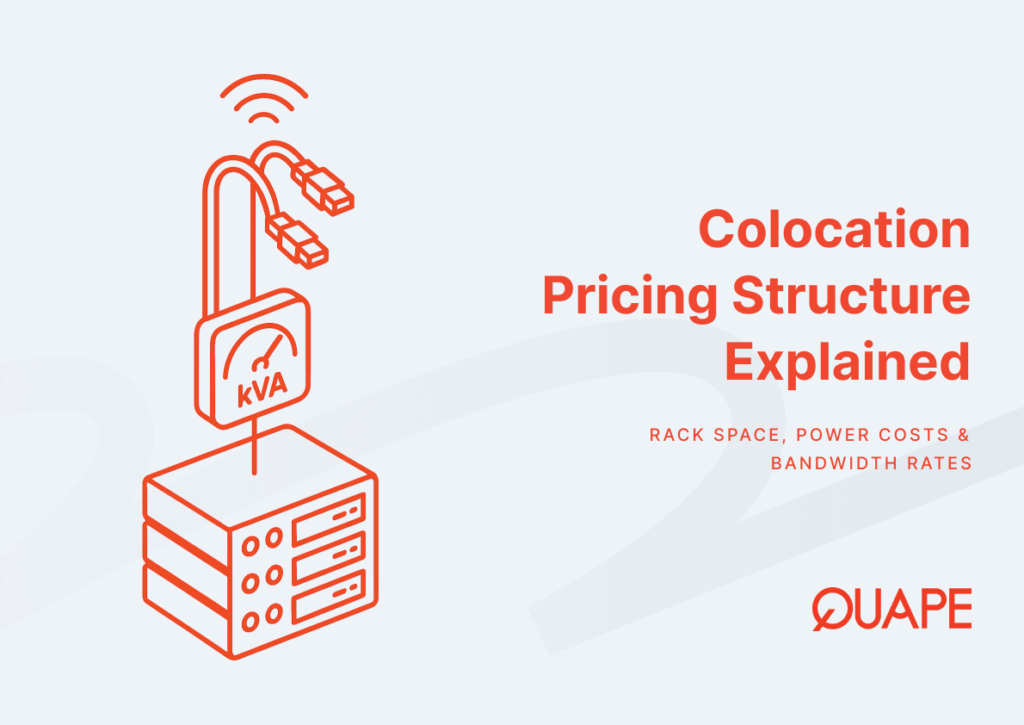
Colocation pricing often appears straightforward on vendor rate cards, yet the real cost structure involves multiple interdependent components that interact in ways most IT managers only discover after deployment. Understanding how rack space allocation, power consumption, and bandwidth commit rates compound or offset one another determines whether your colocation investment delivers predictable operating costs or exposes your organization to unexpected variability. Singapore’s colocation market adds further complexity through quarterly electricity tariff adjustments, constrained data center supply, and regional bandwidth pricing dynamics that directly affect total cost of ownership. This article deconstructs the primary pricing components, explains how facility efficiency and service-level agreements influence billing models, and shows how operational decisions at the procurement stage shape long-term cost predictability.
What Is Colocation Pricing Structure
A colocation pricing structure defines how providers quantify and charge for the resources a tenant consumes or reserves within a shared data center facility. Unlike public cloud pricing that meters ephemeral compute instances, colocation services bill for persistent physical resources: rack units that occupy floor space, power circuits that supply electrical capacity, and network ports that deliver connectivity. Each component carries distinct unit economics. Rack space charges reflect real estate footprint and cooling overhead. Power pricing recovers electricity procurement costs, distribution losses, and the facility’s power usage effectiveness ratio. Bandwidth fees depend on transit pricing, peering relationships, and whether the provider provisions committed or burstable capacity. Providers bundle these elements into tiered offers or allow tenants to configure custom allocations, and the chosen billing model determines whether costs remain fixed or fluctuate with actual consumption.
Key Takeaways
- Colocation pricing comprises three recurring elements: physical rack space, allocated or metered power, and network bandwidth with commit rates or burstable limits.
- Power usage effectiveness directly influences total energy costs; facilities with PUE around 1.45–1.56 consume less electricity per unit of IT load, which can reduce per-kW billing rates or improve cost predictability.
- Singapore electricity tariffs adjust quarterly based on fuel prices, transmitting wholesale energy volatility into colocation bills unless providers offer fixed-rate or hedged power contracts.
- Bandwidth pricing reflects regional IP transit costs, which have declined over time but vary by geography and service guarantees, creating meaningful price tiers between base and premium connectivity.
- Allocated power billing provides cost predictability but requires paying for reserved headroom, while metered models lower upfront reservation costs but expose tenants to variable monthly charges.
- Service-level agreements with higher uptime commitments or faster remote hands response often carry surcharges that compound base rack and power fees, affecting total cost structure.
- Land and energy constraints in Singapore tighten colocation supply, sustaining or elevating pricing for premium, low-latency facilities despite declining global bandwidth costs.
Key Components of a Colocation Pricing Structure
Rack Space Allocation & Physical Footprint Costs
Rack space pricing begins with the physical unit you occupy: a single rack unit (1U) within a shared cabinet, a dedicated half rack (20U–22U), or a full 42U private rack that isolates your equipment from other tenants. Shared rack configurations distribute floor space and cooling costs across multiple customers, reducing per-unit pricing but limiting physical access and introducing potential neighbor effects if adjacent equipment generates unexpected heat or consumes more power than allocated. Dedicated racks eliminate those variables, providing exclusive cabinet access and simplified cabling, yet they require higher minimum commitments because the provider cannot reclaim unused rack units for other tenants. Cabinet allocation also determines the footprint density the facility must support. High-density deployments with blade servers or GPU workloads concentrate power draw and heat generation within small vertical spaces, requiring enhanced cooling and potentially triggering density surcharges if the facility’s cooling infrastructure cannot accommodate concentrated thermal loads without localized hot spots.
Providers typically price rack space as a fixed monthly fee per unit or per cabinet, recovering their capital expenditure on raised floors, fire suppression, and structural load capacity. This fixed component anchors the cost structure, but it interacts with power and bandwidth allocations in ways that affect total pricing. A 1U server consuming 0.3 kVA in a shared rack incurs different cooling overhead than a 10U configuration drawing 1.2 kVA, even though the rack space multiple is only 10×. The cooling delta influences whether the provider applies tiered power pricing or assesses density penalties, making rack space allocation a starting point rather than a complete cost picture.
Power Consumption, kVA Thresholds & Electricity Costs
Power pricing recovers the electricity cost the provider incurs to supply your equipment, but it also reflects the facility’s power usage effectiveness, which quantifies how much energy the data center consumes for cooling, lighting, and distribution losses relative to the energy delivered to IT equipment. Modern large facilities report annualized PUE values around 1.45–1.56, meaning every kilowatt supplied to servers requires an additional 0.45–0.56 kW for cooling and auxiliary systems. Lower PUE reduces total energy consumption per unit of IT load, enabling providers to offer more competitive per-kW rates or absorb electricity tariff volatility without passing full increases to tenants. Higher PUE amplifies the electricity cost base, pressuring providers to either raise per-kW billing or tighten power allocations to preserve margin.
Colocation vendors deploy multiple billing models for power: allocated circuits that reserve a fixed kVA or kW capacity, metered models that charge actual consumption measured at the power distribution unit, or blended approaches that combine a base allocation with overage fees. Allocated power provides cost predictability because you pay a flat rate regardless of whether your equipment draws 30% or 95% of the reserved capacity, but it requires reserving headroom for peak loads, effectively paying for unused capacity most of the time. Metered billing lowers the upfront reservation cost and charges only what you consume, yet it exposes you to variable monthly bills if workload patterns shift or if the facility manages power and cooling infrastructure inefficiently. Blended models attempt to balance predictability and efficiency by setting a base threshold with incremental charges for usage beyond that level, but they introduce complexity in forecasting monthly costs.
Singapore’s electricity tariffs add another layer of variability. The Energy Market Authority adjusts retail electricity components quarterly based on wholesale fuel prices, causing commercial tariffs to fluctuate. For example, published quarterly averages shifted from approximately 29.5 cents per kWh to 28.1 cents per kWh year-over-year between mid-2024 and mid-2025, reflecting sensitivity to natural gas procurement costs. Providers that pass through electricity costs directly transmit this volatility to tenants, while those offering fixed-rate or hedged contracts absorb the risk in exchange for slightly higher baseline rates. The choice between variable and fixed power pricing determines whether your colocation operating expense remains stable or tracks regional energy market conditions.
Bandwidth Commit Rates, Network Peering & Connectivity Pricing
Bandwidth pricing quantifies how much data your equipment can transmit and receive over the provider’s network infrastructure, typically expressed as a committed information rate (the guaranteed minimum throughput) or a burstable limit (the maximum allowed with overage billing). Committed rates provide predictable performance and cost, ensuring your applications always have the specified throughput regardless of overall facility utilization, but they require paying for capacity you may not fully use during off-peak hours. Burstable bandwidth lowers the base cost by allocating a smaller commit rate and allowing temporary spikes, yet it introduces billing uncertainty if traffic patterns exceed the 95th percentile threshold that many providers use to calculate overage charges. The economic trade-off mirrors power billing: predictability versus utilization efficiency.
Network redundancy and peering relationships materially affect bandwidth unit costs because they determine the upstream routes your traffic traverses. Facilities with diverse carrier ecosystems and direct peering connections to major internet exchanges reduce reliance on expensive IP transit, lowering the marginal cost per megabit. Regional IP transit pricing has declined over time, driven by competition and capacity expansion, yet significant geographic dispersion persists. TeleGeography data shows that while global internet bandwidth grew approximately 23% in 2023, transit price declines vary by region, and last-mile connectivity, cross-connect fees, and port speed options create meaningful pricing tiers between base and premium service levels. Providers that bundle base bandwidth into rack pricing simplify cost structure but may charge premiums for committed circuits, low-latency routes, or direct connections to cloud on-ramps.
Bandwidth pricing also interacts with service-level agreements that define packet loss, latency, and jitter guarantees. Higher SLA commitments require the provider to over-provision upstream capacity and maintain redundant paths, costs they recover through surcharges on premium connectivity tiers. Understanding how commit rates, burstable limits, and SLA guarantees compound helps you match connectivity pricing to actual application requirements rather than over-provisioning for theoretical peak loads.
Additional Chargeable Services & SLA-Level Variations
Service-level agreements extend beyond uptime percentages to encompass response times for remote hands support, incident escalation procedures, and access to on-site technicians for hardware interventions. Basic SLAs typically include business-hours support with next-business-day response, adequate for non-critical workloads but insufficient for applications requiring immediate physical access to rebooting servers or swapping failed components. Enhanced SLAs with 24/7 remote hands availability, sub-hour response commitments, and priority escalation carry monthly surcharges that compound base rack and power fees. These add-on costs often appear modest as line items, yet they accumulate across multiple deployments and directly affect total cost of ownership when incidents occur frequently or require complex interventions.
Additional chargeable services include IP address allocations beyond the base block, cross-connect installations for private links to other tenants or carriers, and visitor access fees for on-site troubleshooting. Some providers bundle these elements into higher-tier packages while others charge à la carte, creating pricing variability that complicates direct comparisons across vendors. Understanding which services your operations require and how frequently you’ll invoke them clarifies whether bundled pricing or pay-per-use models better align with your cost structure. SLA-level variations also influence billing predictability: contracts with fixed service fees stabilize costs, while those with usage-based support charges introduce variability tied to incident frequency.
Practical Pricing Considerations in Singapore’s Colocation Market
Singapore’s colocation market operates under unique supply and regulatory dynamics that influence pricing structure and availability. The government has implemented selective land allocations and temporary moratoria on new data center approvals to manage energy consumption and sustainability targets, tightening the supply of premium colocation capacity. This policy environment creates upward pressure on pricing, particularly for facilities offering low-latency connectivity to regional cloud hubs and financial exchanges. Data center tier classification further stratifies the market: Tier III facilities with N+1 redundancy and 99.982% uptime commitments command pricing premiums over Tier II deployments, reflecting the capital investment required for concurrent maintainability and fault tolerance.
Electricity tariffs in Singapore transmit wholesale energy market volatility into colocation operating costs because the Energy Market Authority adjusts retail components quarterly based on fuel procurement. Natural gas prices dominate the wholesale electricity mix, and fluctuations in global LNG markets directly affect commercial electricity bills. For tenants on variable power billing, this mechanism introduces cost uncertainty that complicates annual budgeting. Providers offering fixed-rate power contracts absorb this volatility, but they price the risk into baseline rates, creating a trade-off between predictability and potentially lower costs if energy prices decline.
Regional bandwidth pricing also shapes Singapore colocation economics. The city-state functions as a major internet exchange and subsea cable landing point, concentrating carrier diversity and direct peering opportunities that reduce IP transit costs compared to less-connected markets. However, last-mile cross-connects and port speed upgrades remain discretionary charges that vary widely across providers. The Asia-Pacific colocation market is projected to grow from USD 20.23 billion in 2024 to USD 70.88 billion by 2034, driven by cloud adoption, AI workloads, and enterprise digitalization. This demand growth interacts with land and energy constraints to sustain pricing for premium facilities despite global bandwidth cost declines, making early capacity reservations advantageous for tenants requiring guaranteed availability.
How QUAPE’s Colocation Servers Simplify Cost Structure & Reduce Variability
QUAPE’s colocation server offerings address common pricing complexity by bundling rack space, power allocation, and base bandwidth into fixed monthly rates without hidden overage fees or quarterly electricity adjustments. Each tier specifies exact rack unit allocation, kVA limits, and bandwidth commit rates upfront, eliminating the ambiguity that arises when providers charge separately for each component or introduce density surcharges after deployment. For example, the 1U plan includes 0.3 kVA power and 100 Mbps shared bandwidth at SGD 280 per month, while the 42U full rack provides 3.0 kVA and 200 Mbps for SGD 2,200 monthly. This structure allows IT managers and procurement teams to forecast annual operating costs accurately without modeling electricity tariff volatility or bandwidth overage scenarios.
Hosting equipment in a TIA 942-rated facility with 99.9% uptime and 99.99% power availability further stabilizes cost predictability by reducing incident-related expenses. Facilities lacking redundant power distribution or concurrent maintainability capabilities expose tenants to unplanned downtime costs that often exceed monthly colocation fees when business continuity depends on always-on systems. QUAPE’s infrastructure integrates multiple upstream connectivity providers, biometric access controls, and 24/7 monitoring into the base service tier, eliminating the need for separate SLA add-ons that compound pricing in unbundled models. For organizations evaluating colocation server plans, the transparent, all-inclusive pricing model reduces procurement complexity and aligns monthly expenses with actual resource consumption rather than variable market conditions.
Ready to Lock in Predictable Colocation Costs?
Colocation pricing extends beyond simple rack rental to encompass power consumption dynamics, bandwidth commit structures, and service-level agreements that interact in ways most IT managers only fully understand after deployment. Singapore’s market conditions introduce additional complexity through quarterly electricity adjustments, supply constraints from land and energy policy, and regional bandwidth pricing shaped by carrier diversity and peering economics. Choosing between allocated and metered power models, committed and burstable bandwidth, and bundled versus à la carte service tiers determines whether your colocation investment delivers stable operating costs or exposes your organization to unexpected variability. QUAPE’s fixed-rate colocation server plans simplify this decision by bundling rack space, power, and connectivity into transparent monthly pricing backed by TIA 942 infrastructure and 99.9% uptime commitments. Contact our sales team to discuss how predictable colocation pricing supports your infrastructure planning without the complexity of variable electricity tariffs or bandwidth overage fees.
Frequently Asked Questions
Why do colocation providers charge separately for power instead of including it in rack space pricing?
Power represents a variable operating cost that changes with electricity tariffs and tenant consumption patterns, while rack space reflects fixed capital expenditure on floor space and cooling infrastructure. Separating the two allows providers to adjust power billing when energy costs fluctuate without repricing entire service tiers, and it enables tenants to optimize costs by matching power allocations to actual equipment draw rather than paying for unused capacity bundled into rack fees.
What is the difference between committed and burstable bandwidth in colocation pricing?
Committed bandwidth guarantees a minimum throughput level regardless of overall facility utilization, providing predictable performance at a higher base cost because the provider must reserve upstream capacity exclusively for your use. Burstable bandwidth allows temporary traffic spikes beyond a lower base allocation, reducing fixed costs but introducing overage charges if sustained usage exceeds the 95th percentile threshold, making it suitable for workloads with variable traffic patterns.
How does a facility’s PUE affect my colocation bill?
Power usage effectiveness quantifies total facility energy consumption relative to IT equipment power draw, so a facility with PUE 1.50 consumes 0.50 kW for cooling and distribution per 1.0 kW delivered to your servers. Lower PUE reduces total electricity procurement, enabling providers to offer more competitive per-kW rates or absorb tariff increases without passing full costs to tenants, while higher PUE amplifies energy costs that providers typically recover through pricing.
Why do Singapore colocation prices remain elevated despite global bandwidth cost declines?
Land and energy constraints, combined with selective government approvals for new data center capacity, limit supply growth even as demand from AI workloads and enterprise digitalization accelerates. This supply-demand imbalance sustains pricing for premium facilities with low-latency connectivity to regional exchanges, offsetting the cost reductions from declining IP transit prices that benefit less capacity-constrained markets.
Should I choose allocated or metered power billing for my colocation deployment?
Allocated power provides cost predictability by charging a fixed rate for reserved kVA regardless of actual consumption, making it suitable for budget-conscious deployments with stable workloads, but it requires paying for unused headroom during normal operation. Metered billing charges only actual consumption, reducing costs when utilization is low but exposing you to variable monthly bills if workloads spike or if facility inefficiency increases total energy draw beyond forecasted levels.
What additional costs should I expect beyond base rack, power, and bandwidth fees?
Common add-ons include enhanced SLA tiers with faster remote hands response, additional IP address allocations beyond the base block, cross-connect installations for private links to carriers or other tenants, visitor access fees for on-site troubleshooting, and density surcharges if your equipment exceeds standard cooling thresholds. Clarifying which services your operations require and how providers bundle or charge à la carte for them prevents unexpected line items.
How do electricity tariff adjustments in Singapore affect long-term colocation cost forecasting?
Singapore’s Energy Market Authority adjusts retail electricity components quarterly based on wholesale fuel prices, causing commercial tariffs to fluctuate with global natural gas markets. Providers passing through electricity costs directly transmit this volatility to tenant bills, complicating annual budgeting, while those offering fixed-rate or hedged power contracts stabilize costs in exchange for slightly higher baseline rates that reflect the provider’s risk absorption.
Why does rack space allocation affect more than just physical footprint costs?
Shared rack configurations distribute cooling and floor space costs across multiple tenants, reducing per-unit pricing but introducing neighbor effects if adjacent equipment generates unexpected heat or power draw. Dedicated racks eliminate those variables and simplify cabling, yet they require higher minimum commitments because providers cannot reclaim unused capacity, and high-density deployments may trigger surcharges if concentrated thermal loads exceed the facility’s cooling design thresholds.
Plan your next step
When requesting comparable proposals, use the Singapore colocation quotation checklist to specify equipment, power, connectivity and support.