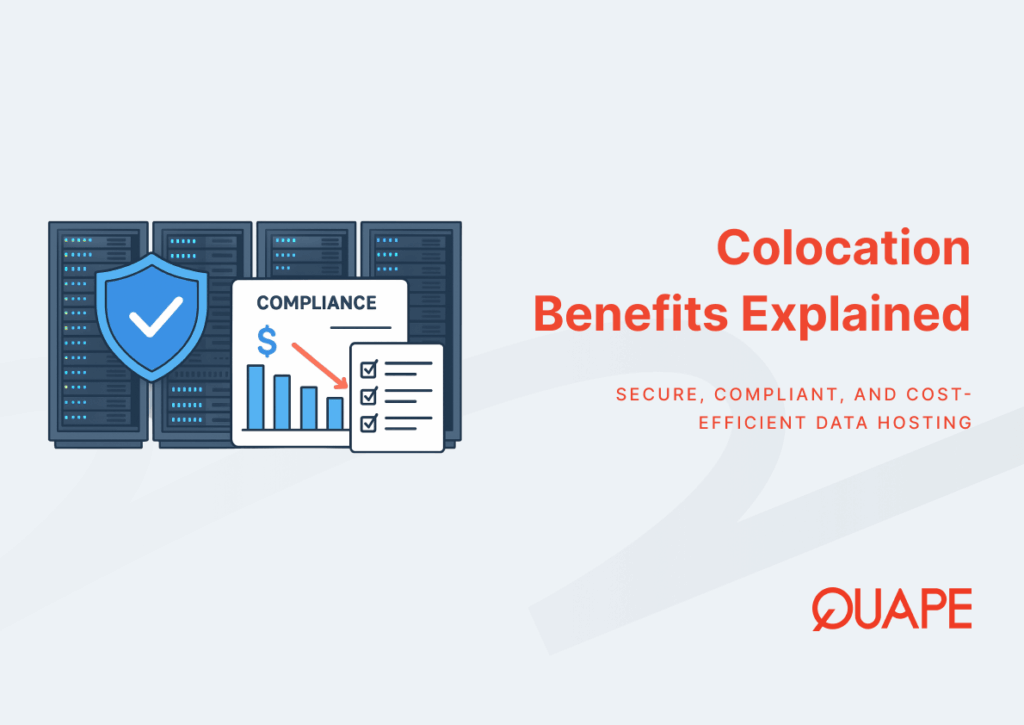
As cloud adoption accelerates, enterprises are rediscovering the value of control. Colocation services bridge the gap between full ownership and flexible scalability, giving organizations the ability to manage their own hardware inside secure, professionally managed data centers. This approach delivers what modern IT leaders demand most: data control, regulatory compliance, and lower, more predictable operating costs, especially in markets like Singapore, where governance and uptime standards are uncompromising.
Key Takeaways
- Physical control: Colocation enables direct ownership of hardware and data flows, essential for meeting PDPA and ISO 27001 compliance obligations in Singapore
- Cost predictability: Fixed monthly costs for rack space and power eliminate cloud egress fees and variable consumption charges that destabilize long-term budgets
- Performance optimization: Strategic peering relationships and redundant network paths reduce latency for APAC-facing applications
- Hybrid foundation: Colocation facilities serve as neutral interconnection points, enabling seamless integration between on-premises infrastructure and public cloud bursting
- Regulatory alignment: Singapore’s stable legal framework and submarine cable infrastructure position it as APAC’s primary colocation hub
- Infrastructure resilience: TIA-942 standards and redundant power systems ensure 99.9% uptime commitments backed by contractual SLAs
Why Colocation Matters for Modern IT Infrastructure
Data center strategy now operates within competing pressures: cloud adoption accelerates operational flexibility, yet compliance frameworks increasingly demand demonstrable control over physical infrastructure. Colocation hosting resolves this by decoupling infrastructure control from facility management. Organizations retain ownership of servers and storage while delegating power distribution, climate control, and security operations to specialized providers.
This separation matters because regulatory environments, particularly Singapore’s PDPA framework, require organizations to prove they maintain governance over data processing and storage locations. Cloud hosting introduces ambiguity in this chain of custody; colocation eliminates it by placing customer hardware in auditable, geographically fixed facilities. The model also addresses cost volatility. Public cloud pricing operates on consumption-based models where egress fees, instance scaling, and storage costs fluctuate monthly. Colocation converts these variables into fixed line items: rack space, allocated power, and bandwidth commitments.
The distinction between colocation and other hosting models hinges on control boundaries. Cloud providers own the hardware stack and abstract infrastructure through APIs; customers interact with virtualized resources. Colocation reverses this: customers own physical servers, install their own operating systems, and configure networking independently. The facility provides only the environmental services, redundant power, cooling, fire suppression, and connectivity to carrier networks, that would otherwise require capital investment in private data center construction.
Understanding Colocation Servers and Their Core Advantages
Colocation servers represent customer-owned hardware deployed within shared or dedicated rack environments. The tenant purchases or leases physical machines, typically 1U to 42U form factors, and installs them in allocated rack space. This contrasts with cloud hosting models where virtualization layers abstract hardware ownership, and with dedicated server arrangements where the provider owns the physical equipment and leases it to the customer.
The colocation model shifts infrastructure responsibilities onto a shared axis. The facility manages power distribution, HVAC systems, physical security perimeters, and network carrier access. The tenant handles everything above the rack: server procurement, operating system installation, application deployment, security patching, and data backup. This division enables workload optimization because organizations select hardware specifications aligned with application requirements rather than conforming to predefined instance types or managed hosting packages.
Data Control, Maintaining Ownership and Governance
Data control in colocation environments stems from physical custody. When an organization places servers in a colocation rack, it retains exclusive access to those machines. No hypervisor layer mediates storage access; no shared tenancy model distributes workloads across pooled hardware. This arrangement directly supports compliance with PDPA and ISO 27001 frameworks because data sovereignty requirements depend on demonstrable control over where data resides and who can access it.
Singapore’s PDPA mandates that organizations transferring personal data overseas ensure receiving parties apply comparable protection standards. Colocation simplifies this by enabling customers to select facility locations within Singapore’s jurisdiction and enforce contractual terms that prohibit provider access to customer hardware without explicit authorization. ISO 27001 certification, common among Singapore colocation facilities, establishes information security management systems with auditable controls for access logging, incident response, and vulnerability management.
Governance extends beyond regulatory compliance into operational authority. Colocation customers define their own security policies: firewall rules, intrusion detection configurations, encryption standards, and authentication mechanisms. Cloud environments enforce provider-defined security boundaries; colocation removes these constraints, allowing organizations to implement controls matched to their specific threat models and risk tolerances.
Cost Efficiency, Reducing Operational and Cloud Costs
Cost structures in colocation operate on fixed capacity allocations rather than consumption-based billing. A 1U server plan includes defined rack space, power allocation (measured in kVA), bandwidth commitment, and IP addresses at a predictable monthly rate. This contrasts sharply with public cloud pricing where compute instances, storage volumes, and data transfer fees accumulate based on usage patterns that often prove difficult to forecast accurately.
The financial appeal becomes evident in long-term ROI calculations for stable workloads. Applications with consistent resource requirements, database servers, file storage, continuous integration systems, incur predictable costs in colocation environments. The same workloads in cloud environments generate variable expenses through egress charges (data leaving the cloud provider’s network), instance runtime costs that scale with utilization, and storage fees that compound as data volumes grow.
Hybrid infrastructure strategies amplify these savings. Organizations can colocate workloads with steady-state resource demands while using public cloud for burst capacity or development environments. Colocation pricing models make this feasible by offering incremental capacity additions, scaling from 1U to 42U racks, without requiring renegotiation of fundamental cost structures or absorbing early termination penalties common in cloud committed-use discounts.
Workload Optimization, Performance, Latency, and Uptime
Performance optimization in colocation environments depends on network architecture and power reliability. Singapore facilities benefit from direct connections to submarine cable landing stations, reducing latency for APAC-facing applications. Network redundancy and peering relationships enable colocated servers to exchange traffic with major cloud providers, content delivery networks, and regional internet exchanges without routing through tertiary transit providers.
This connectivity model improves application responsiveness because packets traverse fewer autonomous systems between origin and destination. Latency reductions matter for real-time applications, video conferencing, financial trading platforms, gaming servers, where millisecond delays degrade user experience. Colocation facilities positioned near internet exchange points provide natural peering opportunities that cloud regions, despite their distributed presence, cannot replicate without additional costs.
Uptime commitments in colocation facilities derive from redundant infrastructure. Power and cooling systems operate with N+1 or 2N redundancy, ensuring that single-component failures do not interrupt service. Backup generators activate automatically during utility outages; redundant HVAC units maintain temperature and humidity within operational specifications. These systems enable facilities to offer 99.9% uptime SLAs, translating to approximately 8.76 hours of permissible downtime annually, far exceeding typical office internet connection reliability.
Key Infrastructure Components Behind Reliable Colocation
Colocation reliability rests on interlocking infrastructure systems that isolate tenant equipment from environmental and operational failures. Power distribution, cooling, security perimeters, and network connectivity function as discrete subsystems, each engineered with redundancy to prevent single points of failure from cascading into service interruptions.
Physical security frameworks in modern colocation facilities implement layered access controls. Biometric authentication verifies identity at facility entry; mantrap vestibules prevent tailgating; video surveillance covers all access corridors; and cabinet-level locks restrict access to individual racks. These measures protect against unauthorized physical access, a risk vector that cloud abstractions obscure but do not eliminate.
Data center tier classifications codify infrastructure expectations. Tier 3 facilities, common in Singapore colocation, provide concurrent maintainability, meaning components can be serviced without shutting down equipment. This requires dual power paths to every server, redundant cooling systems, and sufficient generator capacity to sustain operations during extended utility outages. Organizations selecting colocation providers should verify tier certifications rather than relying on marketing claims, as operational practices determine actual resilience.
Remote hands support extends operational capabilities for organizations without on-site staff. Facility technicians perform hardware installations, cable management, equipment reboots, and visual inspections under customer direction. This service bridges the gap between physical infrastructure access and remote management tools, enabling geographically distributed teams to maintain equipment without travel overhead.
Security & Compliance Frameworks
ISO 27001 certification establishes a management system for information security that encompasses policies, procedures, and controls. Colocation facilities holding this certification demonstrate structured approaches to risk assessment, access control, incident management, and business continuity. For customers, provider certification simplifies compliance audits because facility-level controls, physical security, environmental monitoring, personnel vetting, inherit the provider’s audit results rather than requiring independent verification.
Singapore’s regulatory environment reinforces these standards. PDPA compliance requirements mandate organizations implement reasonable security arrangements for personal data protection. Colocating in ISO 27001-certified facilities helps satisfy this obligation because the certification process requires facilities to document and test their security controls annually. Customers can then focus internal compliance efforts on application-layer security and data handling procedures rather than auditing facility-level infrastructure.
Compliance frameworks extend beyond certification badges into operational practices. Facilities must maintain audit logs for physical access events, implement change management procedures for infrastructure modifications, and conduct regular security awareness training for staff. These practices reduce insider threat risks and provide evidence trails that support forensic investigations or regulatory inquiries.
Power & Cooling Infrastructure
Power redundancy in colocation facilities typically implements N+1 or 2N configurations. N+1 means that if the facility requires N power units to operate, it maintains N+1 units so that any single failure preserves service. 2N architectures duplicate the entire power distribution path, two utility feeds, two generator systems, two UPS units, providing complete redundancy at higher capital cost.
TIA-942 standards define these power architectures along with cooling requirements. Cooling systems must maintain equipment within manufacturer-specified temperature ranges, typically 18-27°C (64-80°F), to prevent thermal throttling or hardware failure. Precision HVAC units with hot-aisle/cold-aisle containment optimize cooling efficiency by directing conditioned air to equipment intakes and exhausting heated air separately.
Power utilization effectiveness (PUE) measures facility efficiency by comparing total facility power consumption to IT equipment power consumption. The Uptime Institute’s 2024 survey reports an industry average PUE of 1.56, meaning that for every watt consumed by IT equipment, an additional 0.56 watts powers cooling, lighting, and other facility systems. Modern Singapore facilities often achieve PUE values below 1.4 through efficient cooling designs and power distribution technologies.
Network Connectivity & Peering Efficiency
Network connectivity in colocation facilities operates through carrier-neutral models that provide access to multiple upstream internet service providers and cloud on-ramps. This contrasts with cloud providers’ proprietary networks where traffic routing and peering relationships remain opaque to customers. Carrier neutrality enables organizations to select connectivity providers based on latency, cost, and performance requirements rather than accepting bundled network services.
Peering relationships reduce latency by enabling direct traffic exchange between networks at internet exchange points. When two networks peer, traffic between them bypasses transit providers, reducing hop counts and improving responsiveness. Singapore hosts major regional peering points, Equinix Singapore, SGIX, that aggregate traffic from APAC carriers, cloud providers, and content delivery networks.
Hybrid infrastructure architectures depend on efficient peering. Organizations running workloads across colocation facilities and public cloud need low-latency, high-bandwidth connections between these environments. Direct cloud interconnects, offered by major providers, terminate within colocation facilities, enabling private connectivity that bypasses the public internet and reduces data transfer costs compared to standard egress fees.
Regional Focus, Why Singapore Is the Colocation Capital of APAC
Singapore’s position as APAC’s colocation hub stems from geographic, regulatory, and infrastructure advantages that compound over time. The nation sits at the convergence of major submarine cable routes connecting Asia, Australia, and the Middle East. This places Singapore’s data centers within low-latency reach of markets representing over 60% of global internet users.
Submarine cable infrastructure determines international connectivity options. Singapore hosts landing stations for over 20 cable systems, including SEA-ME-WE (connecting Southeast Asia to the Middle East and Europe), Asia-Pacific Gateway, and numerous intra-APAC cables linking to Indonesia, Philippines, Thailand, and Vietnam. This cable diversity provides redundant international paths that improve resilience against cable cuts, common events in undersea infrastructure.
Regulatory stability differentiates Singapore from regional alternatives. The government maintains consistent data protection policies, intellectual property enforcement, and political neutrality that reassure multinational organizations about long-term operational risks. Unlike jurisdictions with fluctuating data localization requirements or unpredictable policy interventions, Singapore’s legal framework evolves through consultative processes with transparent implementation timelines.
Data sovereignty considerations push organizations toward Singapore for APAC operations. Housing data within Singapore satisfies localization requirements for multiple regional markets while maintaining connectivity to global networks. This contrasts with locating infrastructure in markets with restrictive data transfer policies that complicate hybrid or multi-cloud architectures.
Inside a Singapore Colocation Data Center
Operational workflows in Singapore colocation facilities follow standardized procedures that balance security with customer access needs. Authorized personnel submit access requests through online portals, specifying visit purposes and duration. Facility staff validate credentials against approved contact lists before issuing temporary access badges. Inside the facility, CCTV surveillance, motion sensors, and escort requirements ensure that visitors remain in authorized areas.
Equipment installation follows structured processes. Customers ship hardware to facility loading docks where staff verify shipments against advance manifests. Technicians transport equipment to designated racks, install servers according to customer specifications, cable management procedures ensure proper airflow, and power connections follow redundancy policies to prevent accidental single-feed configurations. Remote hands services extend this support to routine maintenance tasks, drive replacements, cable reconnections, visual inspections, requested through ticketing systems.
Environmental monitoring systems track temperature, humidity, power consumption, and network connectivity in real time. Alerts trigger when parameters exceed thresholds, enabling proactive intervention before conditions degrade equipment performance. Customers access monitoring dashboards through facility portals, providing visibility into rack-level metrics without requiring physical presence.
Hybrid Infrastructure, Combining Colocation with Cloud Scalability
Hybrid infrastructure architectures position colocation as the stability layer for mission-critical workloads while leveraging public cloud for variable capacity demands. This model addresses a fundamental tension in IT operations: predictable workloads benefit from fixed infrastructure costs and maximum control, while unpredictable workloads require elastic scaling and minimal management overhead.
Typical hybrid patterns colocate database servers, authentication systems, and application tiers with steady resource demands. Cloud environments handle front-end web tiers that scale with traffic variations, development and testing environments that spin up and down on demand, and batch processing jobs with irregular scheduling requirements. This separation optimizes cost because steady-state workloads avoid cloud consumption charges while dynamic workloads avoid colocation’s capacity-planning lead times.
Network connectivity between colocation and cloud determines hybrid architecture feasibility. Direct interconnects, AWS Direct Connect, Azure ExpressRoute, Google Cloud Interconnect, provide private, high-bandwidth links between colocation facilities and cloud regions. These connections bypass the public internet, improving security and reducing latency for data synchronization, backup replication, and microservice communication across hybrid deployments.
Future hybrid architectures will likely incorporate edge computing patterns where colocation facilities serve as aggregation points for distributed edge nodes. Applications requiring low latency, autonomous vehicles, augmented reality, industrial IoT, process data at edge locations but synchronize results to centralized colocation infrastructure for analysis, storage, and regulatory compliance.
How QUAPE’s Colocation Solutions Enable Control & Savings
QUAPE’s colocation services in Singapore address core enterprise requirements, cost predictability, regulatory compliance, and operational control, through structured service tiers and transparent infrastructure standards. The provider’s TIA-942-certified facility delivers 99.9% uptime guarantees backed by redundant power systems, carrier-neutral connectivity, and 24/7 monitoring.
Service level agreements define uptime commitments, response times for support requests, and remediation procedures for infrastructure failures. These contractual protections matter because they establish financial penalties for provider underperformance, creating economic incentives for maintaining service quality. Organizations evaluating colocation providers should scrutinize SLA terms carefully, as vague language around “best effort” support or exclusions for “scheduled maintenance” can undermine practical reliability.
Long-term value calculations for colocation depend on accurate workload characterization. Applications with consistent resource utilization, file servers, email systems, internal tools, generate compelling ROI because fixed monthly costs remain stable while cloud alternatives accumulate charges through continuous consumption. Break-even analysis typically spans 12-24 months depending on hardware amortization schedules and cloud pricing models for equivalent capacity.
Plan Comparison, From 1U to Full Rack
QUAPE’s colocation plans scale from 1U single-server deployments to 42U full-rack configurations, enabling organizations to match capacity to workload requirements without overprovisioning. The 1U plan (SGD 280/month) provides 0.3kVA power, 100Mbps shared bandwidth, and 2 IPv4 addresses, suitable for development servers, monitoring tools, or secondary infrastructure.
Mid-tier options, 5U (SGD 680/month) and 10U (SGD 1,200/month), support small application stacks with database, application, and web tiers distributed across multiple servers. Power allocations increase to 0.8kVA and 1.2kVA respectively, accommodating higher-density equipment like GPU servers or storage arrays with multiple disk spindles.
Enterprise deployments typically consume 20U half-racks (SGD 1,500/month) or 42U full racks (SGD 2,200/month) to house redundant infrastructure. Full-rack configurations include 3.0kVA power, 200Mbps bandwidth, and 16 IPv4 addresses, sufficient for clustered database systems, load-balanced application tiers, and backup infrastructure. Dedicated racks also enable custom security policies, separate network segments, and simplified cable management compared to shared-rack environments.
Service Reliability & Support
Reliability in colocation services extends beyond infrastructure redundancy into operational support capabilities. QUAPE provides 24/7 monitoring of power distribution, network connectivity, and environmental conditions with automated alerts for threshold violations. Remote hands technicians respond to support requests for physical tasks, equipment reboots, cable reconnections, hardware installations, typically within specified SLA timeframes.
Support responsiveness matters during incident scenarios. When a server becomes unresponsive, remote management tools (IPMI, iLO, iDRAC) provide primary diagnostic and recovery mechanisms. If these fail, remote hands staff perform visual inspections, check cable connections, and execute manual power cycles under customer direction. This capability reduces incident resolution times compared to scenarios requiring customer staff to travel to the facility.
Power availability guarantees, 99.99% in QUAPE’s infrastructure, translate to approximately 52 minutes of permissible downtime annually. This exceeds typical office utility reliability and matches or exceeds availability targets for most enterprise applications. Organizations with stricter uptime requirements can implement dual-facility redundancy, colocating failover infrastructure in geographically separated data centers to protect against facility-level outages.
Transitioning from Cloud to Colocation
Migrating workloads from public cloud to colocation requires structured planning around application dependencies, data volumes, and cutover coordination. Initial assessment identifies workloads suitable for colocation, typically those with predictable resource utilization, regulatory data residency requirements, or high data transfer volumes that generate excessive cloud egress fees.
Hardware procurement follows workload specifications. Organizations either purchase new servers matched to application requirements or reuse existing equipment. Right-sizing matters because overprovisioning increases costs without improving performance, while underprovisioning creates capacity constraints that require subsequent expansion. Capacity planning should account for growth projections over the expected hardware lifecycle, typically 3-5 years.
Data migration strategies depend on dataset sizes and acceptable cutover windows. Small datasets (under 1TB) transfer efficiently over internet connections during maintenance windows. Larger datasets may justify physical media shipping, loading data onto drives, shipping to the colocation facility, and performing local transfers, to avoid multi-day network transfers. Hybrid transition patterns maintain cloud infrastructure during migration, validating colocation performance before final cutover to minimize rollback complexity.
Conclusion, Achieving Compliance, Control & Cost Advantage
Colocation services address structural challenges in modern IT infrastructure by separating physical facility management from hardware and data governance. Organizations gain regulatory compliance capabilities through demonstrable control over data residency and security policies, cost predictability through fixed monthly pricing independent of consumption patterns, and performance optimization through carrier-neutral connectivity and regional network positioning.
Singapore’s infrastructure advantages, submarine cable density, regulatory stability, and PDPA alignment, position it as APAC’s primary colocation hub. The market’s projected growth from USD 20.23 billion in 2024 to USD 70.88 billion by 2034 reflects increasing enterprise recognition that hybrid architectures combining colocation stability with cloud elasticity outperform single-platform strategies for most workloads.
QUAPE’s TIA-942-certified facility and structured service tiers provide a practical entry point for Singapore-based organizations seeking to transition from cloud-only models or upgrade from inadequate office infrastructure. The path forward begins with workload assessment, identifying applications that benefit from fixed costs, physical control, and low-latency APAC connectivity, followed by capacity planning and structured migration.
Ready to evaluate colocation for your infrastructure? Contact our sales team to discuss workload requirements, compliance objectives, and capacity planning.
Frequently Asked Questions
What distinguishes colocation from managed hosting or dedicated servers?
Colocation transfers only facility responsibilities, power, cooling, security, while customers retain ownership and management of physical hardware. Managed hosting and dedicated servers involve provider-owned equipment leased to customers, with varying degrees of management responsibility. This ownership distinction affects capital expenditure treatment, hardware customization options, and data governance boundaries under frameworks like PDPA.
How do colocation costs compare with long-term public cloud expenses?
Colocation operates on fixed monthly costs for allocated rack space, power, and bandwidth, independent of actual utilization. Public cloud charges accumulate based on compute instance runtime, storage consumption, and data transfer volumes. For steady-state workloads with consistent resource demands, colocation typically achieves cost parity within 12-24 months and generates savings thereafter. Variable workloads with unpredictable scaling patterns often benefit more from cloud elasticity despite higher per-unit costs.
What compliance frameworks do Singapore colocation facilities typically support?
Major Singapore colocation providers maintain ISO 27001 certification for information security management and align with PDPA requirements for personal data protection. Facilities may also hold SS 564 (Singapore Standard for Data Centres), MTCS (Multi-Tier Cloud Security), and undergo regular audits for SOC 2 Type II compliance. Organizations in regulated sectors, finance, healthcare, should verify provider certifications match their specific industry requirements.
How does hybrid infrastructure combining colocation and cloud reduce operational risk?
Hybrid architectures distribute workloads according to their characteristics: predictable applications with compliance requirements colocate for maximum control and cost efficiency, while variable workloads leverage cloud elasticity. This separation prevents single-vendor lock-in, provides disaster recovery options across independent infrastructure, and enables gradual migration between platforms as requirements evolve. Direct interconnects between colocation and cloud reduce the latency and security concerns of traversing public internet.
What technical prerequisites must organizations satisfy before colocating servers?
Organizations need clearly defined hardware specifications matched to application requirements, remote management capabilities (IPMI, iDRAC, iLO) for out-of-band access, documented network architecture including IP addressing and routing policies, and established operational procedures for monitoring, patching, and incident response. Teams should also verify staff capability to manage physical infrastructure remotely or budget for remote hands services to supplement internal expertise.
How do power redundancy levels affect colocation service reliability?
Facilities with N+1 redundancy maintain one additional power component beyond operational requirements, enabling single-failure tolerance. 2N architectures duplicate entire power paths, two utility feeds, generators, and UPS systems, providing higher resilience but at increased cost. Organizations should select redundancy levels based on application availability requirements: N+1 typically supports 99.9% uptime SLAs suitable for most business applications, while 2N enables 99.99% or higher for mission-critical systems.
What security measures differentiate enterprise-grade colocation from office server rooms?
Enterprise colocation facilities implement layered physical security, biometric access controls, mantrap vestibules, CCTV surveillance, and 24/7 security staff, that office environments cannot cost-effectively replicate. Environmental controls maintain stable temperature and humidity that prevent hardware degradation, fire suppression systems protect against catastrophic loss, and redundant power systems prevent outages from utility disruptions. These measures collectively reduce unplanned downtime and hardware failure rates compared to office infrastructure.
How long does typical migration from cloud to colocation require?
Migration timelines span 4-12 weeks depending on workload complexity and data volumes. Initial planning and workload assessment require 1-2 weeks, hardware procurement and facility onboarding add 2-4 weeks, and data migration plus cutover validation consume 1-6 weeks based on dataset sizes. Organizations should plan migrations during low-traffic periods to minimize business impact and maintain parallel cloud infrastructure until colocation performance validates against production requirements.