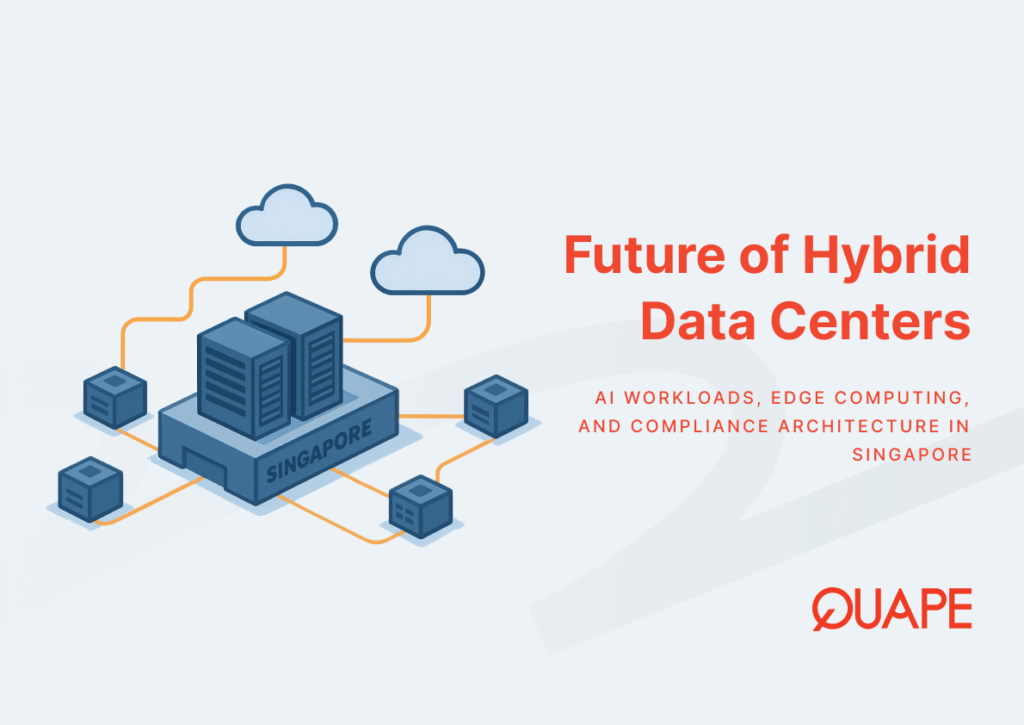
Singapore’s role as a regional connectivity hub is being reshaped by three forces: accelerating investment in AI-ready infrastructure, rising demand for edge computing nodes across APAC, and tightening data-sovereignty requirements under frameworks like the Personal Data Protection Act. Organizations now face a practical choice between centralized cloud deployments and distributed architectures that partition workloads by latency, compliance, and compute intensity. Hybrid data centers, which combine colocated core infrastructure with edge nodes for time-sensitive tasks, address this tension by enabling enterprises to control regulated data locally while leveraging regional connectivity for cross-border workflows. This model reflects a broader shift in how businesses balance performance, cost, and governance as digital infrastructure becomes a strategic asset across Southeast Asia.
A hybrid data center integrates multiple deployment models, typically colocated private infrastructure, public cloud services, and geographically distributed edge nodes, into a unified architecture managed as a single operational environment. Unlike traditional single-site deployments, hybrid designs allow organizations to allocate workloads based on specific requirements: latency-sensitive applications run at edge locations near end users, compliance-bound data remains within sovereign facilities, and compute-intensive batch jobs utilize high-density racks in centralized hubs. Singapore’s position as an APAC interconnection gateway makes it a natural anchor point for hybrid architectures serving regional markets, particularly when paired with edge capacity in secondary cities across Southeast Asia.
Key Takeaways
- Workload partitioning drives hybrid adoption: AI training and batch processing concentrate in high-density Singapore facilities, while inference and IoT tasks migrate to distributed edge nodes for reduced latency.
- Interconnectivity determines performance: Carrier-neutral colocation with peering exchange access and multi-homed upstreams materially reduces regional round-trip times, directly improving application responsiveness across APAC markets.
- Compliance shapes architecture: Singapore’s PDPA and MAS guidance for regulated sectors require data-governance controls that often mandate hybrid designs to keep sensitive information local while using cloud resources for non-regulated workloads.
- Investment signals infrastructure maturity: Multi-billion-dollar acquisitions of Singapore data center operators reflect investor confidence in sustained demand driven by AI and cloud expansion, with major players targeting capacity increases from ~650 MW to over 1.2 GW.
- Edge spending accelerates regionally: APAC edge computing investment reached approximately USD 48.9 billion in 2024, creating demand for hybrid models that link central hubs with distributed compute resources.
- Energy constraints influence design: Machine learning workloads impose significant power and cooling demands, pushing organizations toward facilities with proven density capabilities and modular infrastructure that scales predictably.
- Regional capacity expansion alters dynamics: Planned data center projects across Southeast Asia could multiply regional supply, shifting pricing and availability assumptions for tenants evaluating long-term commitments.
Key Components and Concepts Driving Hybrid Data Center Evolution
Edge Computing and Its Role in Workload Distribution
Edge computing distributes processing capacity closer to data sources and end users, reducing the round-trip distance that network packets must travel. This proximity matters most for applications where milliseconds of latency directly affect user experience or operational outcomes, real-time analytics for manufacturing sensors, video streaming with adaptive bitrate control, autonomous vehicle coordination, or financial trading platforms. As 5G networks expand coverage across Singapore and neighboring markets, the density of connected devices increases, generating larger volumes of data that become impractical or expensive to backhaul to centralized facilities for every transaction.
Organizations adopt edge architectures to offload specific workload types from core data centers while maintaining centralized control over policy, security, and data aggregation. A retail chain might process point-of-sale transactions and inventory updates at store-level edge nodes, syncing aggregated sales data to a Singapore colocation facility where business intelligence systems analyze regional trends. The edge nodes handle immediate operational needs with single-digit millisecond response times, while the colocation services infrastructure provides the interconnected backbone for data consolidation, backup, and integration with cloud-based analytics platforms. This division of responsibility allows enterprises to optimize infrastructure spending by deploying only the compute capacity each location requires rather than over-provisioning centralized resources.
IDC forecasts indicate APAC edge spending reached approximately USD 48.9 billion in 2024, reflecting strong regional adoption across industries that depend on distributed processing. Growth at this scale creates demand for hybrid management tools that treat edge nodes and core facilities as a unified environment, automating workload placement based on latency requirements, data residency rules, and available capacity. Singapore-based IT teams managing regional deployments increasingly use orchestration platforms that dynamically route traffic between edge locations and central colocation racks, shifting compute tasks as network conditions or business priorities change throughout the day.
Importance of Interconnectivity for Multi-Cloud and Cross-Border Data Flow
Interconnectivity determines how efficiently data moves between an organization’s private infrastructure, third-party cloud services, and external networks serving customers or partners. Carrier-neutral colocation facilities in Singapore provide direct cross-connects to major cloud providers, enabling private high-bandwidth links that bypass the public internet. These dedicated connections reduce latency, improve security by eliminating exposure to shared transit paths, and often lower data transfer costs compared to internet-based cloud egress fees. Enterprises running hybrid workloads, such as a database colocated in Singapore with application servers in AWS or Azure, depend on these cross-connects to maintain consistent performance as traffic flows between environments.
Peering exchanges play a complementary role by allowing networks to exchange traffic directly rather than routing through upstream providers. Singapore hosts several Internet Exchange Points where ISPs, content delivery networks, and enterprise networks interconnect, materially reducing the number of network hops required to reach regional destinations. Historical data from Internet Society research shows that effective peering strategies reduced regional latencies to Singapore down to approximately 60 milliseconds in documented cases, demonstrating measurable performance gains from strategic interconnect decisions. For businesses serving customers across APAC, latency and peering infrastructure directly affects application responsiveness and user satisfaction in markets like Indonesia, Thailand, and the Philippines.
Multi-homed connectivity, contracting with multiple upstream internet providers, adds resilience by ensuring that network failures or capacity saturation at one provider do not disrupt service. Organizations colocating in facilities with diverse carrier options can negotiate bandwidth contracts that balance cost and redundancy, scaling capacity as traffic patterns evolve. This flexibility becomes particularly valuable during traffic spikes or when expanding into new geographic markets, as teams can add peering relationships or adjust upstream allocations without physical infrastructure changes. The combination of carrier neutrality, peering access, and diverse upstreams transforms colocation facilities into regional connectivity gateways that enable hybrid architectures to function as a coherent whole rather than isolated silos.
Supporting AI Workloads with Scalable Infrastructure
AI workloads divide into two broad categories with distinct infrastructure requirements: training, which involves processing massive datasets to build or refine machine learning models, and inference, which applies trained models to new data for predictions or classifications. Training demands high-density GPU arrays, sustained power draw often exceeding 10 kW per rack, and robust cooling systems capable of removing concentrated heat loads. Research published in peer-reviewed journals confirms that machine learning operations significantly increase energy consumption and carbon exposure compared to traditional compute workloads, making power and cooling infrastructure a primary consideration for organizations deploying AI at scale.
Singapore colocation facilities designed to support AI infrastructure typically offer higher power density allocations, ranging from 3 kW per rack for general-purpose compute up to 15 kW or more for GPU-intensive applications, paired with modular cooling architectures that scale as tenant requirements grow. Data gravity, the tendency for applications and services to cluster near large datasets due to the impracticality of moving terabytes or petababytes across networks repeatedly, reinforces the value of colocating AI training infrastructure with primary data repositories. Enterprises that generate substantial proprietary data, financial institutions analyzing transaction records, healthcare providers processing medical imaging, or manufacturers aggregating sensor telemetry, often find that housing both data storage and GPU compute within the same facility reduces network bottlenecks and accelerates model iteration cycles.
Inference workloads, by contrast, prioritize low latency and geographic distribution over raw compute density. Once a model is trained, deploying it to edge nodes near end users enables real-time responses without the round-trip delay of querying a centralized facility. A hybrid architecture might train models using high-density racks in a Singapore colocation environment where data scientists can access petabyte-scale datasets, then deploy optimized inference endpoints to edge locations across APAC where customer-facing applications consume predictions. Understanding power and cooling requirements becomes essential as organizations scale AI initiatives, since underestimating infrastructure capacity can create deployment bottlenecks that delay product launches or force expensive emergency upgrades.
Major infrastructure operators in Singapore have publicly outlined expansion plans responding to AI-driven demand, with companies like Keppel targeting capacity growth from approximately 650 MW to over 1.2 GW of gross power. This investment reflects market confidence that AI workloads will continue expanding, driven by adoption in sectors ranging from autonomous systems to generative content tools. For IT teams evaluating long-term infrastructure strategies, the availability of AI-ready colocation capacity provides an alternative to public cloud GPU instances that may carry higher recurring costs or impose limits on data control and governance.
Managing Regional Latency and Compliance in Singapore
Regional latency affects application performance for users distributed across multiple countries, with network distance and routing efficiency determining the delay between user actions and system responses. Singapore’s geographic position in Southeast Asia, combined with extensive submarine cable connectivity linking APAC, EMEA, and Oceania, positions it as a logical hub for organizations serving regional markets. However, latency to neighboring countries still varies based on interconnectivity quality, direct peering and diverse fiber routes reduce round-trip times, while circuitous paths through congested transit networks introduce delays that degrade user experience.
Hybrid data center architectures address regional latency by distributing workload components based on performance requirements. Centralized databases and business logic that multiple applications share remain colocated in Singapore facilities with robust interconnectivity, while user-facing application tiers deploy to edge nodes in Jakarta, Manila, Bangkok, or other population centers. This distribution keeps interactive elements close to users, minimizing the perceptible lag in web applications or mobile services, while allowing backend systems to leverage Singapore’s regulatory environment and interconnection ecosystem. For enterprises with customers in multiple APAC markets, this model balances performance optimization with operational simplicity.
Data sovereignty and compliance introduce additional constraints that shape hybrid architectures. Singapore’s Personal Data Protection Act establishes baseline legal requirements for collecting, using, and transferring personal data across borders, while the Monetary Authority of Singapore provides guidance for regulated financial institutions. Organizations subject to these frameworks often adopt hybrid designs that keep regulated data within Singapore-colocated infrastructure, maintaining direct control over access policies, encryption, and audit trails, while using cloud or edge resources for workloads involving non-personal information. This separation allows teams to leverage cloud-native tools and regional edge capacity without triggering compliance concerns, provided they implement clear data classification and routing policies that prevent regulated information from leaving controlled environments.
Evaluating compliance and data sovereignty implications requires mapping specific legal obligations to technical controls, a process that often reveals trade-offs between operational flexibility and regulatory adherence. Some organizations choose to colocate all sensitive systems in Singapore and treat cloud services as an extension layer for non-critical workloads, while others implement more granular controls that dynamically route requests based on data classification. Either approach benefits from Singapore’s established legal frameworks and the operational maturity of its data center ecosystem, which provides predictable compliance outcomes compared to less mature regional markets.
Practical Application of Hybrid Data Centers in Singapore’s Business Landscape
Singapore enterprises and SMEs adopt hybrid architectures for reasons spanning cost optimization, performance requirements, and digital transformation initiatives. Financial services firms use colocated infrastructure to meet MAS requirements for data governance while connecting to cloud-based analytics platforms that process non-regulated business intelligence. E-commerce platforms colocate transactional databases in Singapore to serve the regional market, deploying edge nodes in high-traffic cities to cache product catalogs and accelerate page load times for local shoppers. Manufacturing companies integrate IoT sensor networks with edge processing nodes that filter and aggregate telemetry data before transmitting summarized insights to centralized systems colocated alongside ERP and planning applications.
Digital transformation projects often drive hybrid adoption when legacy on-premises systems must interoperate with modern cloud-native services. Rather than forcing a complete migration that disrupts operations and introduces risk, organizations establish colocated infrastructure as a bridge between existing investments and new capabilities. A healthcare provider might colocate patient record systems to maintain compliance and direct control while using cloud-hosted machine learning services to analyze anonymized medical data for research. This incremental approach reduces transformation risk by allowing teams to validate new technologies in production without dismantling proven systems.
SMEs benefit from hybrid models by avoiding the capital expenditure of building private data centers while retaining more control and cost predictability than pure public cloud deployments. Colocating a small number of racks in a Singapore facility provides dedicated infrastructure for core applications, proprietary databases, and backup systems, while less critical workloads run in cloud environments that scale elastically with demand. This arrangement gives smaller teams access to enterprise-grade power, cooling, and physical security without the overhead of managing facility operations, freeing internal resources to focus on application development and business logic.
Smart manufacturing initiatives exemplify hybrid architecture benefits. Production equipment generates continuous sensor streams that edge gateways filter to identify anomalies or performance trends, forwarding only relevant data to centralized analytics systems. This pattern reduces bandwidth costs by eliminating unnecessary data transfer while keeping real-time control loops local to factory floors where microsecond response times matter. The analytics layer, colocated in Singapore, aggregates data from multiple production sites, applies machine learning models to predict maintenance needs, and integrates with enterprise resource planning systems that optimize inventory and scheduling. This division of responsibility allows manufacturers to modernize operations incrementally, adding edge capabilities to existing sites while centralizing intelligence in a managed colocation environment.
How Colocation Servers Enable the Future of Hybrid Data Centers
Colocation infrastructure serves as the controlled anchor point in hybrid architectures, providing the power density, network diversity, and physical security that distributed edge nodes and public cloud regions cannot replicate. Organizations retain direct hardware control, allowing custom server configurations optimized for specific workload profiles, high-memory database servers, GPU-accelerated training rigs, or storage-dense backup appliances, without the constraints of standardized cloud instance types. This control extends to network architecture decisions, where tenants can deploy load balancers, firewalls, and SD-WAN appliances that implement hybrid connectivity policies tailored to their security and performance requirements.
Tier 3 data center facilities in Singapore offer redundant power distribution, cooling systems with N+1 or 2N configurations, and carrier-neutral network access that supports multi-homed connectivity strategies. These characteristics align with the reliability expectations of hybrid architectures, where colocated systems often serve as the authoritative source for critical data or the control plane coordinating distributed edge deployments. Network redundancy becomes essential when a central colocation facility must remain accessible to edge nodes and cloud services regardless of individual carrier failures or internet routing disruptions, making the combination of diverse upstream providers and peering exchange access a non-negotiable requirement for many enterprises.
Scalability in colocation contexts means the ability to add rack space, power capacity, and network bandwidth incrementally as requirements grow, without disrupting existing systems. Organizations starting with a few rack units can expand to half-rack or full-rack deployments as server counts increase, negotiating power and cooling allocations that match actual usage rather than paying for unused capacity. This flexibility complements hybrid strategies that evolve over time, a pilot edge deployment might initially use a small colocated footprint to centralize management tools, expanding as more edge sites come online and aggregate traffic increases. The predictable cost structure of colocation servers, where monthly fees cover space, power, and connectivity without the variable pricing of cloud compute, simplifies budgeting for infrastructure that must remain operational long-term.
Multi-homed connectivity transforms colocation facilities into regional gateways by ensuring that traffic can reach destinations across APAC, EMEA, and the Americas through multiple independent paths. This redundancy matters for hybrid architectures where colocated infrastructure must maintain constant connectivity to public cloud services, edge nodes, and external partners. A single upstream provider failure or capacity saturation event becomes a non-issue when alternative providers carry traffic seamlessly, maintaining application availability and user experience. For organizations with strict uptime requirements, financial trading platforms, healthcare portals, or SaaS providers, the combination of facility redundancy and network diversity delivered by quality colocation providers creates the operational foundation that hybrid architectures depend on.
Strategic Considerations for Singapore-Based Hybrid Infrastructure
Investment trends signal sustained confidence in Singapore’s data center market, with recent transactions including multi-billion-dollar acquisitions of major operators driven by anticipated demand from AI and cloud expansion. These deals reflect investor assessment that Singapore will remain a critical APAC hub despite land and power constraints that limit facility construction. Structure Research estimates Singapore’s data center market at approximately USD 2.6 billion in 2023, with projected compound annual growth around 11% over five years, reinforcing the city-state’s role as a strategic infrastructure location.
Regional capacity dynamics add complexity to long-term planning. Southeast Asian markets beyond Singapore are rapidly expanding data center footprints, with planned projects potentially multiplying regional capacity and altering competitive dynamics. This expansion creates opportunities for hybrid architectures that leverage Singapore as a core hub while placing edge capacity in Jakarta, Manila, or Kuala Lumpur where land and power availability support growth. Organizations must balance the interconnectivity and regulatory advantages of Singapore-based infrastructure against the economic and latency benefits of distributing workloads to emerging regional markets.
Energy considerations increasingly influence infrastructure decisions as AI workloads drive power consumption upward. Peer-reviewed research confirms that large-scale machine learning operations significantly increase energy demand and associated carbon exposure, prompting both regulatory scrutiny and corporate sustainability commitments. Organizations deploying AI infrastructure must evaluate not only whether facilities can provide sufficient power density today but also whether operators have credible roadmaps for renewable energy integration and efficiency improvements that align with long-term environmental goals. This evaluation becomes particularly relevant in Singapore, where government policy emphasizes sustainable development and where energy costs directly affect operational budgets.
Hybrid architectures offer strategic flexibility by avoiding vendor lock-in and preserving optionality as technology and business requirements evolve. Unlike pure public cloud deployments where application architectures may become tightly coupled to proprietary services, hybrid models maintain separation between infrastructure layers, making it feasible to adjust the mix of colocated, edge, and cloud resources as economics or performance requirements shift. This flexibility carries value for organizations navigating uncertain growth trajectories or regulatory environments, as it preserves the ability to rebalance infrastructure commitments without costly re-platforming efforts.
For tailored hybrid data center strategies that balance performance, compliance, and cost, contact our team to discuss your specific requirements.
Frequently Asked Questions
What defines a hybrid data center architecture in the Singapore context?
A hybrid data center combines colocated private infrastructure in Singapore facilities with distributed edge nodes across APAC and integration with public cloud services. This model allows organizations to partition workloads based on latency requirements, compliance obligations, and compute intensity while maintaining unified management. Singapore’s role as a regional connectivity hub makes it a natural anchor point for hybrid designs serving Southeast Asian markets.
Why do AI workloads drive demand for colocation infrastructure?
AI training requires high-density GPU arrays, sustained power delivery often exceeding 10 kW per rack, and robust cooling systems capable of removing concentrated heat loads. Peer-reviewed research confirms that machine learning operations significantly increase energy consumption compared to traditional compute. Colocation facilities offering higher power density allocations and modular cooling infrastructure provide the physical capacity that public cloud GPU instances may not deliver at comparable cost for sustained large-scale workloads.
How does interconnectivity affect regional application performance?
Carrier-neutral colocation with access to peering exchanges and multiple upstream providers reduces the number of network hops required to reach destinations across APAC. Internet Society research documents cases where effective peering strategies reduced regional latencies to Singapore down to approximately 60 milliseconds. For applications serving users in multiple countries, this connectivity quality directly affects response times and user experience compared to single-homed or poorly interconnected infrastructure.
What role does Singapore’s regulatory environment play in hybrid architecture decisions?
Singapore’s Personal Data Protection Act establishes legal requirements for handling personal data, including cross-border transfer restrictions. Organizations subject to these rules often adopt hybrid designs that keep regulated data within Singapore-colocated infrastructure under direct control while using cloud or edge resources for non-sensitive workloads. This separation allows teams to leverage regional edge capacity and cloud-native tools without triggering compliance violations.
How do edge computing and central colocation facilities complement each other?
Edge nodes process latency-sensitive workloads close to end users or data sources, reducing round-trip network delays for real-time applications. Central colocation facilities in Singapore provide the interconnected backbone for data aggregation, business intelligence systems, and integration with cloud platforms. This division optimizes infrastructure spending by deploying only the compute capacity each location requires while maintaining centralized control over policy, security, and data management.
What cost advantages do hybrid architectures offer compared to pure cloud deployments?
Colocation delivers predictable monthly costs covering space, power, and connectivity without the variable pricing of cloud compute instances or data egress fees. Organizations with sustained compute requirements often find that colocating hardware reduces long-term operational expenses compared to equivalent cloud capacity. Hybrid models allow teams to optimize spending by colocating baseline workloads while using elastic cloud resources for variable demand, achieving better economics than either approach alone.
How does Singapore’s data center capacity expansion affect tenant planning?
Major operators have announced capacity increases from approximately 650 MW to over 1.2 GW, responding to AI-driven demand. However, regional expansion across Southeast Asia may multiply overall supply and alter competitive dynamics. Organizations evaluating long-term commitments should consider both Singapore’s advantages in interconnectivity and regulatory maturity against emerging opportunities in secondary markets where land and power availability support growth at potentially lower cost.
What infrastructure characteristics support hybrid workload orchestration?
Effective hybrid architectures require high-bandwidth, low-latency connectivity between colocated infrastructure, edge nodes, and cloud services. Multi-homed network access with diverse carriers ensures resilience against single points of failure. Facilities offering carrier-neutral cross-connects to major cloud providers enable private dedicated links that bypass public internet routing, reducing latency and improving security for traffic flowing between environments. Combined with robust power density and cooling capacity, these characteristics enable unified management tools to treat distributed resources as a single operational environment.