Internet connectivity failures cost Singapore businesses an average of thousands of dollars per hour, yet many IT managers still rely on single-carrier setups that expose their operations to avoidable outages. Network redundancy and strategic peering arrangements determine whether your applications maintain performance during infrastructure stress or suffer cascading failures that ripple through customer-facing services. Colocation facilities designed with multi-homed connectivity and direct access to Internet Exchange Points give enterprises architectural options that transform network reliability from a reactive cost center into a proactive performance advantage. The difference between 99.5% and 99.98% uptime isn’t just statistical, it represents the gap between acceptable service delivery and revenue-protecting infrastructure that supports latency-sensitive workloads without compromise.
Network redundancy describes the practice of maintaining multiple independent network paths, equipment, and connectivity providers to eliminate single points of failure in data transmission infrastructure. When one path fails, traffic automatically reroutes through alternate channels without service interruption. This approach combines physical layer diversity (redundant fiber routes, multiple carrier connections) with control plane mechanisms (BGP routing protocols, automated failover logic) to create resilient network architectures that maintain performance under fault conditions.
Key Takeaways
- Internet Exchange Points measurably reduce link delays by shortening interconnection paths compared to standard transit routing, improving regional traffic performance while lowering transit costs.
- Multi-homing with BGP enables automated failover across two or more upstream providers, giving network operators direct control over route selection and redundancy without manual intervention.
- Tier III data center designs require concurrent maintainability through redundant distribution paths, targeting 99.982% annual availability with approximately 1.6 hours of downtime per year.
- Singapore’s position as a regional connectivity hub depends on subsea cable diversity, with over 99% of international traffic transiting undersea routes that require redundant landing points to maintain resilience.
- Colocation environments with carrier-neutral designs enable on-site cross-connects to multiple upstream providers and IXPs, delivering deterministic routing options that public cloud architectures cannot replicate.
- Edge computing deployments reduce inference latency by up to 75% compared to centralized cloud approaches for time-sensitive workloads, making regional peering and low-latency interconnects critical for AI and real-time applications.
- Recent subsea cable damage in the Red Sea affected an estimated 17% of global internet traffic, demonstrating how single-route dependencies create sudden capacity and latency shocks across regions.
Introduction to Network Redundancy and Peering
Network resilience depends on how effectively your infrastructure handles the transition between normal operations and fault conditions. When a primary fiber path experiences physical damage or an upstream provider suffers routing instability, the speed and transparency of failover separate minor incidents from business-impacting outages. Colocation services built around carrier-neutral principles enable this resilience by providing physical proximity to multiple network providers and direct interconnection options that bypass lengthy transit paths.
Internet peering creates direct traffic exchange relationships between networks, either through private agreements or shared Internet Exchange Point infrastructure. Unlike traditional transit arrangements where your traffic traverses multiple intermediary networks before reaching destinations, peering establishes shorter paths that reduce both latency and operational costs. Research from Arizona State University demonstrates that IXP-based peering reduces reliance on paid transit while improving local performance for regional traffic exchanges. Singapore hosts several major IXPs that support this model, allowing enterprises deploying infrastructure in Singapore data centers to access regional networks through single-hop connections rather than multi-hop transit routes.
The interaction between redundancy mechanisms and peering strategy determines your network’s practical resilience profile. Redundant paths provide the architectural foundation, while strategic peering relationships optimize the quality and cost-efficiency of those paths. When colocation facilities offer both on-site access to multiple carriers and direct IXP connectivity, they enable network designs that maintain performance under failure scenarios while simultaneously reducing baseline latency for normal operations. This dual benefit makes redundancy planning inseparable from peering strategy in environments where both uptime requirements and performance expectations shape infrastructure decisions.
Data center interconnection patterns influence how effectively redundancy translates into operational continuity. Facilities that concentrate multiple carriers and IXP nodes in single locations create natural peering ecosystems where cross-connects between customers and providers occur within the same building. This physical proximity reduces the time required to provision new connections, lowers the cost of adding redundant paths, and simplifies the operational complexity of managing multi-homed network architectures. The result is infrastructure that adapts more quickly to changing connectivity needs without requiring extended lead times or disruptive physical relocations.
Key Components of Network Redundancy in Colocation Environments
Multi-Homing and BGP Routing
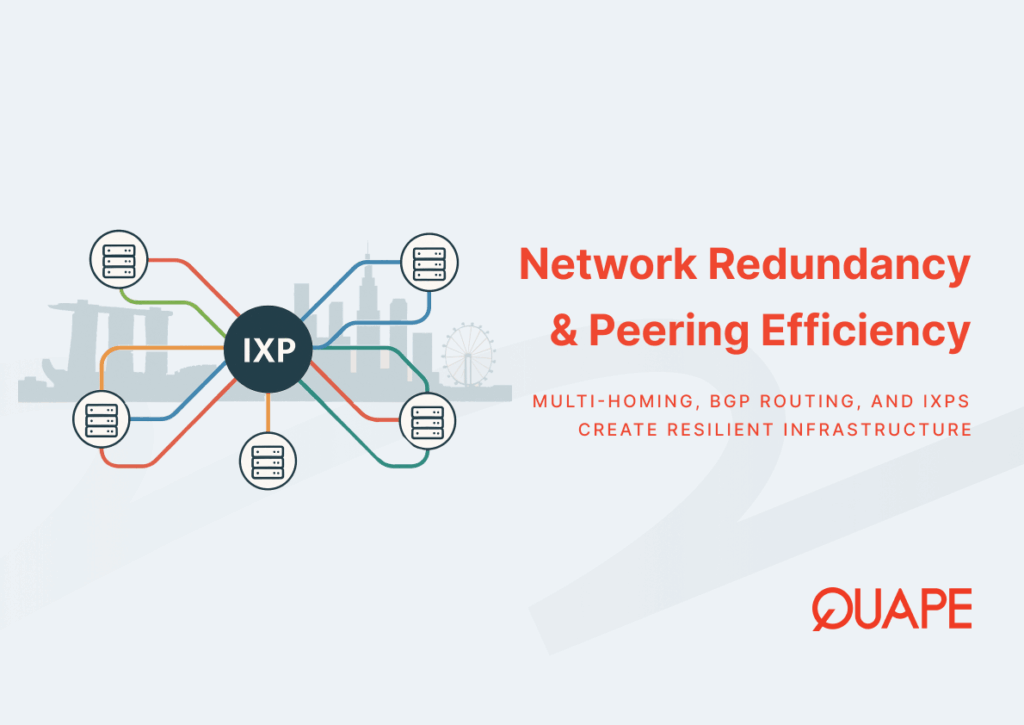
Multi-homing establishes connections to two or more upstream internet service providers simultaneously, creating parallel paths for traffic to enter and exit your network. Border Gateway Protocol manages route selection across these connections by continuously evaluating available paths and directing traffic based on policies you define. When configured properly, BGP detects upstream failures within seconds and automatically reroutes traffic through remaining healthy connections without requiring manual intervention or causing user-visible disruptions.
The control plane mechanisms that BGP provides work independently from the physical redundancy of your fiber connections. You might maintain connections to three different carriers, but without BGP’s route selection and failover capabilities, your network cannot intelligently choose between those paths or respond automatically to degraded conditions. Research published on ResearchGate confirms that BGP-based multihoming enables automated failover while giving network operators granular control over traffic engineering policies that balance load distribution with performance optimization.
Autonomous System Numbers identify your network uniquely in the global routing table, allowing you to participate in BGP peering relationships as an independent entity rather than as a downstream customer hidden behind your provider’s address space. Obtaining an ASN and announcing your own IP prefixes gives you direct control over inbound traffic routing, letting you implement sophisticated policies that prefer lower-latency paths, balance traffic across multiple links, or deliberately route sensitive workloads through specific carriers with contractual SLA commitments. This level of control proves essential for enterprises operating latency-sensitive applications where routing determinism matters as much as raw bandwidth availability.
Route reflectors and redundant routing protocols add another layer of resilience within multi-homed architectures by ensuring that route updates propagate reliably across your internal network infrastructure. When external BGP sessions establish peering with upstream providers, internal BGP distributes those learned routes to all your edge routers and core infrastructure. Route reflector designs prevent full-mesh requirements that would otherwise force every router to maintain direct BGP sessions with every other router, reducing configuration complexity while maintaining complete routing information across your network topology.
Redundant Fiber Paths and Carrier Diversity
Physical fiber paths represent the foundation on which all network redundancy depends, regardless of how sophisticated your routing protocols or traffic engineering policies become. Two circuits purchased from different carriers might both transit the same underground conduit for significant portions of their routes, creating correlated failure risks that undermine theoretical redundancy benefits. True carrier diversity requires not just different service providers but verification that those providers maintain physically diverse fiber routes with minimal shared infrastructure between your location and critical peering or transit points.
Dark fiber leases offer maximum control over path diversity by giving you direct access to the physical fiber strands without relying on a carrier’s pre-configured routes or shared infrastructure. When colocation facilities maintain relationships with multiple fiber infrastructure providers, customers gain options to construct truly diverse paths by selecting different conduits, building entry points, and route combinations that minimize geographic and logical overlap. This approach demands more sophisticated network operations capabilities but delivers deterministic diversity that carrier-provided “diverse” circuits cannot always guarantee.
Singapore’s dependence on subsea cable systems for international connectivity makes understanding cable landing diversity critical for enterprises requiring true geographic redundancy. Analysis from the Center for Strategic and International Studies notes that over 99% of Singapore’s international telecom traffic depends on undersea cable routes, meaning that cable landing site diversity directly impacts your ability to maintain connectivity during cable damage incidents. Recent Red Sea cable cuts in 2025 affected an estimated 17% of global internet traffic according to Microsoft’s reporting, forcing sudden traffic reroutes that introduced latency spikes and capacity constraints across multiple regions simultaneously.
Backbone connectivity diversity extends beyond access circuits to include the core network paths your traffic traverses between regional hubs. Tier 1 providers maintain their own global backbone infrastructure without purchasing transit from other networks, while Tier 2 providers peer extensively but still purchase some transit capacity for reaching certain destinations. Understanding this hierarchy helps you evaluate whether your carrier diversity strategy truly provides independent paths or whether your “diverse” carriers ultimately converge on shared backbone infrastructure for significant portions of your traffic flows. Colocation environments that host multiple Tier 1 and Tier 2 carriers enable direct comparison and selection based on actual path diversity rather than marketing claims.
Load Balancing and Traffic Engineering
Load balancing distributes traffic across multiple available paths based on capacity, latency, health status, or policy-defined preferences, preventing any single link from becoming a bottleneck while other circuits sit underutilized. Unlike simple failover that activates backup paths only during outages, active load balancing uses all available capacity simultaneously and provides graceful degradation when individual circuits experience partial failures or performance degradation. This approach maximizes your return on connectivity investments while improving aggregate throughput beyond what any single circuit provides.
Traffic engineering policies define how your network makes intelligent routing decisions that balance competing objectives such as minimizing latency, maximizing throughput, avoiding congested paths, or preserving capacity for priority applications. Modern traffic engineering integrates real-time monitoring data with policy-based routing to continuously adjust traffic distribution as network conditions change. When implemented within colocation infrastructure that includes robust power and cooling systems, traffic engineering capabilities operate reliably without introducing operational dependencies on infrastructure elements that might themselves become failure points.
Quality of Service mechanisms work alongside traffic engineering to prioritize latency-sensitive applications over bulk data transfers when network congestion forces difficult allocation decisions. QoS tagging and enforcement ensure that voice traffic, real-time collaboration tools, or financial trading applications receive preferential treatment during periods of high utilization, preventing business-critical workloads from suffering degraded performance due to background synchronization or backup traffic consuming available capacity. The effectiveness of QoS depends on end-to-end implementation across all network segments, making carrier cooperation and policy alignment essential for predictable results.
Network monitoring systems provide the telemetry data that drives both automated traffic engineering decisions and manual capacity planning activities. Continuous measurement of packet loss rates, latency distributions, jitter characteristics, and bandwidth utilization patterns reveals trends before they become visible to end users. When monitoring detects degraded performance on specific paths, automated systems can shift traffic to healthier circuits while alerting operations teams to investigate root causes. This feedback loop transforms network redundancy from passive insurance into active optimization that constantly adapts to changing conditions.
Peering Agreements and Internet Exchange Points (IXPs)
Internet Exchange Points function as neutral switching facilities where multiple networks physically interconnect and exchange traffic through shared peering fabric infrastructure. By establishing presence at an IXP, networks can peer directly with dozens or hundreds of other participants through a single physical port, dramatically reducing the interconnection complexity compared to arranging individual bilateral peering sessions at distributed locations. Research published in ScienceDirect confirms that IXPs empirically shorten interconnection paths and reduce link delays compared to standard transit routing arrangements.
The economic benefits of IXP participation extend beyond technical performance improvements to include substantial reductions in transit costs for regional traffic. When two Singapore-based networks peer directly at a local IXP, their traffic exchanges bypass international transit links entirely, eliminating recurring bandwidth charges while simultaneously improving latency for users in both networks. This dynamic creates a positive feedback loop where increased IXP participation improves both performance and cost-effectiveness, making Singapore’s position as a regional peering hub increasingly valuable as more networks establish local presence.
Tier 1 network providers operate extensive global backbone infrastructure and maintain settlement-free peering relationships with other Tier 1 networks, creating an interconnected mesh that routes traffic globally without purchasing transit capacity. Tier 2 providers peer extensively at IXPs and through private arrangements but still purchase some transit from Tier 1 networks to reach certain destinations. Understanding these relationships helps you evaluate whether your multi-homed connectivity strategy provides genuinely diverse paths or whether your different carriers ultimately depend on common upstream providers for significant portions of their global reach.
Direct connect and cloud interconnect services offered by major public cloud providers often integrate with IXP infrastructure or colocation facilities to provide lower-latency, higher-reliability connections compared to standard internet-based access. These dedicated interconnection options reduce the number of network hops between your colocation equipment and cloud resources, improving performance predictability while often providing more favorable pricing for data transfer compared to internet egress charges. When colocation facilities offer on-site cloud interconnect capabilities alongside traditional carrier cross-connects, they enable hybrid architectures that optimize workload placement based on performance requirements and cost considerations.
Practical Applications of Network Redundancy for Businesses in Singapore
Singapore’s role as a regional connectivity hub creates unique opportunities for enterprises requiring low-latency access to APAC markets while maintaining resilient connectivity to global destinations. The concentration of subsea cable landing sites, IXP infrastructure, and carrier networks within Singapore data centers enables network designs that combine regional performance optimization with global reach. Companies deploying latency-sensitive applications benefit particularly from this concentration, as direct peering relationships established through Singapore colocation facilities provide single-hop access to regional networks that would require multiple transit hops from other locations.
Edge computing strategies depend fundamentally on network proximity and low-latency interconnection to deliver their performance advantages. Research analyzing edge computing deployments reports latency reductions up to 75% compared to centralized cloud architectures for specific inference and real-time workloads. These dramatic improvements emerge from the combination of compute resources positioned closer to end users and optimized network paths that minimize transmission delays. When edge infrastructure colocates with IXP fabric and diverse carrier options, applications can simultaneously benefit from compute proximity and network path optimization that compounds performance gains beyond what either approach achieves independently.
Disaster recovery planning must account for both data replication requirements and network failover capabilities to ensure business continuity during infrastructure failures. Organizations maintaining synchronous replication between primary and backup sites face strict latency budgets that limit geographic distance between locations, while asynchronous replication tolerates higher latency but introduces recovery point objectives measured in minutes or hours rather than seconds. The network architecture connecting these sites determines whether failover events complete transparently or require manual intervention that extends downtime. Redundant routing between geographically distributed colocation facilities provides the foundation for automated disaster recovery orchestration.
Submarine cable system diversity directly impacts Singapore’s connectivity resilience given the nation’s near-total dependence on undersea routes for international traffic. The 2025 Red Sea cable incidents demonstrated how concentrated cable damage can force sudden traffic reroutes that introduce latency spikes and capacity constraints across broad regions. Enterprises requiring predictable international connectivity must evaluate not just which carriers they purchase from but which cable systems those carriers utilize and whether their backup circuits transit different cable routes with separate landing sites. This level of diligence proves especially critical for financial services, gaming, and real-time collaboration applications where latency variability directly impacts user experience.
Hybrid cloud architectures combine on-premises or colocation infrastructure with public cloud resources to optimize workload placement based on performance, compliance, security, and cost considerations. Network connectivity between these environments determines whether hybrid approaches deliver their intended benefits or introduce operational complexity that outweighs advantages. Direct interconnects from colocation facilities to major cloud providers create predictable, low-latency paths for hybrid traffic while avoiding internet routing variability. When these connections combine with multi-homed upstream providers for internet-bound traffic, organizations gain flexible architectures that route each workload through optimal paths rather than forcing all traffic through a single connectivity model.
Software-defined networking technologies enable programmatic control over traffic routing and policy enforcement across complex hybrid and multi-cloud environments. SDN controllers integrate with BGP routing, load balancing systems, and cloud interconnection platforms to implement dynamic traffic steering based on real-time performance metrics, application requirements, or cost optimization policies. The effectiveness of SDN approaches depends on underlying network redundancy that provides multiple viable paths for the controller to select between. Without physical diversity in connectivity options, SDN becomes merely a sophisticated interface to a fundamentally limited network architecture.
Enterprise connectivity requirements continue evolving as applications become more distributed and user expectations for performance increase. Organizations that once tolerated best-effort internet connectivity now require predictable latency, jitter, and packet loss characteristics that approach private network quality. This shift drives demand for colocation environments that combine diverse carrier options with direct IXP access and cloud interconnection capabilities, enabling network architects to construct customized solutions that meet specific application requirements without overprovisioning expensive dedicated circuits for all traffic types.
How Colocation Servers Enhance Network Redundancy and Peering Efficiency
Colocation facilities designed with carrier-neutral principles provide physical infrastructure where multiple competing network providers maintain presence, enabling customers to establish cross-connects to their choice of upstream carriers without requiring the colocation operator to act as exclusive connectivity provider. This architectural approach eliminates vendor lock-in while creating competitive pressure that benefits customers through improved service quality and pricing. The concentration of carriers within a single facility reduces the lead time and cost of adding new connections, making multi-homed redundancy configurations practical for organizations that would find the logistics prohibitive if circuits terminated at geographically distributed locations.
Network capacity planning becomes more flexible when colocation infrastructure supports rapid provisioning of additional circuits or bandwidth upgrades through existing carrier relationships. Organizations experiencing traffic growth can activate new connections or increase capacity on existing circuits without lengthy contract negotiations or physical infrastructure buildouts. This operational flexibility proves essential for businesses experiencing rapid growth or seasonal traffic patterns that strain fixed-capacity connectivity arrangements. When capacity planning integrates with redundancy requirements, colocation environments that host multiple carriers enable staged capacity additions that maintain diverse routing while scaling aggregate bandwidth.
High availability architectures depend on infrastructure reliability that extends beyond network circuits to include redundant power systems, cooling infrastructure, and physical security controls that protect the equipment maintaining network connectivity. Data centers meeting Tier III standards implement concurrent maintainability through redundant distribution paths for power and cooling, targeting 99.982% annual availability according to Uptime Institute definitions. This availability figure, corresponding to approximately 1.6 hours of downtime per year, represents the infrastructure foundation on which network redundancy builds. Network diversity cannot overcome infrastructure failures in facilities lacking proper power and mechanical system redundancy.
Infrastructure reliability improvements in Singapore’s colocation market reflect both enterprise demand for higher availability and growing capacity to serve AI and edge computing workloads requiring consistent performance. Industry analysis indicates that colocation services represented approximately 38.9% of Singapore’s data center market revenue in 2024, making it the largest segment by revenue. Market projections estimate growth from USD 4.16 billion in 2024 to USD 5.60 billion by 2030, driven partly by regional demand for low-latency infrastructure supporting emerging applications. This expansion creates opportunities for enterprises to evaluate colocation versus dedicated server options based on specific network redundancy and peering requirements rather than accepting one-size-fits-all solutions.
Network optimization in colocation environments emerges from the combination of direct control over equipment configuration, proximity to diverse connectivity options, and ability to implement customized routing policies without constraints imposed by shared infrastructure providers. Organizations can deploy specialized routing hardware, implement advanced traffic engineering policies, or integrate SD-WAN controllers that would be impractical in managed hosting environments where infrastructure standardization limits customization. This flexibility proves particularly valuable for enterprises with complex networking requirements that don’t fit standard service provider templates.
QUAPE’s colocation infrastructure combines TIA 942 Rated 3 certification with multi-homed upstream connectivity designed to support redundant network architectures. The facility’s carrier-neutral design enables customers to establish connections with multiple providers while maintaining access to regional peering options that optimize traffic routing for Singapore and APAC destinations. By concentrating diverse connectivity options within reliable infrastructure, the environment supports network designs that balance redundancy, performance, and cost-effectiveness based on specific application requirements rather than forcing compromise between competing priorities.
Organizations deploying latency-sensitive applications benefit particularly from colocation architectures that position compute resources adjacent to IXP fabric and diverse carrier cross-connect options. This physical proximity enables network designs where application servers maintain direct paths to end users through optimized peering arrangements rather than traversing multiple transit hops that introduce unpredictable latency variations. The combination of compute proximity and network path optimization delivers compound performance improvements that neither distributed cloud nor centralized data center architectures achieve independently. Learn more about QUAPE’s Colocation Server Solutions.
Conclusion
Network redundancy and strategic peering transform connectivity from a commodity service into a competitive advantage that directly impacts application performance, operational costs, and business continuity capabilities. The architectural decisions you make regarding carrier diversity, IXP participation, and routing redundancy establish the foundation on which your infrastructure either maintains reliable performance during stress conditions or suffers cascading failures that ripple through customer-facing services. Colocation environments built around carrier-neutral principles and direct IXP access enable network designs that optimize both resilience and performance without forcing tradeoffs between redundancy and cost-effectiveness. As Singapore continues expanding its position as APAC’s connectivity hub through new subsea cable investments and growing IXP participation, organizations establishing presence in strategically designed colocation facilities gain infrastructure advantages that pure cloud or single-carrier approaches cannot replicate.
For tailored infrastructure and network architecture solutions that optimize redundancy, peering efficiency, and application performance, contact our team.
Frequently Asked Questions
What is the difference between network redundancy and peering, and why do both matter?
Network redundancy provides multiple independent paths and equipment to maintain connectivity during failures, while peering creates direct traffic exchange relationships that shorten routing paths and reduce latency. Redundancy ensures service continuity when infrastructure fails, while peering optimizes the quality and cost of those paths during normal operations. Both work together to create resilient networks that maintain performance under varying conditions.
How does BGP routing enable automated failover in multi-homed networks?
BGP continuously monitors available routes across all your upstream connections and automatically detects when paths become unavailable or degraded. When a primary connection fails, BGP converges on alternate routes within seconds and redirects traffic through remaining healthy connections without manual intervention. This automation eliminates the delays inherent in manual failover procedures and prevents extended outages caused by single-circuit failures.
Why is carrier diversity more complex than just purchasing circuits from different providers?
Different carriers often purchase dark fiber from the same infrastructure providers or share conduit space through substantial portions of their routes, creating correlated failure risks. True diversity requires verification that your circuits traverse physically separate fiber paths with minimal shared infrastructure between your location and critical destinations. Without this verification, seemingly diverse connections may both fail simultaneously during fiber cuts or facility-level incidents.
What advantages do Internet Exchange Points provide for Singapore-based enterprises?
IXPs enable direct peering with multiple regional networks through a single port, dramatically reducing the complexity and cost of establishing diverse connectivity. Traffic exchanged through local IXPs bypasses international transit entirely, improving latency for regional users while eliminating recurring bandwidth charges for that traffic. Singapore’s IXPs also provide access to regional cloud providers and content networks that don’t maintain direct presence in every facility.
How do colocation facilities support network redundancy better than office-based infrastructure?
Colocation facilities concentrate multiple carrier options in single locations with physical cross-connect infrastructure already installed, reducing the cost and lead time of establishing redundant connections. They also provide infrastructure reliability through redundant power and cooling systems that office environments typically lack. This combination of connectivity diversity and infrastructure resilience enables network architectures that would be prohibitively expensive to replicate in distributed office locations.
What role do subsea cables play in Singapore’s connectivity resilience?
Over 99% of Singapore’s international traffic transits subsea cable systems, making cable route diversity essential for maintaining global connectivity during damage incidents. Organizations requiring reliable international connections must evaluate which cable systems their carriers utilize and ensure backup circuits transit different cables with separate landing sites. Recent cable damage events have demonstrated how concentrated failures can affect 17% of global traffic when route diversity proves insufficient.
When should enterprises consider investing in edge computing combined with optimized peering?
Applications requiring response times under 50 milliseconds or real-time data processing benefit substantially from edge deployments that position compute resources closer to end users. When edge infrastructure colocates with IXP fabric, the combination of compute proximity and optimized network paths delivers latency reductions that can reach 75% compared to centralized cloud approaches. Financial services, gaming, IoT analytics, and AI inference workloads particularly benefit from this architecture.
How does Tier III data center certification relate to network redundancy planning?
Tier III certification ensures concurrent maintainability through redundant power and cooling distribution paths, targeting 99.982% availability for the physical infrastructure supporting your network equipment. Network redundancy depends on this foundation because diverse circuits cannot maintain connectivity if the facility loses power or cooling. Effective redundancy planning requires both network path diversity and infrastructure reliability that prevents equipment failures from undermining your connectivity investments.