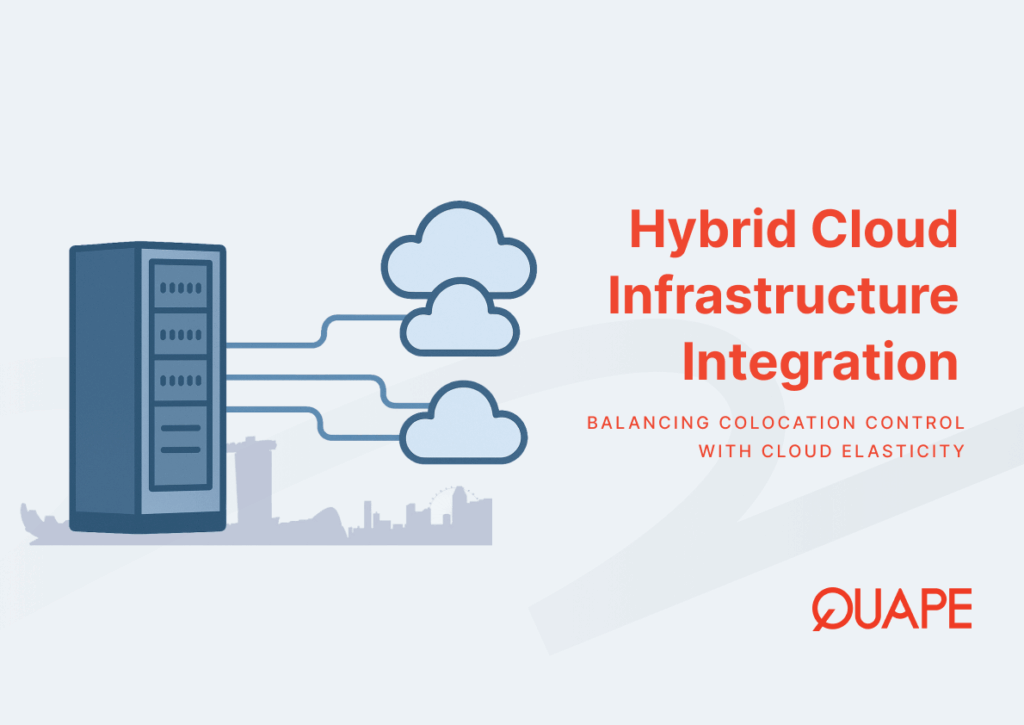
Organizations face a structural shift in how they deploy compute and storage. Hybrid cloud solutions address the tension between control and elasticity by integrating colocation servers with public cloud capacity. This architectural pattern allows enterprises to anchor predictable workloads on dedicated hardware while reserving cloud resources for variable demand. For businesses operating in Singapore, hybrid models offer access to regional interconnect fabric and low-latency peering across APAC markets. The combination of physical infrastructure control and API-driven cloud extensions defines the dominant enterprise deployment strategy through 2027.
What Are Hybrid Cloud Solutions?
Hybrid cloud solutions combine private infrastructure with public cloud services through interconnect and orchestration layers. The private component typically consists of colocation servers or on-premises data centers that house mission-critical workloads, sensitive data, or applications requiring consistent performance. Public cloud services such as AWS, Azure, or Google Cloud supply burst capacity for seasonal traffic spikes, development environments, or geographically distributed workloads. Interconnect technologies link these environments, enabling workload portability and unified management across both domains.
The architectural logic behind hybrid cloud stems from enterprise requirements that neither public cloud nor colocation alone can satisfy. Organizations need the capital efficiency and global reach of public cloud while retaining hardware-level control, data sovereignty, and cost predictability that colocation services provide. Gartner forecasts that approximately 90% of organizations will adopt hybrid cloud arrangements by 2027, reflecting the model’s ability to balance operational expenditure flexibility with infrastructure ownership.
Key Takeaways
- Hybrid cloud solutions integrate colocation servers with public cloud platforms to deliver both control and scalability within a unified architecture.
- Colocation provides low-latency, cost-predictable infrastructure for base workloads, while public cloud supplies elastic capacity for variable demand.
- Interconnect fabric and peering reduce latency between colocated hardware and cloud endpoints, enabling performant hybrid topologies.
- Singapore’s planned 700 MW Jurong Island data center park signals government support for large-scale infrastructure growth, strengthening the region’s interconnect capacity.
- McKinsey estimates global data center capital requirements of $6.7 trillion by 2030, with the majority driven by AI workloads that demand both colocated rack space and cloud-scale compute.
- Private cloud components within hybrid architectures address compliance, data sovereignty, and security policy enforcement that regulated industries require.
- Hybrid deployment models shift skill requirements toward infrastructure engineers who manage interconnect, governance, and orchestration across multiple environments.
- Asia-Pacific continues to attract significant investor capital for data center M&A activity, driven by AI infrastructure demand and regional traffic growth.
Key Components of Hybrid Cloud Solutions
Role of Colocation in Hybrid Architectures
Colocation servers anchor hybrid architectures by hosting workloads that benefit from physical hardware control, predictable latency, and fixed operating costs. Organizations deploy database clusters, transactional systems, and compute-intensive applications on colocated infrastructure when performance consistency outweighs the elasticity advantages of public cloud. Unlike virtualized cloud instances, colocation allows enterprises to specify server configurations, install proprietary hardware accelerators, and maintain direct access to storage arrays without abstraction layers that introduce latency or limit customization.
Data center interconnect capabilities determine the effectiveness of colocation within hybrid topologies. Singapore colocation data centers equipped with high-speed cross-connects to cloud on-ramps enable low-latency communication between colocated servers and public cloud services. This interconnect fabric supports use cases such as hybrid database replication, where primary instances run on colocation hardware while read replicas scale elastically in the cloud. The physical proximity of colocation racks to internet exchange points and cloud service providers reduces round-trip times that would otherwise degrade application performance in distributed architectures.
Colocation also provides a migration path for organizations transitioning from legacy on-premises infrastructure to cloud-native operations. Enterprises can relocate physical servers from office environments to professionally managed colocation facilities, gaining redundant power, carrier-grade connectivity, and environmental controls while retaining existing hardware investments. This staged approach allows IT teams to refactor applications for cloud compatibility over time rather than forcing immediate re-architecture.
Private Cloud and Data Control
Private cloud components within hybrid solutions operate on dedicated infrastructure that organizations fully control, either through colocation servers or on-premises deployments. This isolation enables enforcement of security policies, encryption standards, and access controls that regulatory frameworks mandate. Industries subject to data center compliance requirements such as financial services, healthcare, and government contractors often deploy private cloud infrastructure to maintain audit trails, restrict data residency, and implement network segmentation that public multi-tenant environments cannot guarantee.
Data sovereignty considerations drive private cloud adoption in jurisdictions with strict cross-border data transfer regulations. Organizations operating in Singapore and across APAC markets face varying national data protection laws that require workload placement within specific geographic boundaries. Private cloud environments hosted in Singapore colocation facilities allow enterprises to process customer data locally while using public cloud regions for non-sensitive analytics or content delivery. This separation satisfies legal obligations without sacrificing the operational benefits of cloud scalability.
Dedicated servers within private cloud environments also support workloads that exhibit predictable resource utilization patterns. Applications with stable CPU, memory, and storage demands often achieve lower total cost of ownership on private infrastructure compared to continuously running equivalent public cloud instances. The fixed monthly costs of colocation rack space and power allocation eliminate the variable billing complexity and potential cost overruns associated with metered cloud consumption.
Interconnect and Network Fabric for Hybrid Integration
Interconnect technologies form the critical integration layer between colocation infrastructure and public cloud endpoints. Direct physical cross-connects, virtual private network tunnels, software-defined wide area networking, and multi-cloud exchange fabrics enable secure, low-latency communication across hybrid environments. Internet exchange points and peering facilities provide high-bandwidth pathways that bypass congested public internet routes, reducing latency and improving packet delivery consistency for latency-sensitive applications.
Organizations designing hybrid architectures must evaluate interconnect options as a first-order architectural decision. The Internet Society’s analysis of APAC peering infrastructure identifies local internet exchange points as essential for regional traffic performance and cost-efficient data transfer. Singapore’s position as a regional interconnect hub offers enterprises access to diverse peering relationships and redundant transit providers, reducing dependency on single carriers and improving fault tolerance across network redundancy configurations.
Multi-protocol label switching and software-defined WAN technologies extend hybrid connectivity beyond simple point-to-point links. These protocols enable dynamic traffic routing, quality of service prioritization, and automated failover between colocation sites and cloud regions. Enterprises deploying hybrid database clusters or distributed application tiers rely on these capabilities to maintain transaction consistency and minimize data synchronization delays across geographically separated infrastructure.
Scalability with Public Cloud Extensions
Public cloud platforms supply burst capacity that hybrid architectures activate during demand spikes, geographic expansion, or experimental workloads. API-driven provisioning allows applications running on colocation servers to dynamically spawn cloud instances when traffic exceeds baseline capacity, then terminate those resources when demand normalizes. This elasticity converts unpredictable capital expenditure for over-provisioned hardware into variable operating expense aligned with actual utilization.
Load balancing mechanisms distribute traffic across colocation and cloud endpoints based on predefined policies, health checks, and geographic routing rules. Organizations configure load balancers to direct steady-state traffic to cost-efficient colocation infrastructure while overflow requests route to cloud instances that scale horizontally. This traffic shaping optimizes infrastructure costs by maximizing utilization of fixed-cost colocation resources before incurring incremental cloud charges.
Hybrid deployment models also support development and testing workflows that require ephemeral infrastructure. Engineering teams can provision cloud environments for feature testing, performance benchmarking, or user acceptance validation without consuming production colocation capacity. Once testing completes, these temporary cloud resources terminate automatically, avoiding the idle server costs that plague over-provisioned on-premises environments.
Practical Application for Businesses in Singapore
Singapore’s data center market demonstrates structural characteristics that favor hybrid cloud adoption. Mordor Intelligence estimates colocation services represent approximately 39% of the national data center market revenue, indicating strong enterprise preference for managed infrastructure versus self-operated facilities. This market composition reflects Singapore’s land constraints, high electricity costs, and regulatory requirements that make third-party colocation economically advantageous compared to building private data centers.
The government’s allocation of Jurong Island land for a 700 MW data center park signals public policy support for large-scale infrastructure growth. This capacity expansion addresses supply constraints that previously limited Singapore’s ability to attract hyperscale deployments and AI infrastructure projects. For enterprises pursuing hybrid strategies, increased local capacity translates to improved interconnect options, competitive pricing pressure on colocation services, and reduced latency to cloud on-ramps as hyperscale providers expand regional points of presence.
Regional latency characteristics influence workload placement decisions within hybrid architectures. Organizations serving customers across APAC markets benefit from Singapore’s position as an interconnect hub, where submarine cable landings and terrestrial fiber networks converge. Applications requiring low-latency access to users in Jakarta, Bangkok, Manila, and Hong Kong achieve better performance from Singapore-based colocation infrastructure than from distant public cloud regions. This latency advantage supports real-time trading platforms, multiplayer gaming backends, and IoT data aggregation systems that cannot tolerate round-trip delays exceeding 50 milliseconds.
Small and medium enterprises in Singapore increasingly adopt hybrid models to avoid the operational complexity of managing physical infrastructure while retaining control over sensitive data. Digital transformation initiatives often begin with migrating commodity workloads such as email and file storage to public cloud services, while customer databases and proprietary applications remain on colocation servers. This selective migration reduces total infrastructure footprint without exposing confidential business data to multi-tenant cloud environments.
How Colocation Servers Enable Hybrid Cloud Scalability
Colocation servers provide the stable foundation upon which hybrid architectures layer elastic cloud capacity. Organizations deploy colocation infrastructure to host workloads that require physical hardware specifications unavailable in public cloud instance catalogs. Specialized applications demanding GPU acceleration, high-memory configurations, or non-x86 processors operate on custom hardware installed in colocation racks, while supporting microservices and web tiers scale horizontally in the cloud. This division aligns infrastructure costs with workload characteristics, avoiding the premium pricing that public cloud charges for specialized instance types.
Rack space scalability within colocation facilities supports incremental infrastructure growth without long-term capacity planning. Enterprises can begin with minimal rack units for initial deployments, then expand vertically by adding servers to existing racks or horizontally by leasing additional rack space as workload demands increase. This growth flexibility mirrors the elasticity advantage of public cloud while preserving hardware ownership and fixed monthly costs that improve financial predictability.
Managed services offered by colocation providers reduce the operational burden of maintaining hybrid infrastructure. Organizations without dedicated data center operations teams can leverage vendor-supplied remote hands support for hardware installation, cable management, and basic troubleshooting. These services allow small IT departments to operate sophisticated hybrid architectures without developing expertise in physical infrastructure management, lowering the barrier to hybrid adoption for resource-constrained enterprises.
The cost structure comparison between colocation and cloud hosting demonstrates hybrid model advantages for mixed workload portfolios. Baseline applications with predictable resource consumption achieve lower three-year total cost of ownership on colocation infrastructure, while variable workloads benefit from cloud pay-per-use economics. Organizations optimizing hybrid deployments allocate 70-80% of compute capacity to colocation servers for steady-state operations, reserving 20-30% cloud allocation for burst capacity and geographic expansion.
Hardware compliance requirements in regulated industries often mandate physical infrastructure control that only colocation provides. Organizations subject to PCI-DSS, HIPAA, or financial industry regulations implement security controls at the hardware layer, including encrypted storage drives, hardware security modules, and air-gapped network segments. These physical security measures integrate with cloud-based application layers through carefully designed interconnect boundaries that maintain compliance while enabling hybrid scalability.
Strategic Considerations for Hybrid Cloud Adoption
McKinsey’s forecast of $6.7 trillion in global data center capital investment by 2030 reflects the infrastructure demands that AI workloads and data-intensive applications generate. Approximately $5.2 trillion of this projected expenditure ties directly to AI compute requirements, creating structural demand for both hyperscale cloud capacity and colocated infrastructure that enterprises use to train models, host inference engines, and store training datasets. Organizations planning hybrid architectures must account for this capital cycle’s impact on colocation pricing, interconnect availability, and cloud service expansion in key markets.
Investor M&A activity in Asia-Pacific data center assets demonstrates sustained confidence in regional infrastructure demand. Reuters reported continued heavy investment in APAC data centers throughout 2024, driven by AI infrastructure build-outs and cloud service provider expansion. This financial backing accelerates construction of new facilities, upgrades to existing colocation properties, and deployment of high-density power infrastructure that hybrid workloads increasingly require. Enterprises evaluating colocation providers should assess vendor financial stability and expansion roadmaps to ensure long-term infrastructure availability.
Skill requirements shift when organizations adopt hybrid cloud models. IT teams accustomed to managing either purely cloud-native or traditional on-premises environments must develop competencies in interconnect configuration, multi-cloud orchestration, and hybrid security governance. Recruitment strategies increasingly prioritize candidates with experience in both infrastructure domains, reflecting the operational complexity that hybrid architectures introduce. Organizations without internal expertise often engage managed service providers to bridge knowledge gaps during initial hybrid deployments.
Cost shock risks emerge when enterprises miscalculate the total cost of ownership differences between colocation base loads and cloud burst capacity. Poorly designed hybrid architectures that fail to align workload characteristics with appropriate infrastructure types can exceed both pure-cloud and pure-colocation cost structures. Effective hybrid deployment requires rigorous workload analysis, cost modeling across multi-year timeframes, and governance frameworks that prevent uncontrolled cloud resource sprawl.
Organizations pursuing hybrid strategies should establish clear workload placement policies before deployment begins. Decision frameworks that evaluate each application based on latency requirements, data sovereignty constraints, cost sensitivity, and scalability patterns guide appropriate infrastructure assignments. Regular workload reviews identify opportunities to rebalance between colocation and cloud as application characteristics evolve or as pricing dynamics shift.
Ready to architect a hybrid infrastructure that balances control and scalability? Contact our sales team to discuss colocation solutions tailored to your hybrid cloud requirements.
Frequently Asked Questions
What defines a hybrid cloud solution versus multi-cloud deployment?
Hybrid cloud integrates private infrastructure such as colocation servers with public cloud services through interconnect and unified management, creating a single operational environment. Multi-cloud simply uses multiple public cloud providers without necessarily including private infrastructure components.
How does colocation reduce hybrid cloud operating costs compared to pure cloud deployment?
Colocation converts variable cloud instance costs into fixed monthly expenses for baseline workloads, eliminating continuous metered billing for predictable applications. Organizations reserve cloud capacity for variable demand that benefits from elasticity, reducing total infrastructure costs by 30-50% compared to running equivalent capacity entirely in public cloud.
What interconnect bandwidth does hybrid architecture require between colocation and cloud?
Bandwidth requirements depend on data synchronization frequency and application coupling between environments. Loosely coupled architectures with asynchronous data replication operate effectively on 1-10 Gbps interconnect, while tightly coupled distributed databases or real-time analytics often require 10-100 Gbps dedicated links to maintain acceptable latency.
Can small businesses benefit from hybrid cloud models or are they only suitable for enterprises?
Small businesses benefit from hybrid models when they operate workloads with compliance requirements, predictable resource consumption, or latency-sensitive regional customers. Starting with minimal rack space for core applications while using cloud for web presence and email provides cost efficiency and control without enterprise-scale infrastructure investment.
How does Singapore’s data center capacity expansion affect hybrid cloud pricing?
Increased capacity such as the planned 700 MW Jurong Island development improves colocation price competition and interconnect options as more providers enter the market. Expanded supply typically reduces rack space costs and increases negotiating leverage for enterprises evaluating hybrid infrastructure providers.
What security considerations differ between hybrid cloud and single-environment deployments?
Hybrid architectures introduce security boundary management across interconnect links, requiring careful firewall configuration, encryption for data in transit, and identity federation between private and public environments. Organizations must implement consistent security policies across both domains while accommodating different compliance frameworks that each environment operates within.
How frequently should organizations reassess workload placement in hybrid architectures?
Quarterly reviews align with cloud pricing changes and application evolution patterns. Organizations should evaluate workload performance metrics, cost trends, and capacity utilization to identify migration opportunities between colocation and cloud as business requirements shift.
What role does automation play in managing hybrid cloud infrastructure?
Automation tools enable consistent provisioning, configuration management, and monitoring across colocation and cloud environments. Infrastructure-as-code practices allow teams to define hybrid topologies declaratively, reducing manual configuration errors and accelerating deployment cycles for new applications spanning both infrastructure types.