Singapore’s position as Asia-Pacific’s premier colocation destination stems from its dense submarine cable network, low-latency regional connectivity, and government-backed digital infrastructure policies. Enterprises that collocate servers in Singapore gain direct access to dozens of subsea cable landings, multiple Internet Exchange Points, and a regulatory framework that treats data centers as critical national infrastructure. These advantages reduce round-trip latency to APAC markets, improve routing redundancy, and provide the stability needed for latency-sensitive workloads such as financial trading platforms, real-time communications, and cloud gaming services. For businesses planning regional expansion or seeking alternatives to high-cost public cloud models, Singapore’s connectivity density and compliance standards make it a natural hub for colocation services that support both operational control and geographic reach.
Understanding Singapore’s Role as a Colocation Hub
A colocation hub functions as a geographic concentration point where multiple network operators, cloud providers, and content delivery networks converge to exchange traffic, establish peering relationships, and provide low-latency access to regional markets. Singapore operates as this type of hub for Asia-Pacific because it sits on major east-west subsea cable routes, hosts extensive carrier-neutral facilities, and maintains policy frameworks that encourage investment in digital infrastructure. Unlike isolated data centers that rely on a single carrier or limited routing options, Singapore’s hub architecture enables diverse network paths, localized traffic exchange through Internet Exchange Points, and the physical infrastructure required to support high-density rack deployments. This combination reduces dependency on international transit for intra-APAC traffic and creates an environment where enterprises can deploy hardware closer to end users while maintaining global connectivity.
Key Takeaways
- Singapore hosts dozens of submarine cable landings that connect Asia-Pacific to Europe, South Asia, and North America, providing routing diversity and resilience against single-cable failures.
- The Singapore Internet Exchange (SGIX) and nine other active IXPs enable local peering with hundreds of member networks, reducing transit costs and lowering latency for regional traffic.
- Government initiatives such as IMDA’s Green Data Centre Roadmap position data centers as foundational infrastructure and encourage sustainable growth with clear regulatory guidance.
- Singapore’s fixed-broadband penetration rate of 27.4 subscriptions per 100 people reflects mature digital connectivity that supports enterprise-grade colocation deployments.
- The concentration of carrier-neutral facilities and multi-homed network access gives colocated infrastructure direct connectivity to regional markets without routing through distant exchange points.
- Market investment flows exceeding USD 1.3 billion in recent dealshttps://www.reuters.com/markets/deals/kkr-singtel-consortium-invest-13-billion-st-telemedia-global-data-centres-2024-06-18/ demonstrate strong capital confidence in Singapore’s colocation sector and future capacity expansion.
- Proximity to Southeast Asian markets reduces network hops for applications serving users in Indonesia, Malaysia, Thailand, and Vietnam, improving response times for latency-sensitive services.
Geographic Location and Regional Latency Benefits
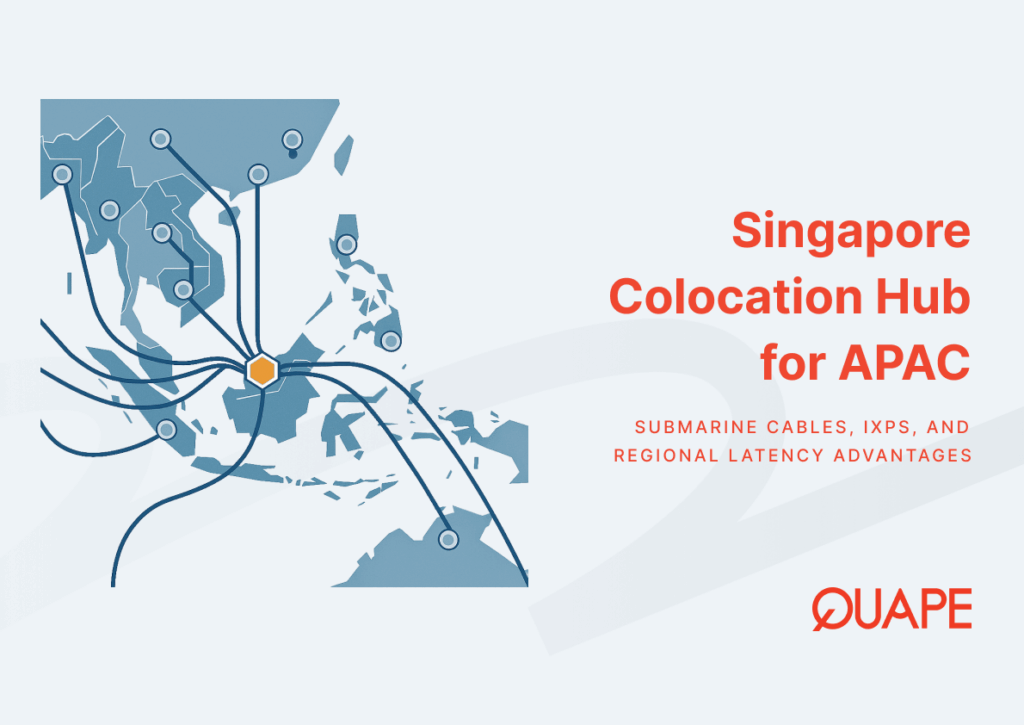
Singapore’s physical position at the southern tip of the Malay Peninsula places it on direct subsea cable routes that link APAC markets with Europe, the Middle East, and North America. This geographic advantage reduces the number of network hops required to reach major population centers in Indonesia, Malaysia, Thailand, and Vietnam, which directly lowers round-trip latency for applications serving these markets. When enterprises collocate servers in Singapore rather than routing traffic through distant exchange points in other regions, they eliminate unnecessary transit delays and improve response times for latency-sensitive workloads such as financial trading platforms, multiplayer gaming servers, and real-time video conferencing. The interaction between Singapore’s location and APAC network topology creates a natural convergence point where multiple carriers establish Points of Presence, further concentrating routing efficiency and reducing the physical distance data must travel to reach end users across the region. For detailed analysis of how latency and peering architecture influence regional data flow, technical teams can review the interaction between IXP participation and transit-free routing paths.
Submarine Cable Density and Global Routing Efficiency
TeleGeography’s submarine cable mapping data identifies Singapore as one of Southeast Asia’s densest cable landing points, with dozens of active systems including SEA-ME-WE 5, Asia-Pacific Gateway, and newer deployments planned to increase capacity to 40+ cables in the near term. This density improves routing efficiency by creating multiple physical paths between Singapore and international destinations, which allows network operators to distribute traffic across diverse routes and maintain connectivity even during cable maintenance or unexpected outages. The redundancy inherent in a multi-cable environment also reduces reliance on any single carrier or cable system, giving enterprises colocated in Singapore the ability to engineer failover configurations that maintain service continuity during infrastructure disruptions. Carnegie Endowment research on subsea cable networks in Southeast Asia highlights Singapore’s strategic role as a hub that connects intra-APAC traffic with intercontinental routes, a positioning that directly benefits businesses requiring global reach without sacrificing regional performance. Organizations can further explore network redundancy principles to understand how diverse cable landings interact with carrier-neutral facilities to create resilient connectivity architectures.
Carrier Diversity and Connectivity Advantage
Singapore’s colocation facilities support multi-homed network configurations that connect to multiple upstream providers, Internet Exchange Points, and private peering arrangements. This carrier diversity prevents single points of failure in routing paths and allows enterprises to select providers based on cost, performance, and geographic reach rather than being locked to a single ISP’s network footprint. The Singapore Internet Exchange reports peak traffic exceeding 4.6 terabits per second, which reflects substantial local peering volume that keeps APAC-to-APAC traffic within the region rather than routing it through international transit links. When enterprises collocate in carrier-neutral facilities with direct IXP access, they gain the ability to exchange traffic locally with cloud providers, content delivery networks, and regional ISPs, reducing both latency and transit costs. Internet Society data identifying 10 active IXPs and 720 combined member networks demonstrates the depth of Singapore’s peering ecosystem, which creates competitive pressure on transit pricing and improves routing efficiency for businesses that deploy infrastructure in this environment. The combination of dense submarine cable connectivity and local peering infrastructure establishes Singapore’s connectivity advantage over locations with fewer cable landings or limited carrier options.
Data Sovereignty, Compliance, and Tier Standards
Singapore’s regulatory environment treats data centers as critical national infrastructure, with government agencies such as the Infocomm Media Development Authority publishing frameworks like the Green Data Centre Roadmap to guide sustainable sector growth. This policy support creates predictable conditions for enterprises evaluating long-term colocation investments, particularly those subject to compliance requirements from financial regulators, healthcare standards bodies, or data protection authorities. Facilities certified to TIA-942 standards provide defined uptime targets, redundant power systems, and physical security controls that align with enterprise risk management frameworks, while Singapore’s data sovereignty regulations establish clear jurisdictional boundaries for data processing and storage. The interaction between compliance frameworks and Tier III/IV facility capabilities enables organizations to meet contractual obligations for uptime, audit access, and incident response without building dedicated data center infrastructure. For businesses operating in regulated industries or serving customers with strict data residency requirements, understanding data center tier classification and compliance standards helps align infrastructure decisions with operational risk tolerances and regulatory mandates.
Practical Advantages for Businesses in the Asia-Pacific Region
Small and medium enterprises expanding into APAC markets benefit from Singapore’s colocation ecosystem because it provides enterprise-grade infrastructure without requiring capital investment in facility construction, power systems, or network carrier contracts. By colocating servers in Singapore, businesses gain access to Tier III data centers, redundant power supplies rated at 99.99% availability, and bandwidth options that scale from shared 100Mbps connections to dedicated multi-gigabit circuits as demand grows. This scalability enables companies to start with modest rack space allocations and expand capacity incrementally based on traffic growth, which reduces financial risk compared to over-provisioning dedicated facilities or committing to long-term cloud contracts with usage-based pricing that escalates unpredictably. Singapore’s role as a hub also simplifies cross-border data transfer for organizations operating in multiple APAC countries, since routing through a central Singapore Point of Presence reduces the complexity of managing separate peering arrangements in each market. Enterprises evaluating hybrid infrastructure models that combine colocation with cloud services can leverage Singapore’s connectivity density to establish low-latency interconnections between on-premises hardware and public cloud regions, while those assessing colocation ROI over multi-year periods should account for both direct cost savings and the operational benefits of carrier-neutral facility access.
How Colocation Servers Improve APAC Network Performance and Control
Colocation servers deployed in Singapore provide organizations with full hardware ownership and direct control over system configurations, operating system patches, and application deployments, which differs from public cloud models where the underlying infrastructure remains abstracted behind virtualization layers. This control enables IT teams to optimize kernel parameters for specific workloads, deploy custom networking configurations, and maintain air-gapped systems for security-sensitive applications that cannot tolerate shared multi-tenant environments. Singapore’s TIA-942 certified facilities deliver 99.9% uptime through redundant power distribution, N+1 cooling systems, and dual network paths, which supports service-level agreements that require predictable availability for customer-facing applications. The combination of infrastructure reliability and hardware ownership also simplifies compliance audits, since organizations can demonstrate physical control over data storage locations and provide auditors with direct facility access when required by regulatory frameworks. For teams comparing colocation versus cloud hosting architectures, Singapore’s ecosystem offers the flexibility to deploy hybrid models that use colocated servers for stateful applications requiring consistent performance while leveraging cloud services for variable workloads that benefit from elastic scaling. Organizations requiring hands-on maintenance or hardware replacements can coordinate remote hands support with facility operators to perform tasks such as power cycling equipment, swapping failed drives, or installing additional network cards without requiring on-site staff visits.
How Colocation Server Solutions Enhance Singapore’s Hub Advantage
Colocation server deployments amplify Singapore’s hub advantages by allowing enterprises to position compute resources at the geographic center of their APAC customer base while maintaining the flexibility to scale bandwidth, power, and rack space as business requirements evolve. Providers offering tiered plans from 1U server slots to full 42U racks enable organizations to match infrastructure costs to actual capacity needs rather than over-provisioning dedicated facilities or paying cloud premiums for sustained workload patterns. Dedicated racks provide isolated environments for organizations with specific security requirements or high rack-density deployments, while shared rack options reduce entry costs for businesses testing Singapore as a regional hub before committing to larger capacity allocations. Managed service options that include 24/7 monitoring, backup administration, and equipment management reduce operational overhead for teams lacking in-market staff, while bandwidth provisioning from 100Mbps shared connections to multi-gigabit dedicated circuits accommodates workloads ranging from development environments to production systems serving regional traffic. The combination of Singapore’s connectivity infrastructure and flexible colocation service models creates an environment where enterprises can deploy hardware close to APAC markets without accepting the tradeoffs inherent in single-provider cloud platforms or the capital intensity of building dedicated facilities.
Strategic Positioning for Long-Term Infrastructure Planning
Singapore’s concentration of submarine cables, Internet Exchange Points, and carrier-neutral facilities establishes it as the primary colocation hub for enterprises prioritizing APAC market access, compliance with regional data sovereignty requirements, and infrastructure resilience against single-provider dependencies. The government’s Green Data Centre Roadmap and digital economy initiatives signal continued policy support for sector growth, while multibillion-dollar private equity investments in facility expansion demonstrate capital market confidence in Singapore’s long-term role as a regional digital infrastructure hub. Organizations planning multi-year infrastructure strategies should account for Singapore’s advantages in latency reduction, routing diversity, and regulatory stability when evaluating colocation options, particularly those serving latency-sensitive applications or managing compliance obligations across multiple APAC jurisdictions.
To explore how Singapore’s colocation ecosystem can support your infrastructure requirements, contact our team for deployment guidance and facility access options.
Frequently Asked Questions
What makes Singapore’s submarine cable network superior to other APAC locations?
Singapore hosts dozens of active submarine cable landings that connect the region to Europe, North America, and South Asia, creating routing diversity that reduces dependence on single-cable systems. This density provides multiple physical paths for international traffic and improves resilience against cable outages or maintenance events that can disrupt connectivity in locations with fewer landing points.
How do Internet Exchange Points reduce latency for APAC traffic?
IXPs enable direct traffic exchange between networks without routing through international transit providers, which eliminates unnecessary network hops and reduces round-trip times. Singapore’s 10 active IXPs with over 720 member networks create a dense local peering ecosystem that keeps intra-APAC traffic within the region and lowers both latency and transit costs.
What compliance standards apply to Singapore colocation facilities?
TIA-942 certification defines infrastructure requirements for redundancy, uptime, and physical security, while Singapore’s data protection regulations establish jurisdictional boundaries for data processing. Facilities meeting these standards provide the audit trails, access controls, and system documentation needed to satisfy regulatory requirements in finance, healthcare, and other compliance-sensitive industries.
How does carrier-neutral colocation improve network flexibility?
Carrier-neutral facilities allow enterprises to connect to multiple ISPs, cloud providers, and peering exchanges without being locked to a single provider’s network. This flexibility enables organizations to optimize routing based on performance, cost, and geographic reach while maintaining the ability to add or switch carriers as business requirements change.
What power and cooling infrastructure supports high-density server deployments?
Tier III facilities provide N+1 redundant power distribution, backup generators, and dual cooling systems that maintain temperature and humidity within equipment operating ranges. These systems support rack densities from standard 3-5kW configurations to high-density deployments exceeding 10kW per rack, which accommodates both general-purpose servers and specialized hardware such as GPU compute nodes.
How do colocation costs compare to public cloud for sustained workloads?
Colocation pricing based on rack space, power allocation, and bandwidth commits remains constant regardless of CPU utilization or storage consumption, which eliminates the variable costs associated with cloud usage-based billing. For workloads running continuously at consistent resource levels, colocation typically delivers lower total cost of ownership over 24-36 month periods compared to equivalent cloud instance pricing.
What role does Singapore’s geographic location play in serving Southeast Asian markets?
Singapore’s position at the southern tip of the Malay Peninsula places it within low-latency reach of major population centers in Indonesia, Malaysia, Thailand, and Vietnam, reducing network hops and improving response times. This proximity benefits applications requiring real-time interaction, such as financial trading platforms, multiplayer gaming, and video conferencing services.
How does government policy support Singapore’s data center sector growth?
IMDA’s Green Data Centre Roadmap provides regulatory guidance for sustainable facility operations, while national digital economy strategies explicitly link data center capacity to economic development goals. This policy framework creates predictable conditions for infrastructure investment and signals government commitment to maintaining Singapore’s role as a regional digital hub.