Server
Best Dedicated Server Use Cases: Gaming, SaaS, Streaming, E-commerce, Finance
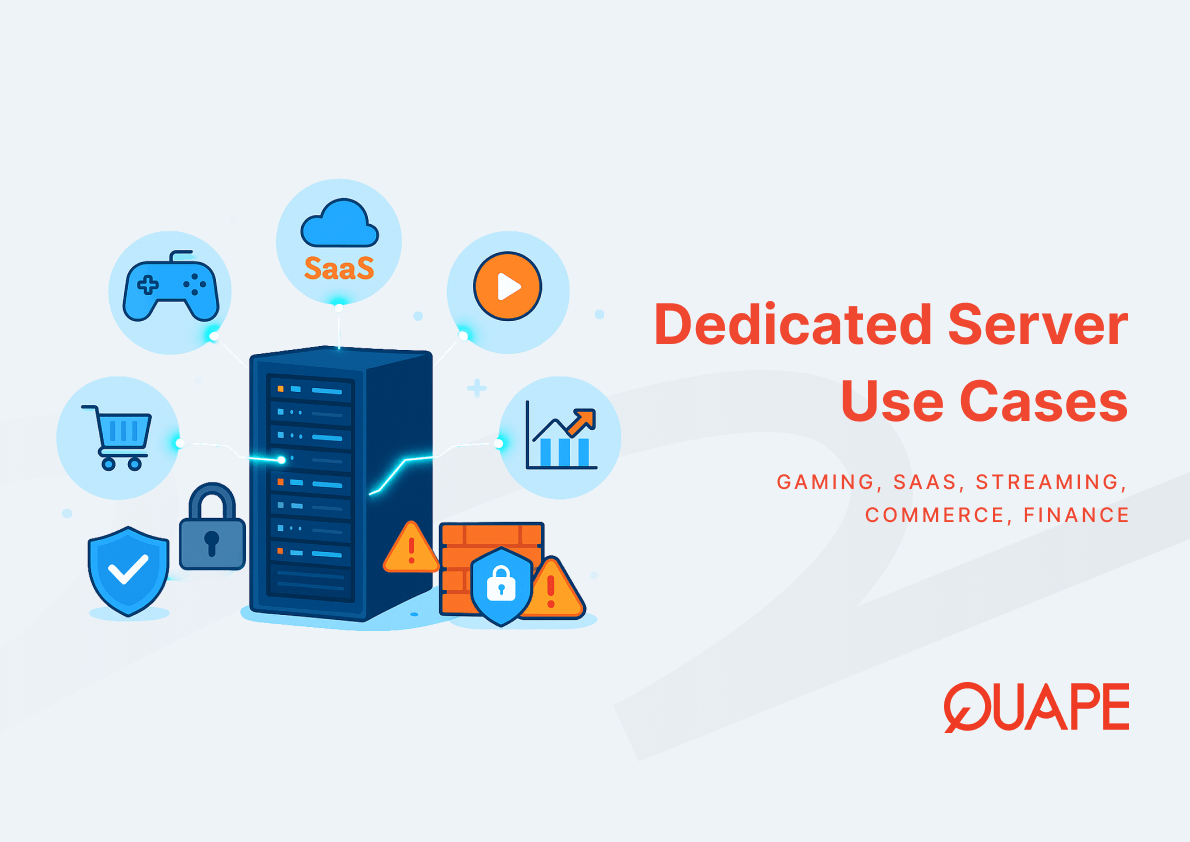
Dedicated servers remain critical infrastructure for workloads where resource isolation, predictable performance, and granular control determine business outcomes. Gaming servers processing real-time player input, financial trading platforms competing on microsecond latency, SaaS applications serving distributed user bases, and streaming services delivering high-bitrate media all depend on infrastructure that eliminates resource contention and provides consistent computational capacity. Organizations selecting dedicated hosting commit to fixed infrastructure costs in exchange for performance predictability, compliance flexibility, and operational control that shared environments cannot deliver. This article examines how different workload types leverage dedicated server characteristics and why Singapore’s connectivity, regulatory framework, and data center infrastructure create deployment advantages for Asia-Pacific operations.
Understanding Dedicated Game Servers
Dedicated game servers operate as authoritative compute nodes that manage multiplayer game state, enforce game logic, and synchronize player actions across distributed clients. Unlike peer-to-peer architectures where one player’s device acts as host, dedicated infrastructure separates game authority from player hardware, eliminating host advantage and ensuring consistent simulation regardless of individual client performance. Game servers process player input streams, execute physics calculations, manage collision detection, and broadcast state updates at fixed tick rates, typically ranging from 20 Hz for casual titles to 128 Hz for competitive shooters. These servers function as single sources of truth for game state, resolving conflicts when client predictions diverge from server-validated outcomes.
Network latency directly determines playability. Research on real-time multiplayer games demonstrates that one-way latency exceeding approximately 50 milliseconds noticeably degrades player performance and responsiveness across many game types. This threshold shapes server placement decisions: APAC-focused games require Singapore or regional hosting to serve players in Indonesia, Malaysia, Thailand, and the Philippines within acceptable latency bounds. Interactive VR and multi-user visual systems show acceptable quality of experience within a 0 to 130 millisecond operating range, with increasing latency directly reducing perceived quality and interactivity. For competitive gaming communities, server location becomes as critical as bandwidth or processing power.
Key Takeaways
- Multiplayer game servers require sub-50 ms latency to maintain responsive gameplay; Singapore placement serves APAC players within this threshold
- Dedicated infrastructure eliminates resource contention, ensuring consistent tick rates and predictable frame processing for game simulation
- High-frequency trading operates on microsecond timescales, demanding specialized network paths and hardware timestamping that dedicated servers enable
- Singapore’s data center capacity expansion (targeting 300 MW additional allocation) supports growing AI, GPU-accelerated hosting, and compute-intensive workloads
- Security incident volumes increased materially in 2024 reporting, with over 30,000 analyzed incidents highlighting the need for hardened dedicated infrastructure
- Streaming media workloads benefit from dedicated bandwidth allocation, preventing throughput degradation during traffic bursts
- PDPA compliance requirements for personal data processing make Singapore-based dedicated servers attractive for regulated industries
- Custom server configurations (BYOS options) allow workload-specific optimization for gaming, AI training, database hosting, and financial applications
Key Components and Workload Characteristics of Dedicated Game Servers
Low Latency and High Uptime Requirements in Multiplayer Environments
Latency sensitivity varies by game genre but universally impacts player retention. First-person shooters and fighting games amplify small timing differences, where 10 to 20 milliseconds of additional delay measurably affects hit registration and reaction-based mechanics. Strategy games and turn-based titles tolerate higher latency but still benefit from responsive interfaces and smooth unit movement. Packet loss creates more disruptive experiences than moderate latency increases; even 1-2% loss causes rubber-banding (visual position corrections) and ability execution failures that frustrate players regardless of average ping times.
Singapore’s network routing advantages reduce RTT for APAC connectivity. The city-state functions as a regional internet exchange hub with direct peering to major ISPs across Southeast Asia, direct subsea cable landings connecting to Australia and Japan, and established connectivity to China through multiple carriers. Dedicated servers in Singapore leverage this infrastructure to minimize hop counts and transit delays for regional player bases. Uptime requirements for game servers often exceed standard SLAs because player communities organize around fixed play schedules, competitive matches, and time-limited events. A 30-minute outage during peak evening hours in Jakarta or Manila can disperse communities to competing titles, creating churn that extends beyond the technical incident duration.
Real-time synchronization protocols like UDP-based netcode tolerate some packet loss but require consistent server processing. When servers share CPU resources with other workloads, variable processing delays create jitter (inconsistent frame timing) that networking stacks cannot compensate for. Dedicated infrastructure ensures game processes receive scheduled CPU time without interference, maintaining stable tick rates even during peak player counts or computationally intensive game states like large-scale battles or physics-heavy destruction sequences.
CPU, RAM, and Storage Optimization for Gaming Servers
Game server CPU demands scale with player count and simulation complexity. A 64-player Battlefield server processes more simultaneous projectile trajectories, destructible environment states, and vehicle physics than an 8-player Counter-Strike instance, requiring proportionally higher single-thread performance and core counts. Modern game engines distribute work across cores, but critical simulation loops often remain single-threaded or limited to 2-4 threads, making per-core clock speed as important as total core count. Intel Xeon versus AMD EPYC processor comparisons reveal trade-offs: Intel’s higher boost frequencies benefit single-thread-bound game logic, while AMD’s core density advantages parallel workloads like database queries or AI pathfinding calculations.
ECC RAM prevents silent memory corruption that can desynchronize game state. When bit flips occur in non-ECC memory, they may corrupt position data, inventory states, or match scores without triggering detectable errors, creating inconsistent game worlds between server and clients. ECC memory in dedicated servers detects and corrects single-bit errors automatically, maintaining state integrity during long-running matches or persistent world simulations. Memory capacity requirements scale with server slot counts and game state complexity: a Minecraft server hosting 100 concurrent players with extensive mod packs may require 32 GB or more, while simpler dedicated servers run comfortably in 8-16 GB.
Storage performance influences map loading times, asset streaming, and player connection speeds. NVMe versus SATA SSD comparisons show that NVMe’s reduced latency and higher IOPS benefit game servers loading large map files or streaming textures during player movement. RAID 1 configurations provide redundancy without the write performance penalties of parity-based RAID levels, important for databases tracking player progression, match statistics, and persistent inventories. Throughput matters less than latency and IOPS for typical game server workloads, since most access patterns involve small random reads rather than sequential large-file transfers.
Network Bandwidth, DDoS Mitigation, and Clean IPs
Network bandwidth requirements depend on player count, update frequencies, and game-specific packet sizes. A 64-tick Counter-Strike server transmits approximately 0.5 to 1.5 Mbps per player depending on server settings and game activity, meaning a full 64-player instance requires 32 to 96 Mbps of sustained upload capacity during active gameplay. Battle royale titles with 100-player matches and higher tick rates can exceed 150 Mbps during initial drop phases when all players remain in range. 10Gbps network infrastructure provides headroom for traffic bursts, multiple game server instances per host, and administrative traffic like remote management, backups, and log aggregation without congesting gameplay packets.
DDoS attacks targeting game servers aim to exhaust bandwidth, saturate connection tables, or exploit protocol vulnerabilities to force player disconnections. Attack vectors include UDP floods targeting game ports, SYN floods against connection establishment, and application-layer attacks exploiting game protocol parsing. DDoS protection for dedicated servers combines upstream filtering at transit providers (to absorb volumetric attacks before they reach hosting infrastructure) with local firewalls enforcing connection rate limits and protocol validation. Effective protection requires capacity exceeding typical attack sizes (many attacks now exceed 100 Gbps) and intelligent filtering that distinguishes malicious traffic from legitimate player connections during active games.
Clean IP addresses matter because gaming servers inherit reputation from previous IP usage. An IP previously associated with spam, malware distribution, or bot activity may appear on blocklists checked by anti-cheat systems, corporate firewalls, or residential ISP filters, preventing legitimate players from connecting. Dedicated static IP addresses with clean reputation ensure game servers remain accessible and avoid false positives from security systems. IPv4 scarcity makes clean address allocation increasingly valuable, while IPv6 adoption in gaming remains inconsistent across client ISPs and game engine implementations.
Use Case Comparison Across Different Business Workloads
SaaS and Web Applications Requiring Consistent Performance
SaaS platforms serving enterprise customers operate under strict SLA commitments where performance consistency determines contract renewals and expansion opportunities. Multi-tenant architectures amplify resource isolation requirements because one customer’s workload spike cannot degrade response times for others. Dedicated servers eliminate “noisy neighbor” effects inherent in virtualized shared hosting, where competing tenants can exhaust CPU cache, saturate memory bandwidth, or create storage IO contention that affects unrelated applications. API backends processing payment transactions, inventory updates, or real-time collaboration must maintain sub-200 millisecond response times even during peak usage periods, requiring guaranteed CPU scheduling and memory bandwidth that dedicated hosting provides over shared alternatives.
Database-backed applications benefit from dedicated infrastructure’s predictable IO performance. PostgreSQL, MySQL, and MongoDB workloads experience performance degradation when storage latency varies or when system memory pressure forces eviction of hot data from buffer caches. Dedicated NVMe storage ensures consistent sub-millisecond read latencies and predictable write throughput for transaction logs and index updates. ECC memory prevents corrupted query results or index structures from silent bit flips during long-running aggregate calculations or complex join operations.
Container orchestration platforms like Kubernetes require substantial overhead capacity for system pods, networking layers (Calico, Cilium), and monitoring stacks before application pods consume resources. Dedicated servers sized for containerized workloads allocate sufficient CPU and memory to maintain orchestration control plane responsiveness even when application pods scale to maximum replica counts. Auto-scaling decisions depend on accurate resource metrics; shared environments may report misleading utilization statistics when hypervisor overhead or neighboring VMs steal cycles from monitoring agents.
Streaming Media and Content Delivery for Low-Latency Experiences
Live streaming platforms delivering video to distributed audiences face bandwidth-intensive workloads where peak concurrent viewers determine infrastructure requirements. A single 1080p60 stream at 6 Mbps bitrate serving 1,000 viewers requires 6 Gbps of sustained egress bandwidth, with traffic patterns showing sharp spikes during popular events or viral content moments. Dedicated servers with 10Gbps network connections and unmetered or high-cap bandwidth allocations prevent throttling during viewer surges that would degrade stream quality or cause buffering for audiences.
Content ingest pipelines transcode uploaded video into multiple bitrates and resolutions for adaptive streaming delivery (HLS, DASH). Transcoding workloads are CPU-intensive and benefit from high core-count processors; a 30-minute 4K upload may require 2-4 hours of CPU time to generate 1080p, 720p, 480p, and 360p variants plus audio tracks. GPU-accelerated transcoding using NVENC or QuickSync reduces processing time but requires compatible hardware; GPU-equipped dedicated servers enable real-time transcoding for live streams where encoding latency must stay below 2-3 seconds to maintain interactivity with chat and viewer engagement.
Video traffic growth continues at double-digit compound annual rates according to historical Cisco forecasts, which documented approximately 12% CAGR in video traffic patterns in prior reporting cycles. Streaming platforms planning capacity must account for sustained growth and unpredictable viral events that temporarily multiply baseline traffic. Caching layers on dedicated servers store frequently accessed video segments in memory or NVMe storage, reducing origin server load and improving cache hit rates that lower egress costs and reduce latency for viewers.
High Frequency Trading and Financial Application Hosting
Financial trading platforms operate on time scales orders of magnitude tighter than gaming or SaaS workloads. High-frequency trading environments function in microsecond ranges, with research documenting that latency-arbitrage races in equity markets show modal durations of approximately 5 to 10 microseconds, illustrating how extremely sensitive these systems are to even sub-millisecond timing differences. Dedicated servers supporting algorithmic trading require specialized network configurations: kernel bypass (DPDK, Solarflare OpenOnload), hardware timestamping NICs, optimized TCP stacks, and direct fiber connections to exchange data centers or liquidity providers.
Compliance obligations shape hosting choices for financial applications. Singapore’s Monetary Authority technology risk management guidelines and PDPA data protection requirements mandate controls over data residency, access logging, and breach notification that are simpler to implement and audit on dedicated infrastructure where compliance tools do not compete with other tenants’ workloads. Financial institutions processing personal data (account information, transaction histories, KYC records) must demonstrate data sovereignty and protection measures that dedicated servers in Singapore facilitate through jurisdictional clarity and infrastructure control.
Latency targets for trading workloads dictate colocation proximity to exchanges and liquidity venues. While gaming optimizes for tens of milliseconds and SaaS targets sub-200 millisecond responses, HFT systems compete on microseconds and nanoseconds, fundamentally changing hardware selection and deployment topology. Traders colocating dedicated servers in the same facility as exchange matching engines achieve RTT measured in microseconds rather than milliseconds, capturing arbitrage opportunities that exist in sub-millisecond windows before market prices converge.
AI Hosting and HPC Compute-Intensive Applications
Machine learning training workloads require sustained high-throughput compute and memory bandwidth that differentiates them from inference or transaction-processing applications. Training large language models, computer vision networks, or recommendation systems involves iterating over datasets millions or billions of times while updating model weights through backpropagation. GPU-accelerated dedicated servers provide the parallel floating-point performance necessary for matrix operations that dominate training time; a modern data center GPU delivers 100-300 TFLOPS of FP16 throughput compared to 1-2 TFLOPS from high-end CPUs.
Vendor shipment announcements in 2024 highlighted surging demand, with major server OEMs reporting quarterly GPU deliveries exceeding 100,000 units as enterprises procured infrastructure for generative AI workloads. This procurement wave reflects organizations transitioning from experimentation on cloud GPU instances to dedicated or collocated GPU racks for cost efficiency during sustained training runs. Cloud GPU pricing creates incentive for dedicated ownership when utilization exceeds 40-60% of monthly runtime, as fixed hardware costs amortize favorably against hourly GPU rental rates.
High-performance computing applications in genomics, computational fluid dynamics, and molecular simulation similarly benefit from dedicated infrastructure’s resource isolation. Multi-day or multi-week simulation runs cannot tolerate interruptions from competing workloads or maintenance windows imposed by shared hosting providers. Dedicated servers allow users to schedule maintenance during natural workflow breaks, control kernel versions and driver updates that affect numerical precision, and configure low-latency interconnects (InfiniBand, RoCE) between nodes for MPI workloads distributing calculations across dozens or hundreds of servers.
Singapore-Specific Deployment Advantages
Singapore functions as a regional hub for APAC connectivity with direct network paths to major population centers and established peering relationships reducing transit costs and latency. Subsea cable infrastructure connects Singapore to Australia (Australia-Singapore Cable, Indigo-West), Japan (Asia Submarine-cable Express), Indonesia (SEA-ME-WE, Tata TGN-Intra Asia), and beyond, creating redundant diverse paths that improve reliability and reduce dependency on single cable systems. This geography benefits gaming servers, API backends, and content delivery workloads targeting Southeast Asian audiences where Singapore data center hosting positions infrastructure within optimal latency bounds.
Data center capacity constraints faced periodic moratorium periods but Singapore authorities recently announced a Green Data Centre Roadmap signaling plans to allocate at least 300 MW of additional capacity in the near term, supporting infrastructure growth while enforcing sustainability standards. This expansion responds to AI and cloud demand documented in regional market analysis showing Asia-Pacific as a leading region for data center deal activity driven by infrastructure procurement for machine learning and enterprise workloads. Organizations planning multi-year deployments benefit from regulatory clarity around capacity availability and environmental compliance requirements shaping future build-outs.
PDPA compliance establishes national baseline obligations for personal data collection, use, and disclosure, creating regulatory predictability for businesses processing customer information, employee records, or transaction data. Singapore’s Personal Data Protection Act provides legal framework similar to GDPR in scope but tailored to APAC business practices and enforcement mechanisms. Dedicated servers processing personal data in Singapore fall under PDPA jurisdiction, requiring appropriate technical and organizational safeguards that infrastructure control facilitates. Data sovereignty considerations make domestic hosting attractive for financial services, healthcare platforms, and e-commerce operations where cross-border data transfer restrictions or audit requirements complicate multi-region deployments.
TIA-942 data center infrastructure provides power redundancy and cooling systems that support high-density racks and sustained uptime. Dual power feeds, N+1 UPS configurations, and redundant cooling loops reduce single-point-of-failure risks for critical workloads. Carrier-neutral facilities enable direct connections to multiple ISPs and cloud on-ramps, improving path diversity and enabling hybrid architectures where dedicated servers interconnect with public cloud resources through low-latency private links.
How Dedicated Servers Improve Game and Application Performance
Resource customization enables workload-specific optimizations impossible in standardized shared hosting. Root access allows administrators to install custom kernels optimized for low-latency networking (PREEMPT_RT patches, tuned scheduler configurations), configure transparent huge pages for database performance, or disable CPU frequency scaling to eliminate latency variance from dynamic frequency transitions. Game servers benefit from kernel parameters tuning TCP buffer sizes, connection tracking table limits, and interrupt affinity binding that distributes network processing across CPU cores.
Private networking and VLAN segmentation separate management traffic from production workloads, improving security posture and simplifying compliance auditing. Private networks with VLAN isolation allow database servers to communicate with application tiers over non-routable RFC1918 addresses, eliminating exposure to internet-based reconnaissance and attack traffic targeting database ports. Administrative access through dedicated management VLANs further isolates privileged operations from production network segments, reducing attack surface and creating audit trails showing which staff accessed systems when.
Security hardening options include custom firewall rules, intrusion detection systems, and security information management integration that dedicated infrastructure accommodates without affecting other tenants. Verizon’s 2024 Data Breach Investigations Report analyzed over 30,000 security incidents including more than 10,000 confirmed breaches, highlighting system intrusion, social engineering, and web application attacks as dominant threat patterns. This threat landscape underscores the need for layered defenses combining network-level filtering, host-based intrusion prevention, application security controls, and proactive monitoring that dedicated servers support through unrestricted access to security tooling and logging infrastructure.
Scalability through controlled expansion differs from cloud auto-scaling but provides cost predictability and performance consistency. Organizations can deploy multiple dedicated servers behind load balancers, adding capacity in fixed increments as workload growth justifies additional hardware. This approach trades cloud elasticity for cost efficiency during sustained high-utilization periods, where dedicated server amortization over 36-48 month lifecycles costs less than equivalent cloud compute consumed continuously.
How Quape Dedicated Servers Enhance These Use Cases
Enterprise hardware foundations ensure reliability through components selected for extended operational lifecycles. Dell server platforms incorporate redundant power supplies protecting against single PSU failures, hot-swappable drive bays enabling storage replacement without downtime, and out-of-band management controllers (iDRAC) allowing remote administration even when operating systems are unresponsive or network stacks have failed. These features reduce MTTR (mean time to repair) and enable proactive maintenance scheduled during low-traffic windows rather than reactive emergency interventions during outages.
Xeon Scalable processors and EPYC architectures provide the computational density necessary for virtualization, containerized workloads, and compute-intensive applications. ECC memory integration across all plans prevents data corruption in long-running processes, database operations, and scientific computations where silent errors could invalidate results or desynchronize distributed system state. NVMe storage configurations with RAID 1 combine performance with redundancy, delivering sub-millisecond latencies and consistent IOPS while protecting against drive failures that could cause data loss or service interruptions.
Custom configuration options through BYOS plans accommodate specialized requirements that standardized SKUs cannot address. Organizations needing specific CPU generations for software licensing, unusual RAM capacities for memory-resident databases, or particular storage configurations for compliance requirements can specify components matching exact workload demands. This flexibility benefits gaming communities running legacy game servers with specific CPU instruction set dependencies, financial platforms requiring timestamping-capable NICs, and AI researchers prototyping hardware configurations before committing to larger deployments.
Multi-homed network connectivity and clean IP allocation provide the foundation for public-facing services requiring both performance and reputation management. 10Gbps network interfaces support high player counts, concurrent API requests, or streaming audiences without bandwidth constraints. Clean IP addresses ensure email deliverability for SaaS platforms sending transactional messages, prevent blocklist issues for game servers, and maintain reputation for financial services where IP reputation affects fraud scoring and security monitoring systems.
Proactive monitoring and TIA-942 Singapore colocation combine infrastructure reliability with geographic advantages for APAC service delivery. 24/7 monitoring detects hardware failures, network anomalies, and security events requiring intervention before they impact end-user experiences. Singapore placement reduces latency for regional audiences, simplifies compliance with PDPA and local data sovereignty expectations, and positions infrastructure within stable political and regulatory environments supporting long-term business planning.
Conclusion
Dedicated servers continue to serve workload categories where resource predictability, security control, and infrastructure customization determine operational success. Gaming servers maintaining sub-50 millisecond latency for regional player bases, financial trading platforms operating on microsecond timescales, streaming services delivering high-bitrate media to concurrent audiences, and AI training workloads requiring sustained GPU compute all benefit from dedicated infrastructure that eliminates resource contention and provides full operational control. Singapore’s position as an APAC connectivity hub, expanding data center capacity allocation, and PDPA compliance framework create deployment advantages for businesses serving Southeast Asian markets or requiring regulatory alignment with regional data protection standards. Organizations evaluating dedicated server adoption should map workload characteristics against infrastructure capabilities, considering latency requirements, compliance obligations, scaling patterns, and total cost of ownership across expected operational lifecycles.
Ready to deploy dedicated infrastructure optimized for your specific workload? Contact our sales team to discuss configuration options, capacity planning, and deployment timelines for Singapore-based dedicated servers.
Frequently Asked Questions
What makes dedicated servers necessary for gaming versus shared hosting?
Gaming servers require consistent CPU scheduling to maintain stable tick rates and predictable frame processing that determines gameplay responsiveness. Shared hosting introduces resource contention and variable latency from competing workloads, creating jitter and frame timing inconsistency that degrades player experience even when average performance metrics appear acceptable.
How does Singapore location benefit APAC-focused applications?
Singapore’s network infrastructure provides direct connectivity to major Southeast Asian population centers, reducing routing hops and transit delays that increase latency. The city-state functions as a regional internet exchange with established peering relationships, subsea cable landings to Australia and Japan, and carrier-neutral facilities enabling multi-provider connectivity for path diversity.
What latency targets do different workload types require?
Gaming servers target sub-50 millisecond one-way latency to maintain responsive real-time gameplay, while SaaS applications typically design for sub-200 millisecond API response times. High-frequency trading operates on microsecond timescales where even single-millisecond delays eliminate arbitrage opportunities. VR and interactive visual systems tolerate 0-130 milliseconds before quality degradation becomes noticeable to users.
Why do financial trading platforms require dedicated rather than cloud infrastructure?
Trading systems demand minimal latency variance and direct network paths to exchanges that cloud multi-tenant networking cannot guarantee. Dedicated servers enable kernel bypass networking, hardware timestamping, and custom TCP stack tuning that reduces jitter and provides consistent sub-millisecond performance. Regulatory compliance and audit requirements also simplify on infrastructure with single-tenant control and clear jurisdictional boundaries.
How do custom BYOS configurations benefit specialized workloads?
Build-your-own-server options allow matching specific CPU generations required by software licensing, configuring exact memory capacities for in-memory databases, or selecting specialized network cards with timestamping capabilities. This flexibility accommodates legacy application dependencies, compliance requirements specifying hardware attestation, and research workloads prototyping configurations before committing to larger deployments.
What security advantages do dedicated servers provide over shared hosting?
Dedicated infrastructure eliminates risks from neighboring tenants including side-channel attacks, resource exhaustion, and compromised VMs affecting other instances. Organizations gain full control over security tooling, firewall configurations, intrusion detection deployment, and security monitoring without restrictions imposed by shared hosting providers. Private networking and VLAN segmentation further isolate sensitive workloads from internet exposure.
How does PDPA compliance affect dedicated server deployment decisions?
Singapore’s Personal Data Protection Act establishes national obligations for personal data processing that apply to dedicated servers hosting customer information, transaction records, or employee data. Infrastructure located in Singapore provides jurisdictional clarity and simplifies compliance demonstration compared to multi-region deployments where cross-border transfer restrictions and varying legal frameworks complicate audit requirements.
What bandwidth requirements do streaming media workloads demand?
Live streaming bandwidth scales linearly with concurrent viewers and bitrate: a 1080p60 stream at 6 Mbps serving 1,000 viewers requires 6 Gbps sustained egress capacity. Peak events or viral content create traffic spikes exceeding baseline by 5-10x, requiring infrastructure headroom through unmetered connections or high-cap allocations that prevent throttling during audience surges. Content delivery benefits from 10Gbps network interfaces providing burst capacity above steady-state requirements.