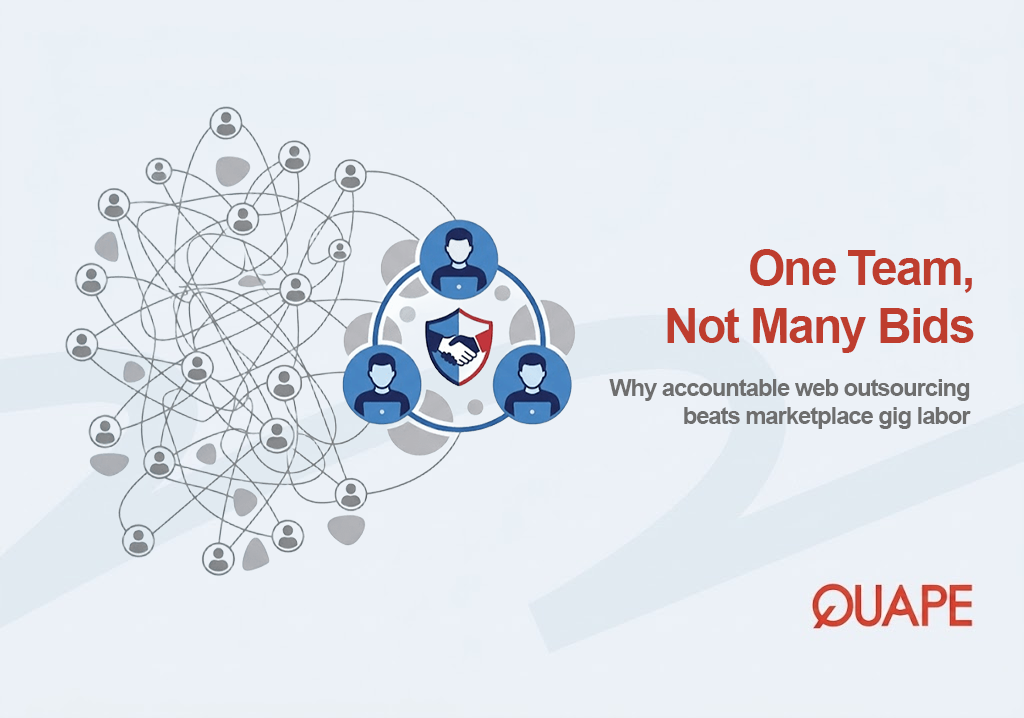
If you run a growing business in Singapore or Southeast Asia and you have ever posted a web project on Freelancer.com, you already know the pattern: dozens of bids arrive within hours, you spend an evening vetting strangers, and you hope the person you pick actually delivers. For a quick one-off task, that model works. For a website or web application your business depends on, the same model quietly transfers every risk onto you. This comparison is for SME owners, founders, and operations managers who have outgrown self-managed gig labor and are deciding whether to keep assembling freelancers project by project or move to a single accountable development partner. The short version: Freelancer.com remains a sensible choice for small, clearly scoped, price-sensitive jobs, while a managed outsourcing model fits better when you need continuity, predictable accountability, and ongoing maintenance for a business-critical platform.
Table of Contents
ToggleWhy Businesses Start Looking for a Freelancer.com Alternative
Freelance marketplaces are now a permanent part of how work gets done. The International Labour Organization estimates that around 545 million people earned income through digital labour platforms globally in 2020, and the ILO’s analysis of digital labour platforms describes how these platforms reshaped the way businesses source skills. The scale is genuine, and so is the convenience. Bestjobsearchapps
The friction shows up later. A logo or a single landing page is one transaction, but a customer-facing website is a living system that needs updates, security patches, and new features long after launch. As the work shifts from a discrete task to an ongoing operational responsibility, the marketplace model starts working against you, because the platform was designed to match buyers and sellers for individual jobs, not to own the long-term health of your web application. That gap, between what marketplaces optimize for and what a maturing business actually needs, is what pushes most SMEs to look for an alternative.
What Freelancer.com Does Well for Short-Term Web Projects
Credit where it is due. Freelancer.com is one of the largest freelance marketplaces in the world, and that scale is a real advantage for the right job. The same ILO research notes that the number of online labour platforms grew from roughly 142 in 2010 to more than 770 by 2020, and Freelancer.com sits at the top of that ecosystem with millions of registered users across almost every digital skill.
For short-term work, the marketplace model is hard to beat on speed and price:
- Fast access to a global talent pool. Post a project and you receive multiple bids within hours, across web development, design, data entry, and more.
- Competitive pricing through bidding. Freelancers compete for your job, which pushes entry prices down, useful when budget is the primary constraint.
- Flexible engagement types. Fixed-price projects suit clearly defined tasks, while hourly projects suit smaller open-ended work.
- Low commitment. There is no retainer and no contract beyond the single job, so you can test a freelancer on something small.
If your project is genuinely a one-off, tightly scoped, and you have the time to manage it yourself, Freelancer.com does exactly what it was built to do. The trouble begins when the job is none of those things.
Where the Marketplace Model Creates Business Risk
A marketplace facilitates a match. It generally does not assume responsibility for project governance, technical architecture, milestone management, or long-term maintenance. Those responsibilities do not disappear, they simply land on you. As a project grows more complex, that quiet transfer of ownership becomes the central risk.
You Become the Project Manager
When you hire through a bidding platform, you inherit the coordination work that an agency would normally absorb. The ILO research is direct about this: digital labour platforms shift coordination responsibilities to clients, who must manage recruitment, communication, task allocation, and quality control themselves. In practice that means you write the requirements, you chase progress, you test the deliverables, and you mediate when something goes wrong. For a founder or operations lead already running a business, that is a second job layered on top of the first, and the quality of the outcome depends heavily on how much project management experience you personally bring.
Every New Project Starts from Zero
The deeper cost is continuity. When a freelance engagement ends, the person who learned your business logic, your data structures, and your past technical decisions leaves with that knowledge. The next freelancer has to rediscover all of it before adding anything new. The OECD’s work on knowledge-based capital highlights how central knowledge retention is to organizational productivity, and repeated turnover directly increases knowledge loss and onboarding cost. Each new bid you award resets institutional memory to zero, which is manageable once and expensive when it happens every quarter.
The Hidden Cost Behind Low Winning Bids
A low winning bid is not the same as a low total cost. The real figure includes platform fees on payments, optional paid bid upgrades to attract better freelancers, change-request charges when scope shifts, and the value of the hours you spend selecting, managing, and re-onboarding people. Total cost of ownership stretches well beyond the developer’s rate, and it tends to grow the longer a project runs. The cheapest developer on paper can become the most expensive project in practice once management time, delays, and rework are counted.
Why These Challenges Matter More for Singapore and Southeast Asian SMEs
These risks are not academic for SMEs in this region. The World Bank estimates that SMEs make up roughly 90% of businesses and more than half of global employment, and in Singapore the digital economy already contributes close to 17% of national GDP according to the Infocomm Media Development Authority. Smaller companies are carrying more of their operations on digital infrastructure than ever, which raises the stakes on every vendor decision.
Accountability Matters More Than the Lowest Price
For a business in fintech, healthcare, education, or e-commerce, software is not a side project, it is the operational backbone, and that changes the calculus. Vendor governance becomes a genuine business risk rather than a procurement detail. The NIST Cybersecurity Framework treats third-party and supplier risk as a core part of an organization’s security posture, and broader industry data consistently shows human error involved in a large share of breaches. When an anonymous contractor handles code that touches customer or payment data, you inherit that exposure with little recourse. A single accountable partner, contractually responsible and documented, is worth more than the cheapest bid in any environment where data sensitivity and compliance are in play.
Long-Term Business Systems Need Long-Term Partners
Long-term supplier relationships reduce transaction costs by lowering the repeated effort of searching for, evaluating, and contracting vendors, a point the OECD makes consistently in its work on firm productivity. A business-critical web platform is a long-term system by definition, so pairing it with a long-term partner aligns the relationship with the asset. Re-sourcing the same capability every few months works against the very continuity these systems depend on.
Managed Outsourcing vs Freelancer Marketplace: Which Model Fits Your Business?
The honest way to frame this is not “marketplace bad, agency good.” It is a question of which model owns which responsibility. SMEs increasingly outsource IT functions to access specialized skills that are hard to recruit internally, as the OECD notes in its work on SMEs, and the right outsourcing structure depends on what you need owned.
| Question | Freelancer Marketplace | Managed Outsourcing |
|---|---|---|
| Who owns project delivery? | You do. You coordinate scope, milestones, and QA across individuals. | The partner does. One team takes ownership from scoping to deployment. |
| Who keeps business knowledge? | Knowledge leaves when each engagement ends. | The same team retains context across projects. |
| Who handles scaling when requirements grow? | You re-post, re-bid, and re-vet new people. | You scale the existing team up or down without re-hiring. |
| Who provides maintenance after launch? | Typically no one, unless re-hired per task. | Built into the engagement as ongoing support. |
That last row matters more than most owners expect. Software maintenance commonly accounts for the majority of total lifecycle effort after deployment, with IEEE-aligned engineering literature often placing it at 60 to 80% of lifecycle cost. The challenge is rarely building software once, it is operating it continuously, and the marketplace model has no native answer for that.
When Quape Is the Better Alternative
This is the scenario where a managed model earns its place. Quape operates as a managed outsourcing partner rather than a marketplace, which changes the shape of the relationship from “find and manage strangers” to “work with one accountable team.”
One Accountable Team Instead of Multiple Freelancers
Instead of sifting through bids and gambling on an unknown individual, you work with a vetted in-house team of full-stack developers who take ownership of the project from consultation through deployment and ongoing maintenance. Accountability sits with one partner instead of being diffused across anonymous contractors, which means when something needs fixing, there is a clear party responsible for fixing it.
Scale Your Development Capacity Without Re-Hiring
You choose between a dedicated contract team or individual developers, and you scale that capacity up or down as the project evolves. Growing requirements no longer trigger a fresh round of posting, bidding, and vetting, because the people already engaged simply absorb the additional scope.
Consistent Developers Who Already Understand Your Business
Because you retain the same people across projects, the institutional knowledge that normally evaporates between freelance engagements stays in place. The team that built your platform is the team that extends it, so you stop paying the recurring tax of re-explaining your business to someone new. For SMEs that want this structure end to end, Quape’s web development outsourcing service is built around retaining that continuity rather than resetting it each time.
Predictable Engagement Instead of Marketplace Uncertainty
The model is positioned around removing the overhead of in-house hiring while delivering predictable, scoped engagements without per-bid or per-upgrade charges. The comparison the reader should make is not bid price versus retainer, it is the total reliable cost of a finished, maintained web project versus the cumulative cost and risk of assembling it from gig labor.
Freelancer.com vs Quape Comparison for SME Decision Makers
| Decision factor | Freelancer.com | Quape |
|---|---|---|
| Initial hiring experience | Fast, many bids, you vet and select | Consultation and scoping with one partner |
| Project delivery responsibility | Rests with you as project manager | Owned by the managed team |
| Communication and time zone | Scattered across global freelancers | Aligned team operating in the SEA timezone |
| Cost transparency | Bid plus fees, upgrades, and overage charges | Scoped engagement without per-bid nickel-and-diming |
| Ongoing support and maintenance | Re-hire per task, no native continuity | Built into the engagement |
| Best choice when | Small, one-off, self-managed, price-led jobs | Continuous, accountable, long-term web projects |
Which Businesses Benefit Most from Moving Away from Freelancer.com?
Not every business should switch, but a clear set should seriously consider it.
Companies Running Customer-Facing Platforms
If your website or application is how customers transact with you, downtime and unfixed bugs cost revenue directly. A platform like that needs an owner, not a rotating cast of contractors.
Businesses That Need Continuous Feature Development
When your roadmap is ongoing rather than a single build, continuity compounds in value. A team that already knows your codebase ships new features faster than one that has to learn it first. Businesses building e-commerce platforms or custom web portals usually fall squarely into this group.
Organizations Operating in Regulated Industries
Finance, healthcare, and education carry documented accountability requirements that anonymous bidding cannot satisfy. Digital transformation tends to succeed or fail on governance and vendor accountability rather than on technology choice alone, a theme the World Economic Forum returns to consistently, and a single contracted partner gives you the paper trail and predictable support that regulated operations demand.
Conclusion
Freelancer.com is not the wrong tool, it is the wrong tool for a specific and increasingly common situation. For a small, clearly defined, price-sensitive task you are happy to manage yourself, the marketplace is fast and cost-effective. But once a website becomes a business-critical system that needs continuity, accountability, and ongoing maintenance, the marketplace quietly hands you responsibilities it was never built to carry. For Singapore and Southeast Asian SMEs in data-sensitive and regulated sectors, where a single contracted entity, transparent scoping, and SEA-timezone communication genuinely matter, a managed outsourcing partner aligns the engagement with the asset. If your web project has outgrown gig labor and you want one accountable team to own it from build to maintenance, the practical next step is to request a free consultation to scope your project and map out what continuous, accountable development would look like for your business.
Frequently Asked Questions
Is Freelancer.com still suitable for small one-off projects?
Yes. For a single, clearly scoped, price-sensitive task that you are willing to manage yourself, the marketplace is fast and cost-effective. It is when the work becomes ongoing and business-critical that a managed partner becomes the better fit.
What makes managed outsourcing different from hiring freelancers?
A freelance marketplace matches you with individuals and leaves project governance, quality control, and maintenance to you. Managed outsourcing gives you one accountable team that owns delivery from scoping through deployment and ongoing support, so coordination is handled for you rather than by you.
Can I hire an individual developer instead of a full team?
Yes. Quape offers both a dedicated contract team for complex projects and individual developers for specific tasks, including on a longer-term basis, so you can match the engagement to the size of the work.
How does ongoing maintenance work?
Maintenance is built into the managed model rather than treated as a fresh hire each time. Because the same team retains knowledge of your platform, security updates, bug fixes, and feature enhancements happen without re-onboarding a stranger to your codebase.
How does pricing compare with freelance marketplaces?
Marketplace pricing looks low at the bid stage but accumulates platform fees, paid upgrades, change-request charges, and your own management time. Quape is structured around predictable, scoped engagements, so the meaningful comparison is total reliable cost of a finished, maintained project rather than the headline bid.
Will I still have control over the project?
Yes. A managed partner provides regular updates, involves you in key decisions, and works to your goals through an agile process, so you stay informed and in control while the team carries the coordination burden.
Can the development team scale as my business grows?
Yes. You scale the existing team up or down as requirements change, without re-posting jobs or re-vetting new freelancers, which preserves both speed and continuity as your roadmap expands.
Is Quape suitable for Singapore SMEs with long-term development needs?
It is built for exactly that. SMEs in regulated and data-sensitive sectors that need vendor accountability, knowledge retention, and SEA-timezone collaboration are the clearest fit for a managed outsourcing relationship over a self-managed marketplace.