Development
Glide Alternative: High-Performance Custom PWA (Progressive Web Apps) for Startups
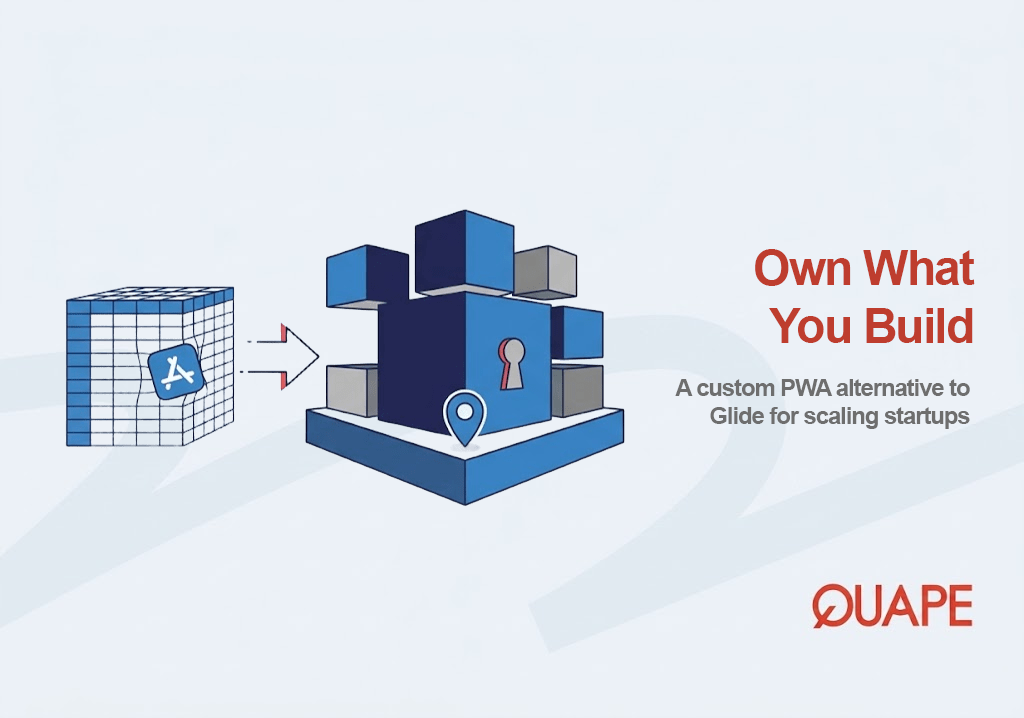
If you built your first product on Glide, validated it, and are now watching your monthly bill climb faster than your revenue, this comparison is for you. The question is not whether Glide is a good platform, because for the right stage it clearly is. The question is whether a no-code platform that hosts your logic, your data, and your runtime is still the right foundation once your application becomes a genuine business asset that customers depend on. For funded and revenue-generating startups in Singapore and across Southeast Asia, the honest answer often shifts after product-market fit, when ownership, predictable cost, and PDPA accountability start to outweigh weekend speed. A custom Progressive Web App is the alternative that lets a growth-stage company keep its momentum while owning what it built.
When Glide Stops Being the Right Platform for a Growing Startup
Glide earns its popularity honestly. It turns a spreadsheet into a working application in a weekend, which is exactly what a founder needs during validation, when the goal is to test an idea cheaply before committing engineering resources. The friction appears later. A platform that optimizes for fast MVPs and lightweight internal tools operates on a different set of assumptions than a platform built to run a customer-facing product at scale. Growth-stage startups rarely fail on Glide because the tool is bad. They outgrow it because their requirements changed: more users, deeper customization, real data governance, and a codebase they can actually own. Recognizing that transition early is what separates a smooth evolution from an expensive emergency rebuild.
The comparison here is not Glide against a custom PWA in the abstract. It is Glide as an entry point against a custom Progressive Web App as a long-term foundation, evaluated through the lens of where your business sits on the maturity curve.
Key Takeaways
- Glide is genuinely excellent for MVPs, prototypes, and internal tools, and a pre-validation founder should usually start there rather than commissioning custom software.
- Glide’s core trade-off is speed in exchange for control: your data lives in a spreadsheet, your logic lives in its visual builder, and your app runs on its hosted runtime, so outgrowing the platform can mean rebuilding from scratch.
- Per-user overages, not the base subscription, are the defining cost risk with Glide, and update-based billing on external data sources adds a second unpredictable layer as customer-facing apps grow.
- A custom PWA inverts the ownership relationship: you own the codebase and the data outright, with no platform dependency that can disable your app or dictate your architecture.
- Quape offers fixed, transparent SGD pricing with no per-seat metering and no per-sync surcharges, so a startup can scale its user base without its software bill outpacing revenue.
- For Singapore businesses, data residency matters. A US-hosted no-code platform leaves you accountable under the PDPA for data you cannot locate, while Quape builds and hosts on Singapore TIA-942 infrastructure with clear PDPA accountability.
- PWAs run from a single codebase across devices, install directly from the browser without an app store, and keep working offline through local caching, which supports both faster iteration and operational resilience.
What Glide Gets Right (And Why Many Founders Start There)
Rapid MVP development with spreadsheets and visual logic
Glide’s defining strength is that it removes the developer from the earliest stage of product creation. A founder connects a Google Sheet or Airtable base, arranges components in a visual builder, and ships a functional app without writing code. This compresses the distance between an idea and something a real user can touch, which is precisely what no-code development is designed to do. During validation, that speed is worth more than architectural elegance, because the objective is to learn whether the idea works before investing in engineering. For an MVP, Glide’s model of data-in-a-spreadsheet, logic-in-a-builder is a feature, not a limitation.
Best-fit use cases for Glide
Glide is at its strongest when the application stays close to what a spreadsheet naturally represents and the user base is contained. That covers a wide and useful range:
- Internal business tools such as operations dashboards and inventory management systems
- Simple CRM and team apps used by a defined set of employees
- Workflow automation that coordinates existing data rather than storing complex relational structures
- Prototypes and proof-of-concept apps built to test an idea before deeper investment
In these scenarios, the per-user cost is easy to justify because the audience is your own team, and the spreadsheet backend matches the shape of the problem. Glide is excellent for internal tools and anything that fits on a spreadsheet, and stating that plainly is the honest starting point for any comparison.
The Scaling Challenges That Push Startups to Look for a Glide Alternative
Why spreadsheet architecture eventually becomes a bottleneck
A spreadsheet is a brilliant interface for tabular data and a fragile one for relational business logic. As an application matures, its data stops being a flat list and starts becoming a web of relationships: users linked to orders, orders linked to inventory, inventory linked to suppliers, each with rules that govern the others. No-code platforms prioritize rapid development through proprietary visual builders, and as complexity increases, businesses encounter limitations in customization and architecture because the logic depends on the platform rather than on portable source code. The bottleneck is not a single feature you are missing. It is that the underlying model was never designed to carry the weight your product now places on it.
The hidden cost of per-user pricing and update-based billing
The pricing story is where the trade-off becomes most concrete. Subscription pricing often looks inexpensive at the outset, then becomes difficult to forecast as a customer-facing application grows. With Glide, the base plan is rarely the problem. Per-user overages are the defining cost risk, and the per-user charge on business-tier plans makes customer-facing or large-team deployments significantly more expensive than the headline price implies. On top of that, update-based billing on external data sources introduces a second unpredictable layer that scales with how actively your app syncs data, not just with how many people use it.
The failure mode is well documented rather than hypothetical. One business scaling toward 500 users saw its costs jump dramatically and had its apps disabled until it upgraded, a scenario that is survivable for an internal tool and existential for a live customer product. Predictable cost is not a luxury at growth stage. It is a condition for planning.
Why code ownership matters once your application becomes a business asset
Early on, nobody cares who technically owns the app, because the app is disposable. That changes the moment the application becomes something the business runs on. When your data lives in a spreadsheet, your logic lives in a visual builder, and your app runs on a hosted runtime you do not control, you cannot simply export the code and move. If you grow beyond the platform, you rebuild from scratch. That is the essence of vendor lock-in: the convenience that accelerated you at the start becomes the constraint that traps you later. Owning portable source code means your application is an asset you can host, migrate, extend, and defend on your own terms.
Why These Trade-Offs Matter More for Singapore Businesses
PDPA accountability and where your application data lives
For a Singapore company, the location of application data is not a technical footnote. It is a compliance obligation. Under the Personal Data Protection Act, the organization collecting personal data remains accountable for how and where it is handled, including when a third-party platform processes it overseas. A no-code platform that bills in US dollars and hosts everything on its own infrastructure leaves a Singapore business accountable for data it does not control and cannot readily locate. That gap is structural, not a setting you can toggle. It is one of the clearest reasons a growth-stage Singapore startup starts evaluating alternatives once real customer data is involved.
Local infrastructure, timezone support, and operational resilience
Where Glide’s model leaves a residency gap, local infrastructure closes it. Quape builds and hosts on Singapore TIA-942 infrastructure with clear PDPA data residency accountability, so the data stays somewhere you can name and answer for. That is reinforced by managed DevOps support included as standard and support that operates in the SEA timezone, which means when a critical application misbehaves, you are not filing a ticket into a distant queue and waiting for a different business day to begin. For a company whose product now carries real operational weight, that difference in response and accountability is part of business continuity, not a nice-to-have.
Custom Progressive Web Apps: A Different Long-Term Strategy
Owning your application instead of renting a platform
A custom Progressive Web App inverts the relationship Glide sets up. Instead of renting a runtime, you own the codebase and the data outright, and the application is engineered to your exact requirements rather than fitted to a template’s mental model. Because PWAs are fundamentally web applications, organizations retain flexibility over deployment, hosting, infrastructure selection, DevOps workflows, and release cadence rather than depending on a proprietary runtime. This is the practical meaning of ownership: no platform dependency that can disable your app, change its pricing, or rebuild your architecture out from under you. When you work with a team that delivers this as a service, the shift from renting to owning becomes the core of a decision to invest in a custom Progressive Web App built around your business rather than around a platform’s constraints.
The technology itself is mature and well specified. According to web.dev’s guidance on Progressive Web Apps, PWAs cache assets locally using Service Workers and browser storage, which lets core functionality continue even when connectivity is poor. That capability is why offline access is now treated as a resilience feature rather than a convenience.
Building around your business instead of platform limitations
Ownership changes what you can build. Instead of shaping your process to fit what the visual builder allows, the software is shaped to fit your workflows, your user experience, and your product roadmap. Because Service Workers cache assets and API responses, users experience faster repeat visits and continued availability during unreliable network conditions, which matters for field teams and mobile workforces operating with inconsistent connectivity. A high-quality PWA is expected to keep providing a functional experience offline rather than showing a browser error page, a standard reflected in Chrome’s Lighthouse guidance on offline behavior. The point is not that a PWA has more features than Glide. It is that the features exist to serve your business rather than the other way around.
Predictable pricing as your users and business grow
The final piece is cost you can forecast. A custom PWA runs from a single codebase across operating systems, which consolidates development and maintenance effort compared with maintaining separate platform-specific applications. Paired with fixed, transparent SGD pricing that carries no per-seat metering and no per-sync surcharges, this means your software cost is a known quantity as your user base expands. A startup can acquire customers and grow usage without watching each new user or each data sync push the bill upward. That predictability is what lets finance and product plan against the same number.
Glide vs Custom PWA: Which Option Fits Your Stage of Growth?
| Consideration | Glide | Custom PWA (Quape) |
|---|---|---|
| Development speed | Very fast, ship an MVP in days | Slower to build, engineered to requirements |
| Ownership | Hosted runtime, logic tied to platform | You own the codebase and data outright |
| Pricing model | Per-user and update-based, scales unpredictably | Fixed transparent SGD pricing, no per-seat metering |
| Customization | Bounded by the visual builder | Built around your workflows and roadmap |
| Data residency | Hosted on the platform’s infrastructure, billed in USD | Singapore TIA-942 infrastructure, PDPA accountability |
| Best fit | MVPs, prototypes, internal tools | Validated, growth-stage customer-facing products |
Development speed favors Glide, and that is exactly why it is the right call before validation. Platform ownership, cost predictability, and data control favor a custom PWA, and those become priorities after validation, when the application is no longer an experiment but the thing your business depends on. The right choice is a function of where you are, not a verdict on which tool is better in isolation.
Which Businesses Should Continue Using Glide, and Which Should Move Beyond It?
When Glide is still the smartest choice
If you are testing an idea, running a small internal tool, or building a prototype for a defined team, Glide remains the smarter choice. Commissioning custom software before you know the idea works is premature optimization: you would be paying for ownership and scale you cannot yet use. Glide wins on day-one speed and cost for exactly this situation, and a founder still in the experimentation phase should probably start there.
When a custom PWA becomes the better investment
The calculus flips once the product is validated and the requirements harden around a customer portal, a SaaS platform, or an application that handles real personal data at scale. At that point ownership, predictable cost, compliance, and scalability stop being abstractions and start being business priorities. This is the scenario where a custom PWA is the stronger long-term investment, because it removes the ceiling rather than raising it slightly.
Planning Your Migration Without Rebuilding Your Business Twice
Common signs you’ve already outgrown Glide
Your MVP platform can quietly become your migration project. A few signals tend to appear together:
- Per-user or update charges have become a meaningful and unpredictable line item
- You are working around the platform’s limits rather than building new capability
- Customer data and PDPA accountability have become a real concern rather than a future one
- You want your application to do things the visual builder cannot express
- The idea is validated and the app is now core to how the business operates
When several of these are true at once, you have likely already outgrown the platform, and the cost of waiting is a larger rebuild later.
Questions to ask before investing in your next application architecture
Before committing to your next build, it helps to interrogate the requirements rather than the tool. Who needs to own the source code, and why? Where must the data physically live to satisfy your compliance obligations? How will cost behave when you have ten times the users? What must the application do that your current platform cannot? Answering these against your business objectives, rather than against a feature list, is what turns a technology decision into a strategy decision.
Ready to Build an Application You Actually Own?
Glide remains an excellent choice for fast MVPs and lightweight internal tools, and no comparison honest about its strengths would suggest otherwise. The strategic shift happens after product validation, when a Singapore or Southeast Asian startup needs ownership of its codebase, pricing it can forecast, PDPA-aligned data residency, and room to scale without a rebuild waiting at the next threshold. For that stage, a custom Progressive Web App is the alternative that carries your momentum forward instead of capping it. If your product has proven itself and you are ready to stop renting your architecture, you can book a consultation to scope your custom PWA build and map the path from where you are to an application you fully own.
Frequently Asked Questions
Is a custom PWA always better than Glide?
No, and that is the honest answer. Glide is the better choice for MVPs, prototypes, and internal tools where speed and low upfront cost matter most. A custom PWA becomes the stronger option after validation, when ownership, predictable pricing, compliance, and scale become priorities.
Why can’t I just export my app from Glide when I outgrow it?
Glide hosts your logic in its visual builder and your data in a connected spreadsheet, so the application is not portable source code you can lift and move. When a business outgrows the platform, the practical path is often rebuilding on an owned foundation rather than migrating the existing build directly.
What makes per-user pricing risky for a growing startup?
With usage-based models, the base subscription is rarely the issue. Per-user overages and update-based billing on external data sources scale with adoption and activity, which makes costs hard to forecast precisely when a customer-facing app is succeeding and growing.
Why does data residency matter more for a Singapore business?
Under the PDPA, your organization stays accountable for personal data even when a third-party platform processes it overseas. A US-hosted platform can leave you responsible for data you cannot locate or control, whereas building on Singapore TIA-942 infrastructure keeps residency and accountability clear.
Do Progressive Web Apps work without an internet connection?
Yes, within limits. PWAs use Service Workers and browser storage to cache assets and data locally, so core functionality can continue during poor or absent connectivity. A well-built PWA is expected to stay functional offline rather than showing a browser error page.
Do I need an app store to distribute a PWA?
No. Modern browsers let users install a PWA directly, which makes deployment and updates independent of app-store approval processes. This lets a growth-stage team ship changes immediately rather than waiting for marketplace review.
How does a custom PWA keep costs predictable as we grow?
A single codebase runs across devices, which consolidates development and maintenance effort, and fixed transparent SGD pricing carries no per-seat metering or per-sync surcharges. Your software cost stays a known quantity as your user base expands, so growth does not automatically inflate your bill.